Pages

Showing posts with label values. Show all posts

Tuesday, July 10, 2012

Browsing

He was very concerned about it.  So concerned, in fact, that he dragged me out of Luxembourg Garden, where we had been talking for over an hour, down Boulevard St.-Michel to the main and largest Gibert-Joseph bookstore on the Boulevard and took me inside.  Until that point, I had only been in small French bookstores, akin to the small quaint bookstores in the small coastal towns of California or the Mom & Pop stores of small-town America.  But even this is not a particularly effective description.  Bookstores in Paris are actually called Libraries and what we typically call a Library is called a Bibliothèque.  There’s a librarie near my apartment that looks exactly like the bookshop in Disney’s Beauty and the Beast, which is supposed to be set in France, isn’t it?  And if you can imagine a small store-front room off of a little road, with paned windows, a painted façade, and the word Librarie painted in white or gold letters, you’re closer to the idea of a typical bookshop in Paris.


Gibert-Joseph, on the other hand, is a large store and is too large to look anything like the little libraries throughout Paris.  I’d seen the stores along St.-Michel, some for books, some for DVDs, some for music, and one a papeterie—where one buys paper and the necessary tools for writing—others for school books, some for selling and some for buying, but because there were so many, I didn’t expect the store he pulled me into to be as large as it was.  Seven floors; but that didn’t keep it from being packed with books.

In our conversation in Luxembourg, lasting a little over an hour, we had talked about literature mostly, for he had read everything.  Like most of the people who I like, and who like me, they all read more often than I do.  I’ve found through them that I’m not much of a reader.  He spoke to me about American writers, English writers, and French writers, and he wanted to know what I’d read, and what I thought about it.  I told him I’d read Zola’s L’Assemoir, which is so depressing its impossible to forget you’ve read it, and I’d read Marguerite de Navarre’s Heptameron, Chronicles by Jean Froissart—the original historian of the Hundred Years’ War, and La Cité des Dames by Christine Pizan.  We talked a long time about some of these, but he had not read all of them.  He also spoke to me about some of the American writers he’d read—the one I remember now was Virginia Woolf.  He’d read To the Lighthouse in English.  I was impressed, to say the least.

Have you ever read Woolf’s To the Lighthouse?  He said it was beautiful writing, but that he was lost on some of it.  I told him it was stream of consciousness and he asked what this meant.  So I explained, using her book as an example.  It’s when she writes everything that comes into her head, as it comes into her head, exactly the way she thinks it—rather than filtering the thoughts through organizations of structure like accepted sentence syntax and punctuation.  It was her feminist response to male structure.  He found the term ‘stream of consciousness’ most interesting.

And after we talked about literature for a while, and he shared with me that his favorite writer was Marcel Proust—and had I read anything of his?  I said I hadn’t, but for those of you who know me, this shouldn’t surprise you, since I never seem to have read what people ask me if I’ve read—and he’d seen the English cover, and are all English covers that way?

I stopped him.  « Qu’est-ce que veux-tu dire? » He responded again, “They are ugly.”  “What are?” “English book covers!”  And that’s what it was, that got him so riled, we had to leave the garden and go into several bookshops so he could prove his point.  He went the Gibert-Joseph showing me the nice, expensive French editions of books which were bound in cloth, and which he admitted were too expensive for a typical purchase, and then he went to the French translations of English books, which covers were clean and simple.  They usually had a picture on the front, with a white bar at the top with the book title, and a white bar at the bottom with the author’s name.  They all looked very much like Penguin’s Classics Series--except white, instead of black.

I had realized this before while walking by the libraries that the books all seemed to be white, and difficult to tell apart.  It occurred to me that the must be technical books of some kind, since some libraries sell merely les livres médicaux (Medical), or livres anciens et rare (Ancient and Rare), livres jeunesse (for Children).  I’d also seen people in the garden reading books, all of which seemed to have the same cover, and took them all for classics.  In fact, I’m sure I have somewhere in my notes: “The French all seem to be reading classics.  Either they’re all very cultured, or they’re catching up on the reading they should have done as young-adults.”  It turns out, and I learned through this tour of Gibert-Joseph that any French literature had these book covers, and it had nothing to do with them being medical books, or law books.  He proceeded show me all sorts of French books, all of which looked very similar.


Then, he spent a long time trying to find the English-language books, and when he did, he was proud of himself.  He touched the flashy book covers and confirmed, “See?  Ugly.”  I admit, I kind of laughed.  I liked the French literature book covers.  They were simple and clean, the way I often like my book covers, and far be it from me to purchase a book with an ugly book cover—no seriously, I won’t—but as always, in comparisons, you realize the mentality of your own culture.

I proceeded to explain that we had book covers like the French ones, too, and pulled out a few of the classics off the bookshelves to show him the covers which looked similar to his beloved French book covers.  Then I told him that we had artistic covers for best-sellers, classics, historical-fictions or non-fictions, and the like.  I pulled out a few books for some other covers, things written by Jack Kerouac or John Steinbeck which often require a book cover more artistic than the ‘classics.’  Then, of course, there were the books whose covers intended to catch your attention so you’d see them and pick them up while waiting in line, or while passing the bookshop into work.  This apparently was not the scenario of his book-buying experiences.

I realize, in retrospection that books have to be this way now.  At least in the United States, book stores are going out of business rapidly, thanks to the likes of ‘digital’ books.  And for those of us who are still holding on to our desire to turn physical pages, amazon will always save us a trip out of the house.  Except for the even smaller population of persons who regularly go into bookshops, wander the books, and purchase one or two to keep the whole thing going a little longer—my father is one such person—bookstores are becoming unnecessary.

Since coming to Paris, I have come to appreciate bookshops a little more.  There’s an art to the proper browsing of books in a bookshop which I observed my father do my whole life, but never tried or put into practice until I came to Paris.  To properly browse a bookshop and then make a purchase, one firstly needs to be somewhat knowledgeable either about books or authors and secondly cannot be searching for any book in particular or else you will never find it.  One must scan the book titles and authors until something strikes a chord, and then one must pull the book off the bookshelf, page through it, and decide if it’s something one wants to buy.  Sometimes walking around the bookshop while carrying said book helps make a decision about the purchase.


The problem with five easy steps to perfect browsing is that most Americans are rather impulsive buyers when it comes to their entertainment, and also, most working Americans don’t believe they have the time to meander through a bookshop.  If we need a cook book we go to the cooking section and find one we like.  If we’ve read a review about a good book, then we go to the bestseller stands and buy it.  But we rarely browse, we rarely have an infinite bank of knowledge about authors and we rarely buy a book we’ve never heard of or read about.  And that’s why we need catchy/flashy book covers.  If we’re in line, and something catches our eye, we’re more likely to read it and decided within seconds if it’s interesting enough to spend time reading.  The French book covers would never do for a working-class American who has so little time to spare.

Or else, that’s what we believe.  Thanks to my French friend from Luxembourg gardens, I now know this about French culture: the French don’t think that way—that they have little time to spare.  I mean, I’m sure they do think they don’t have enough time, but it doesn’t keep them from taking their time.  They browse.  They browse everything.  I found out early on that if I stood in front of the cheeses section of the grocery store for five minutes, no one would find that strange.  The old French woman next to me was doing the same thing.  Browsing the cheeses.  Furthermore, Paris is an entire city of shop windows and if something catches your eye, it’s not so strange to stop and look.  Shoes. Clothing. Jewelry. Food.—and books.  There are stalls outside of bookshops for browsing, something you rarely see in a big city in the United States.  And to me, that’s a significant cultural difference.  Browsing.  Who knew?

*13/7/12 Update: My neighbor gave me this gorgeous french phrase used to express 'window shopping': faire du lèche-vitrines.  Literally it means to lick the showcases (or shop windows).

Monday, May 14, 2012

Paris au Moyen Age

You can slap my wrist later because I haven't done anything even remotely related to my project for almost a week.  For now, you can be proud of me because I got out of the apartment before noon today without the excuse of having to meet my landlady or the necessity of going to a church meeting.  This is what got me out and about today:


Yes.  That's right.  Medieval Paris.  I think I'm in love, and also, I should have known that 1920 isn't long enough ago.  I was walking through the Montparnasse Cemetery the other day, disappointed that all those people had died between 1875 and 2011.  "Isn't there anyone who's been dead LONGER?"  I'm going to Montmartre Cemetery one of these days to see if people there have been dead longer.  After I get my bearings in the parts of Paris I can walk to, I'll start venturing out to the parts I have to Metro to and walk back from.  I'm hoping my shoes will be nice and worn in by then.

Anyway, Medieval Paris.  I went to St.-Sulpice the other day and just about died


(of happiness).

It's just about that beautiful in person, except all that open space around it is a lie.  There's a nice big square out in front of it, where some boys were playing football before I went in to attend messe and they were still there when I got out an hour later, so I sat and watched them for a while.  I have to admit, Catholic mass feels different from an Anglican service, which I've been to half a dozen of.  Even in the center of Paris, there are local paroissiens/parissioners--um, I don't know the spelling in either English or French, so you'll have to take a cross between the two--and its much like it must have been a hundred years ago: a community church service.  Only there are less people than there used to be (or so I assume) and several of the people attending are tourists (I'm going to count myself as one of them for the time being).  I do prefer the church when its silent and I get to walk around and sit and worship God in my own way, but I'm glad to have had the experience of mass, regardless.

St. Sulpice opened doors.  I decided to do some research on it because I want to write an architecture piece on it for one of my classes.  I started with wikipedia, which is really a lot more useful than academia gives it credit for.  And I found this.


And this is what I thought: "Holy Hell.  Streets.  That existed then.  That might exist now."

So it started a long and involved internet search for Medieval maps of Paris in which one of the maps I found was the first one I posted above.  I encourage you to click on the picture and see it at full resolution, if it lets you.  It's awesome.  Well, I'd been wanting to go to St. Germain-des-Prés, when what should I find out but that it's the oldest church in Paris, founded in the 6th century by the SON OF CLOVIS (relaying this information makes me want to cry--seriously).  ARE YOU HEARING ME?!  CLOVIS!  (Also, a Medieval side-note: Clovis-->Clouis-->Louis.  The French have been using that name for a long time.  Is your mind blown?)  Anyway, the tower of the Abbey of St. Germain-des-Prés was finished in 1014.  You're probably one of those people to whom dates mean nothing.  1014 was almost 1000 years ago.

0 0 0 0 0 0 0 0 0 0 0 0 0 0 0 0 0 0 0 0 0 0 0 0 0 0 0 0 0 0 0 0 0 0 0 0 0 0 0 0 0 0 0 0 0 0 0 0 0 0 0 0 0 0 0 0 0 0 0 0 0 0 0 0 0 0 0 0 0 0 0 0 0 0 0 0 0 0 0 0 0 0 0 0 0 0 0 0 0 0 0 0 0 0 0 0 0 0 0 0 0 0 0 0 0 0 0 0 0 0 0 0 0 0 0 0 0 0 0 0 0 0 0 0 0 0 0 0 0 0 0 0 0 0 0 0 0 0 0 0 0 0 0 0 0 0 0 0 0 0 0 0 0 0 0 0 0 0 0 0 0 0 0 0 0 0 0 0 0 0 0 0 0 0 0 0 0 0 0 0 0 0 0 0 0 0 0 0 0 0 0 0 0 0 0 0 0 0 0 0 0 0 0 0 0 0 0 0 0 0 0 0 0 0 0 0 0 0 0 0 0 0 0 0 0 0 0 0 0 0 0 0 0 0 0 0 0 0 0 0 0 0 0 0 0 0 0 0 0 0 0 0 0 0 0 0 0 0 0 0 0 0 0 0 0 0 0 0 0 0 0 0 0 0 0 0 0 0 0 0 0 0 0 0 0 0 0 0 0 0 0 0 0 0 0 0 0 0 0 0 0 0 0 0 0 0 0 0 0 0 0 0 0 0 0 0 0 0 0 0 0 0 0 0 0 0 0 0 0 0 0 0 0 0 0 0 0 0 0 0 0 0 0 0 0 0 0 0 0 0 0 0 0 0 0 0 0 0 0 0 0 0 0 0 0 0 0 0 0 0 0 0 0 0 0 0 0 0 0 0 0 0 0 0 0 0 0 0 0 0 0 0 0 0 0 0 0 0 0 0 0 0 0 0 0 0 0 0 0 0 0 0 0 0 0 0 0 0 0 0 0 0 0 0 0 0 0 0 0 0 0 0 0 0 0 0 0 0 0 0 0 0 0 0 0 0 0 0 0 0 0 0 0 0 0 0 0 0 0 0 0 0 0 0 0 0 0 0 0 0 0 0 0 0 0 0 0 0 0 0 0 0 0 0 0 0 0 0 0 0 0 0 0 0 0 0 0 0 0 0 0 0 0 0 0 0 0 0 0 0 0 0 0 0 0 0 0 0 0 0 0 0 0 0 0 0 0 0 0 0 0 0 0 0 0 0 0 0 0 0 0 0 0 0 0 0 0 0 0 0 0 0 0 0 0 0 0 0 0 0 0 0 0 0 0 0 0 0 0 0 0 0 0 0 0 0 0 0 0 0 0 0 0 0 0 0 0 0 0 0 0 0 0 0 0 0 0 0 0 0 0 0 0 0 0 0 0 0 0 0 0 0 0 0 0 0 0 0 0 0 0 0 0 0 0 0 0 0 0 0 0 0 0 0 0 0 0 0 0 0 0 0 0 0 0 0 0 0 0 0 0 0 0 0 0 0 0 0 0 0 0 0 0 0 0 0 0 0 0 0 0 0 0 0 0 0 0 0 0 0 0 0 0 0 0 0 0 0 0 0 0 0 0 0 0 0 0 0 0 0 0 0 0 0 0 0 0 0 0 0 0 0 0 0 0 0 0 0 0 0 0 0 0 0 0 0 0 0 0 0 0 0 0 0 0 0 0 0 0 0 0 0 0 0 0 0 0 0 0 0 0 0 0 0 0 0 0 0 0 0 0 0 0 0 0 0 0 0 0 0 0 0 0 0 0 0 0 0 0 0 0 0 0 0 0 0 0 0 0 0 0 0 0 0 0 0 0 0 0 0 0 0 0 0 0 0 0 0 0 0 0 0 0 0 0 0 0 0 0 0 0 0 0 0 0 0 0 0 0 0 0 0 0 0 0 0 0 0 0 0 0 0 0 0 0 0 0 0 0 0 0 0 0 0 0 0 0 0 0 0 0 0 0 0 0 0 0 0 0 0 0 0 0 0 0 0 0 0 0 0 0 0 0 0 0 0 0 0 0 0 0 0 0 0 0 0 0 0 0 0 0 0 0 0 0 0 0 0 0 0 0 0 0 0 0 0 0 0 0 0 0 0 0 0 0 0 0 0 0 0 0 0 0 0 0 0 0 0 0 0 0 0 0 0 0 0 0 0 0 0 0 0 0 0 0 0 0 0 0 0 0 0 0 0 0 0 0 0 0 0 0 0 0 0 0 0 0 0 0 0 0 0 0 0 0 0 0 0 0 0 0 0 0 0 0 0 0 0 0 0.

That's a thousand 0's.  For you.  To see how many 0's it would take to make a thousand.  One 0 at the end of every year.  That's a LOT of years.  Okay.  So here I am just looking at this map of this ancient church that used to sit on this one street in--and I realize, it still does.  I can GO.  I can GO.  It's like...a 20 minute walk.  So I decided to make it a Medieval Monday.  I woke up, got ready to go out, and started on my Medieval Monday adventure.  I walked down to Luxembourg Gardens, then down St. Michel, and ancient Roman thoroughfare, past the Abbey Cluny, now the Musée du Moyen Age, left on Blvd. St-Germain, and down, down, down the street until I got to St. Germain-des-Prés.  St. Germaine of the Fields.

I walked in.

Choeur Des Moines De L'abbaye De Saint Benoît Sur Loire – Fantaisie En Do Mineur

I wish you could hear my laugh.  The happy laugh I get when I walk into really old cemeteries.  That kind of laugh.  The "Yes, I really AM here," laugh.  Because the organ was playing.  It reverberated through the entire church.  I don't know if you know what that sounds like.  These old stone churches were made for noise: for singing, for the organ; for soft chattering.

Sometimes one of your senses takes over, disallowing any other from experiencing a space.  I'm fairly certain I was blind for a few moments after I walked into the church because my ears were taking in the surrounding.  But eventually my ears gave in to my eyes.  Not many people know that the ancient statues outside of the medieval churches like Nôtre-Dame and the old Greek and Roman statues used to be painted.  (At the musée du Moyen Age at the Hôtel Cluny/Abbey Cluny (Hôtel-->Hostel, just another word in French for Mansion, basically) they've got some of the heads of the old statues that used to be part of Nôtre-Dame before they were broken off and destroyed in the revolution, and the ancient statues still have red on the lips and cheeks, and green in the eyes, left over paint from long ago.)  In ancient-style, nearly every inch of Saint-Germain-des-Prés is painted.  The columns, the archways, the walls, the ceiling--everything but the floor.

St-Germain-des-Prés
(Cette image est tirée de simplyparis.org)

I didn't take this picture, and it is a beautiful picture, but it doesn't do the place justice.  The inside of the church is darker than this, so much darker.  And the light is not so soft.  It's creepier, somehow.  And yet still, the color comes through, not like a shine, or a punch, but a resonance, refusing to wear away, though it fades.  I have no idea how often they've restored the paint, and I have no idea if it looks anything like what it looked like when it was painted in antiquity, but the point is certainly gotten across.  No other church I've gone in to is painted this way on the inside, though it gives a good idea of what many of the churches must have been like before they were destroyed during the Revolution.

That's another thing to think about.  Here in Paris, the Revolution happened, but no one in particular started it, carried it out, or even felt the effects of it.  It is almost always spoken of in the passive tense.  "Destroyed during the Revolution," but not destroyed by whom?  Destroyed for what reason?  The Revolution is spoken of like a force of nature that came through Paris, destroying the things people miss most about how Paris used to be: the history, the age, the culture; but blame is attached to no one in general reference to the Revolution.  That's very interesting to me.  I can't tell yet, but will get back to you about whether I deem it shame, reverence, respect, a knowledge of happenstance, a statement of fact, or something else entirely as a reason why they speak of the Revolution this way.  In America we kind of think of the French Revolution as this interesting point in history.  Here...the scar isn't interesting, it's just a reminder of pain.  I'll get back to you on this.

Most of the abbey of St.-Germain-des-Prés was destroyed during the Revolution, but the little church still stands, par la grâce de Dieu, I'm sure.  This reminds me of St. Paul's Cathedral in London.  I do believe God saved that place from ruin; why not these churches in Paris?

So I walked in.  Organ playing, making the place creepier than it would have been in silence.  Entire inside of the church painted, making it darker than St. Sulpice.  Smaller than Nôtre Dame, but still with plenty of Chapelle's around the nave and transept.  Candles burning--I lit one in L'Eglise St.Etienne du Mont the other day, so decided not to light one here.  It's less crowded than Nôtre-Dame, or even St. Sulpice; it's easy to misread as a small parish and decide to walk past after seeing the likes of those other churches.  And I know I keep comparing these churches.  Here's why: they told me when we went to London that I'd get sick of going into the Cathedrals and churches, that after a while they'd all start to look the same, or feel the same.  I'm not saying I'm special or anything, I'm no cathedral-whisperer, but that's never happened to me.  They're all so different, they've all got a very particular feel.  Maybe it was knowing that St.-Germain was the oldest, but I think I could really feel it.  It kind of took me by the spirit and clenched its fist around my insides and didn't let go until I left.  I wasn't uncomfortable, but I was sad.  Does anyone else get that way in places with lots of history?

I sat and thought and wrote for about an hour before leaving the church and walking around the area, particularly down Rue du Four, which is a street that existed in Medieval times, despite the names of all the major roads (St. Michel, St. Germain, etc) having changed.  I decided to wander through some of the smaller roads, making my way back to St. Sulpice, and then returning to Abbey Cluny.

Abbey Cluny I have been more or less fascinated by for two weeks, since I first walked by it with Kate on Bd St-Michel.  Old buildings do that to me.  It was an old Roman Bath, I believe, then an Abbey, then it was destroyed, and made into an Abbey again, and destroyed and into an Abbey again, and then destroyed and built onto by some rich woman who bought the land.  (This is all very spotty history, so don't take my word for it.  It's just to give you an idea.)  I kept telling myself I'd go to the Museum, but didn't, and didn't.  Then it became Medieval Monday, and what do you know...there I was.

I had a somewhat successful conversation in French with the man who I bought my ticket from.  He treated me like I wasn't an idiot, which was preferable.  I asked for a student ticket, he asked if I "had less than 26 years."  I said yes.  He asked to see my ID and I said, I'm American.  He smiled and said, "Tarif Reduit" (Reduced Cost).  I said, "Parfait."  He told me there was an audio guide in the next room, and that I could get it in English.  I said, "Merci."  And then I went on my way.  My conversation with the audio guide woman was less perfect because she started speaking to me in English as soon as I asked for an audioguide "en anglais."  I was going to ask for it in French but decided I was really too curious about the middle ages in France to lose half of the information I could get by listening to it in French.  I'm working on it.

My camera died which wasn't even on the radar for me.  So here are some pictures (the ones I could salvage) from my phone, which hasn't died since I got into Paris, as it's got no SIM card and is on flight mode.  Glorious.  But the pictures aren't so glorious.  I'll go back to the Museum and get pictures of the outside, the pleasure gardens (if you want the explanation of that, you can ask for it, and I'll give it), and the Hotel du Cluny.

Roman foundation and brickwork:


The reason Roman buildings NEVER go away.  These bricks are slabs, so walls are more than a foot thick.  The Romans feared being forgotten and made sure they wouldn't be.


Roman ceiling.  Fascinating to me, but maybe not to you.


Hotel du Cluny, the Abbot had his personal chapel.  Here is the staircase leading up to it.


Here are my feet, standing on the floor of the chapelle.  I love floors and ceilings of old buildings best.


Two other things I loved about the museum.

Arms room.  Old weapons/shields/armor are awesome.


This sculpture carved of wood.  My favorite in the museum.


A common theme of thought for the day was that only the history of the rich is ever really kept.  I, of course, was very interested in all of the things I saw, listened to and read about today, but it was very apparent to me that I was reading and listening to the history of the rich, or of the church--which was rich.  There is so little written or recorded about the lives of the common people who lived in Medieval Paris, and that's something I'd like to spend some time looking into.

The man who did a lot of the excavation for Cluny III, the ruins of the third abbey of Cluny, was an American--Kenneth J. Conant.  He dedicated his life to Medieval Architecture, particularly that of Cluny.  I love that he made such a difference somewhere so far from home.  That he gave this place something they hadn't given to themselves.  I think sometimes it takes someone from the outside to remind the people on the inside of how interesting their history and their ruins are.  It takes someone from the outside to ask the questions that no one else thinks important to ask.  Can you imagine what else is under these Parisian roads and buildings?

The last time I wrote a post this long about the things I learned someone made a comment about it being too academic for them.  This should not have hurt my feelings, but it did.  I get that I've been in school for my entire life, but honestly academic??  This stuff is interesting.  So keep your mouth shut and don't relay this kind of information to me in the future.  If you're interested in me reporting on something else other than what I did while in Paris or something other than the fascinating stuff I'm seeing WHILE IN PARIS, then let me know and I'll be happy to oblige if you find a nice way to say it.  I'm the only me you've got, so take me or leave me.  (I'm guessing most of you will opt for the leaving me part...eh, oh well.)

I proceeded to come home and listen to Chants Gregorien late into the night while eating crepes and nutella, which I'm sure they did in the medieval ages, also.

Any suggestions about what Tuesday's theme should be?

Friday, March 23, 2012

Symbols of France

Le Republique Francaise: Liberté – Égalité – Fraternité
These are three values not to be ignored in France: Liberty - Equality - Brotherhood.  I think these are probably the values France has ideally held onto most since the French Revolution.

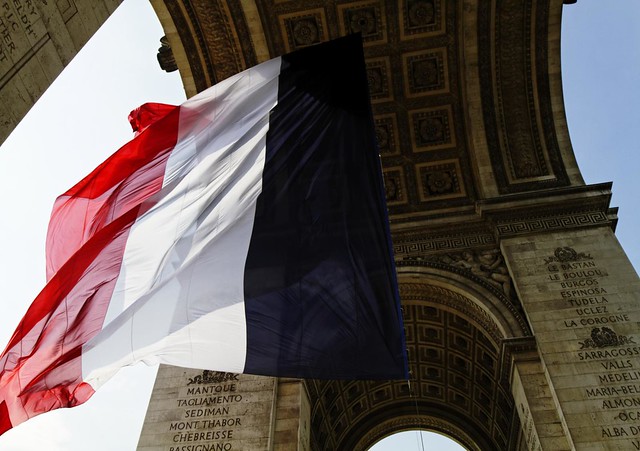
Le drapeau tricolore sous l'arc de triomphe; I have yet to find out why exactly this is done, but it is most certainly a sign of nationalism and it can be seen from so many places within the city.

Fleur-de-lis on the coat of arms of France from ancient times.  Harks back to ancient France, that history and the "legacy" involved.

Lady Liberty - Marianne is an important symbol of France, here she leads men into one of the Revolutions France underwent during the 16th-19th centuries.


Notre Dame, made famous by Victor Hugo after being more or less abandoned after the French Revolution.  A sign of Catholicism in France, but also a National symbol of Gothic architecture.

Blue Virgin Window at Chatres Cathedral - survived from the Romanesque Cathedral after Chartes burned down several times; the Cathedral was not looted during the French Revolution, neither was it destroyed during either of the World Wars.  Once contained the shroud of Mary, given to Charlemagne as a gift from Jerusalem.

Reims Cathedral where the Kings of France--starting with Clovis--were coronated.  This is the third Cathedral on the site, from the 13th century; the cathedral was made bigger for the crowds that would come to coronations.

Joan d'Arc has been a consistent symbol in France, her story being used by everyone from Liberals to conservatives, to the Vichy Regime to French Resistance fighters.
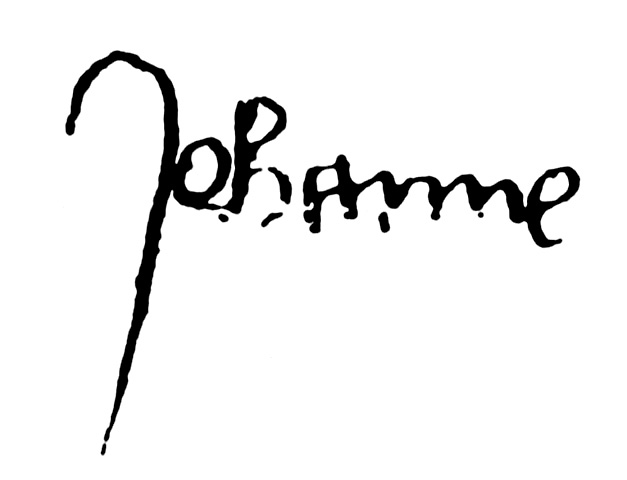
Her signature - 'Jehanne' or 'Johanne'  (I just thought this was awesome.)

In all honesty, when we visited the 'Beauty and Belief' exhibit, and we were asked about symbols from our Field Study sites, I had no idea what to say about France.  It didn't take me long when I really started thinking about it, but it did take me a little time to find out why France used some of these symbols to represent their values, ideals, or history.

There's a lot of nationalism in France, a lot of pride for being French and a LOT of history that gets them to those ideals, values and pride.  This doesn't really surprise me.  There are a lot of things not to be proud of in any country's history, but there's so much more to recognize in France as 'legacy.'  Marianne, France's equivalent to our 'Columbia' or Britain's 'Britannia' is the female personification of France, she is valiant and courageous, she is loyal and she is fiercely behind France and its ideals.  She, like Athena, is a warrior, ready to fight if necessary.

French history is also very important, and because of a rocky past, I think the French are big on ideals.  I think Americans are, too, so maybe that's something we can understand about each other.  The difference is the way we interpret or show those ideals, which is something I don't think we always understand about each other.  But in general, the French choose to remember about their history, the things that make them proud of that history, and I think that's par for the course for any country's national memory.  For France, this includes the Cathedrals, even though so much of France are no longer practicing Catholics; this includes Joan d'Arc, even though the French handed her over to the English to be executed.  This includes the values of the French Revolution: Liberté – Égalité – Fraternité, even though those ideals came at such a high cost.  It is interesting that sometimes a culture's most valued ideals are born out of their darkest moments, perhaps when they realize they need them most.

Charles de Gaulle - Regarded as the leader of the Resistance and 'savior' of France after WWII; in reality the history isn't that simple.
Terrein - see my post on Terrein, and the value of 'mon pays.'
The French Resistance during WWII was regarded as being widespread and entirely influential of the eventual dispelling of Germans from France, in reality, most French were not part of the Resistance throughout the occupation.
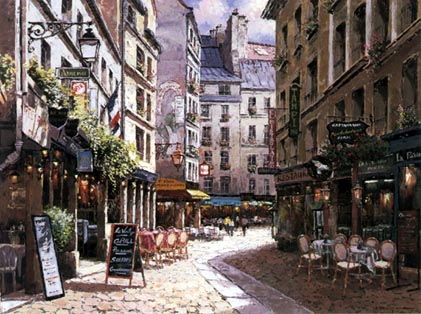
La rue - Community, and small shops; "small town life" is still important in France, even in big cities.  There is a lot of value put on what we would call 'Mom and Pop shops' or bakeries, and having places you frequent.
Conversation.  Need I say more?  The French will make reservations at a restaurant, and once the restaurant fills there is not 'wait' because guests are expected to stay until the close of the restaurant--doing what?  Talking.  I was born for this place.


Not all values are based off of history, though they are usually based in history.  One such value is the value of mon pays--where someone is from.  I think this comes from a long line of defining oneself as not 'French' necessarily but a Parisien or a Poitevin or a -- no, I'm not going to play this game.  Take a gander at this website which is awesome: (http://www.habitants.fr/index.php).  My point is, ultimately, that there's something to defining yourself against the land you've lived in, rather than the nation constructed around that land.

Furthermore, where did the French get their love for their language?

Acadamie francaise - it's main reason for being is to preserve the French language.  I like to think that this is why direct translations of the French language into English sound like old English--or how we USED to speak, and don't anymore.  Without Academie Francaise, I wonder what French would sound like.

The French are profoundly attached to and proud of their language, I think the existence of the Academie Francaise more or less proves that.  We don't have an English Academy making sure we Americans don't ruin the good language of English--though, I'm fairly certain the English DO think we've ruined their language.  The point is, we don't have one.  We might learn about old English, but that's just the point--it's old.  I'm not sure if the love of talking and conversing about anything and everything is where this pride of language came from, but maybe that's something I'll have to ask.

So how will knowing these symbols help me on my Field Study?  Well, there's something to knowing these values exist, and that they're different from our own.  I think there's something else to knowing the basics so that when you get to your chosen country of study you're not always asking the 'What is that?' question, but asking the 'Why is that?' question.  We waste a lot of time asking, 'What is that?' when the really interesting part is finding out "Why is that?" because that is where, in my opinion, the culture is found.

Saturday, March 3, 2012

on "Helping, Fixing, Serving"

I loved the ideas presented in this reading by Rachel Remen, the difference between helping, fixing, and serving.  To merely "help" someone is to see them as weak, when you try to "fix" something you see someone as broken, but when you "serve" you see them as whole, and deserving of strengthening, or I'd like to add, see yourself as deserving of strengthening, which is why you spend the time to serve at all.

But sometimes people aren't strong, and sometimes they are broken, and so what do you do then?  I'm thinking of times in my life when I was most certainly in need of healing, and usually no one came around to help me with the process.  If we're talking about a Field Study, I'm aware of the point this reading is trying to make, and I'm aware that it isn't our place to assume that we are the ones who can strengthen, or "fix" others.  I think that's a good assumption to make because to see something in need of fixing is to see something broken, and many an unbroken cultures have been "fixed" to their and the worlds' detriment.  I don't even begin to think that the relationships I will have with people in the Field will be of any great benefit to them.

But, to me, I think there is great potential.

I think every being is in great need of healing.  Nothing particularly traumatic has ever happened to me, but I live in trauma every day.  I've been profoundly hurt.  I've been left bleeding, figuratively speaking.  And I don't think it's wrong for someone to see me bleeding and come to help me along as the wound heals.  Or, in that case, when we see a wrong being done to someone, our own beliefs should  never get in the way.  How many times has someone been hurting me, and someone could have said something, stood up for me, helped, but they didn't, afraid it would offend, afraid it would be misconstrued, afraid of being hurt themselves.  That's fair.  But fear should never get in the way of doing right.  This reminds me of a scripture, Hebrews 2:15 saying that Christ would come "and deliver them who through fear of death were all their lifetime subject to bondage."

This scripture, the first time I consciously read it, screamed at me "The Holocaust."  It was the 20th century when this evil happened, when this profound lack of humanity took place.  The Holocaust.  But people were so afraid of death that they were "all their lifetime subject to bondage" which really probably isn't too much better than death.  I can't say that death is better than bondage because I don't think that's necessarily true.  I think it depends on the death, it depends on the bondage, it depends on the person, and it depends on the hope at the end of the road.  But I do think that we can't let fear, no matter how small a matter, bind us to silence while others suffer, no matter how small we perceive the suffering.

For this reason, I think our presence can heal people we don't know are hurt or in need of healing.  What I mean to say, is that we can make a profound difference in the lives of individuals, like Remen mentioned about the woman to treated her as a human being, who spent time on her, rather than treating her like a patient.  I think if we operate under the assumption that no one needs to be fixed, or aided out of weakness or brokenness, but instead assume that everyone is deserving of our respect, our time, and our care, we are "serving" and maybe doing a little healing at the same time.

In tenth grade I had a close friend hurt me rather badly.  She didn't stay around to watch the hurt, and certainly didn't stick around to try to mend the hurt.  But that year I met someone who probably didn't notice I was hurting, but spent time on me, treated me as whole, and through him I became whole again.  He has always treated me that way, as a whole person, even when he himself has hurt me.  This can be damaging sometimes, for someone who cuts into you without noticing and then treats you as if you are unhurt, but the point of the matter is that because he treats me as whole, I know I will be again, someday.  And that's why I don't think that helping, fixing and serving are wholly separate.  I think they are all one thing but three ways of going about doing it and only one of them can be done with humility.

Having said all this, however, I understand the point being made, and I emphatically agree that we need the point to get through to our heart.  I like what Remen says about service, that when we "help" it is our strength that helps anothers' weakness.  But when we "serve" it is our limitations, our wounds, and our darkness' which we draw on to be of comfort and to help us understand the people around us.

Thursday, March 1, 2012

Proposal: Methodology and Procedures

Entry
            I plan to find a host family that I might live with, who might help me enter some facet of the community in Paris where I might become more acquainted with Parisian-French culture.  Though I will do no formal interviews on French culture, I do expect the interactions and conversations I have to help me better understand the experiences of the expatriates I am studying.  Though I am aware that Parisian culture has changed in the last 100 years, given the length of time French culture has been developing, an hundred years will make little difference in the large scheme of culture, which has its roots in centuries of history.
            Furthermore, I hope to familiarize myself with the city, but particularly the parts of the city where African-American expatriates lived, worked, and socialized.  I hope to visit many areas in Paris with sufficient history and representation of French culture to help me gather a larger understanding of what the French value, and by association what many expatriates would have clung to as their own values.  I believe I will find these cultural insets within museums of art, history, monuments, churches and cathedrals, day-trips in and directly around Paris to important places.
            More specifically, I also plan to attend some of the most directly related areas where jazz and blues have been fostered in Paris, attend concerts, revues or small shows.  By making myself available to these activities, I hope to meet others who share these interests and might be willing to share their experiences and understanding of Jazz with me.

Informants
            I expect my informants to be musicians and writers of the period I study, and therefore will be reading and listening a lot, analyzing their work and my understanding of their work within their historical context.
            Though I don’t want to focus on contemporary Jazz and its modern expression in France, I will not turn down the opportunity to talk to others about jazz, soul, or blues, if they should want to.  In this way, I am sure my opinions and understanding will be altered by what is shared with me, but I do not plan on formal interviews.  If one should occur, or I find it necessary or beneficial, I will be explicit about the work and study I am doing, what part they play in it, and will most definitely share with them, if given the chance, the understanding they have helped me gain.

Sampling and Recruitment
            I will stick to those sources in American and French history and culture, and African-American music and/or literature.  Because my research focuses in history, few of those ‘sources’ will be living informants.  As such, conversations or interactions with living informants about these topics will either be informal and/or consented to.
            If interviews should be necessary or if they occur, I will have consent forms in French and English to help those informants be aware of my work, how they will influence it, giving them access to my final piece so they have an opportunity to be accurately and faithfully represented.  This is not the focus of my research, however, and so I do not expect it to be a time-intensive or significant part of my overall project.

Description of Method
            The methodology I will be using is primarily an American Studies methodology in which I will gather sources to help me with all four facets of the methodology: Textual Interpretation, Archive Building, Institutional Contextualization and Social Theory.  The intention of looking at all four facets of an event, a place, or an ‘artifact’ is particular to the American Studies field, as it is interdisciplinary in nature and seeks to regards facets of American culture more holistically than if one were to look at American culture through history, sociology, economics, or literary movements alone.
            Textual Interpretation will be gathered from autobiographies of the musicians and writers that lived in Paris and recorded their experiences in Paris.  It will include music recordings as well, and may include a close reading of certain areas of the city.  I will use theories of space and place to help me with this type of close reading.
            Archive Building will consist of everything I can get my hands on from an understanding of the city itself, and its history, African American history, but particularly the history of music and jazz, and the history of African Americans in Paris during the 1920s and 1930s.  A lot of this will be history of people and places.  I will glean much of this information from books, but I plan to use the city itself as a guide, as I visit historical monuments, museums that can share particular insights on archeology, history, culture (art, music, etc.) and other influences the city has sustained or inspired.
            Institutional Contextualization will primarily focus on the institution of jazz and its contextualization within the time period, however once one tries to contextualize an institution with regards to a particular cultural artifact—i.e. a song, a painting, a particular building, or a wall of graffiti—its application differs.  As such, my use of this methodology will change in regards to particular artifacts or places.  I hope my understanding of jazz as an institution, particularly in France will be aided by my attendance to jazz concerts in Paris and a better understanding of how the French took in Jazz as their own during and after the 1920s.
            Last, Social Theory plays a big part in American Studies methodologies and the few I will focus on include race, transnational studies, and urban studies.  Again, much of this information will come from reading, however, I will also try to glean information from the culture of Paris that I observe as I become familiar and acquainted with the city, and the cultures that have contributed to its diversity and culture.  Much of this social theory, however, will be taking place within a better understanding of how African Americans were treated in America and a comparison of how they were treated in France.  Since I cannot interview those who experienced the move from America to France during this time, I will have to rely more on history and a strong ‘archive’ to supplement my understanding.
edited 3/6/12

Ethics of History

"There are different kinds of love and each, according to the Fitz, is never like the other." - Rachel's ofdeerfolk

Um.  So, I totally found a source on the Ethics of History (not the History of Ethics), and I kind of want to give this some more thought, and also I mentioned today in class that it'd be a good post to write about.  So here goes it.

As indicated by my annotated source for Wednesday, this source has a chapter that outlines the three responsibilities of a historian: 1.) to be "advocates of collective memory and responsible for its order."  2.) to be "responsible for the future insofar as it is a matter of their representation of the past." and 3.) to be "responsible for taking over the heritage of the past," doing "justice to the people of the past and..." coming "to terms with crimes and horrors which belong to this heritage" (Carr 197).

I love this idea.

I wish I were a historian.  Also, history is not dead!  And I like the idea of being an advocate of the collective memory, responsible for its order.  I think that means not only uncovering lost truths, but learning and holding on to known truths so it passes through the ages.  This is why I want to learn about these people who played music and lived in Paris, because their experience was also an American one and I don't want it to be forgotten, but I also don't want it to go unnoticed.  I think there are ethics to not letting history be forgotten.  But I also think there are ethics to being expansive and open-minded about the history that really is, and never making a decision.

"The time to make up your mind about people is never." - The Philadelphia Story

I would add, no matter how long they've been dead, you should always take in new information, ESPECIALLY if it will change the way you see a human being.

But I also look at this history in a very real way as my responsibility to the future.  I like the idea of the past reflecting onto the future.

I think the biggest relationship to ethics, however, is in the 3rd point: being responsible for taking over the heritage of the past, doing justice to the people of the past and coming to terms with crimes and horrors which belong to this heritage.  I believe this is important because it implies staying away from the interpretations of history done by others, and making your own decisions.  It means staying away from the stereotypes or decisions people made about others in the past to interpret history at this time and place.  We do this particularly with the horrors of war where we refuse to teach some of the worst parts of history.  But ethically, it is important not to dredge up old hurts, but to see people in the context of those hurts, and when dealing with history I think its particularly important not to color things in a rainbow of goodness for it is much too hard to understand people, their motivations or their intentions if we forget the trauma they went through or the challenges they faced.  As an example, I think it would be ethically wrong to portray the 20s as a time of great fun, new ideas, liberal lives, and wonderful pervading ideals of equality and love for all men.  Sure we remember the flappers and the speakeasies, the great clothes, and the freedom from tradition and strictures.  But it's important to remember also that there were race riots, horrible acts of violence, overspending and reckless living that led to the Great Depression, the racketeering, the murders, scandals, the breakdown of familial relationships, and the oversimplifying of the issues that pervaded the time period.  I think it is far more ethical to make educated guesses about people living at the time when they are taken in the context of the trauma, "crimes and horrors which belong to [their] heritage."

I think there are incredible ethics to writing and representing and learning history.  I think it means endless reading and research, open-mindedness, and a willingness to take all stories into account as possibly true, while checking sources to confirm it.

Saturday, February 25, 2012

When you're talking to yourself, who are you talking to?

I want to talk about my father.  Not for any particular reason, I suppose, just who he is.

My father was born in Washington State, of New England stock, the fourth--and last--child of Richard and Marjorie Plaisted, who are individually their own stories.  From his mother, my father inherited abounding generosity, or at least I imagine it was from his mother because that is mostly what I remember about her.  From her he inherited a love of mystery, a love of movies, a love of reading, a love of cooking.  From his father I imagine he inherited a stoic and admirable work ethic which dictates that his family always comes first.  I remember little of my grandfather, but this I imagine to be true above all else.

I think I am more like my father than I am my mother, which it took a long time for me to figure out.  I think perhaps I have more of him in me.  Not necessarily his good qualities, though if I can live up to those some day, I most certainly will, but a lot of his interests, a lot of his tendencies, a lot of his ideas.  My father got me hooked on hauntings, on mysteries that can never be solved--I always imagine his favorite is Stonehenge.  Because of my father I sit through the credits of every movie.  I love cities.  I love art and museums.  I don't like camping.  I write.  And I don't think these are things I necessarily chose.  In some ways I think they were born into me.  Because I never thought, "I want to be like him, so I will do A. B. and C."  I never thought that at all.  I'm just becoming who I am, and that happens to be a whole lot like him.

My mother would probably disagree with me, but I can't recall either of my parents ever telling me I was beautiful.  My father doesn't say things like this.  My mother said once, "How did I get three such beautiful girls?" I nearly cried for thinking that maybe she really did think I was beautiful.  But on two occasions my father has said to me in public and in private that he thinks I look like his mother.  I have never heard him say that he thinks his mother was beautiful, but it's in his voice that he thinks she was one of the best women that ever existed.  I think he knows I think that too.  So when someone said to my father in public, "Your daughters all look like your wife," which was most certainly meant as a compliment because my mother is beautiful, he said, "Well, I think Jennifer looks more like my mother."  And though I do think my mother and I looked quite similar at certain points in our lives, this comment wasn't just observational, but meant something more, it meant he thought I was beautiful.  Funnily enough, I think if he'd said, "Yes, I think my daughters do look like Paula," I would have interpreted it the same way--that he thought we were beautiful.  It was the comment he made on my looks at all that made me think--maybe he really does think this about me.

I want to tell you something else about my father.  He learned French when he was in grade school, which he attended in New England.  He also, I believe, took French classes in High School.  He never spoke french, except for every once and a while we'd ask him to recite some french literature he'd memorized as a kid, which he did gladly.  When I decided I'd be taking French, he started saying things to me like 'Allons-y' when he wanted us to leave the church building after church.  Or 'Je ne sais pas' (said: J'une say pah) when he didn't have an answer to things.  When I'd try to say things in a french accent, he'd correct me.  He'd say words over and over and over again until I heard the difference between the way I was saying it and the way it was mean to be pronounced.  The word 'beouf' (beef) comes to mind.  When I came back from my first few semester of taking french, my father started buying French films.  Oh, dozens of them!  When he'd never owned a french film before.  He spoke to me in french when I came back for breaks, and he watched french films with me in the evenings when everyone else was out of the house.  He'd done this before, when I started listening to Frank Sinatra, he suddenly bought a hundred Sinatra albums he didn't own before, which he still buys and listens to, and gives to me when I come home so I can load them onto my computer.  No one else in my family has ever done that for me and I don't ask it of them, but he did it on his own, and that's something that still impresses me.

Now, why is beauty so important?  Why is sharing collective interests so important?  Or why is what we say and how we say it so important?  I feel something I've been fighting against in this class is this idea that other cultures are so different from ours.  And I keep screaming from the rooftops, "Ours isn't so easy to figure out either!" and I just need someone to say, "Yes, you're right."  I guess what I'm saying is, I'm not sure if I believe in hegemony.  Because I think about my family and how many different types of people I've had to learn how to communicate with--people who consider themselves American through-and-through, who have put me through the wringer!  I mean, how often have you tried conversing with a New Englander?  It's freaking hard!  But I grew up around that, and there are ways my father communicates that remind me of Hemingway's iceberg (so I call it--where he discusses in his writing that only the bare essentials need to be said to get across a larger meaning) and I find more comfort in one word from my father than I do in twenty sentences from a friend across the hall.  Because I understand what he means, and who he is, and what he's saying.

My mother's communication is not so easy for me to navigate, and yet I've been living with her for just as long, and have been communicating with her effectively for longer.  But as I change, and as my culture changes, she and I have a harder time understanding one another.  Well what does that mean?  For me, it means culture changes.  It means that we can't go in to another culture thinking that "These people are French so they will act this way, this way and that way."  No.  Because if someone said, "Oh, Jennifer is American, which means she think this, this and that," chances are they'd be dead wrong about me.  Because they're communicating with someone who has created their own culture, who comes from two cultures that are worlds apart even if both American.

But, something I find great interest in is the ideas of values.  I think you can make more general blanket statements about cultural values.  As an American, I am bound to value certain things.  It doesn't mean that other cultures don't value those same things, but that there are some I can pick out for certain.  If the French value eloquence, and grandeur, and family then I can safely say that as an American I value independence, individuality and simple pragmatism.  The interesting thing about values is that one need not embody the values they hold dear.  Not every American is pragmatic, just like not ever Frenchman is eloquent, however we sometimes value things we do not embody ourselves.  And this is an extremely interesting idea to me.

My father is not a particularly mysterious man.  But he values the unexplained and the uncertainties of life and of other people.  Furthermore if we talk about politics in the house, he's rarely in favor of propositions that will make him pay more in taxes--he believes in independence, he believes in sustainability--and I think he believes others should be able to support themselves.  And yet I know no one more generous than my father.  Without me perhaps my father would have never bought those french films, and we'd be 24 french films poorer in the Playstead household, but my father seems to value shared experiences.  And though my father values the time he spends on his own, no one else in the family thinks of as many things as he does for things we can do together.  Watching movies, going to plays, driving up the coast for the weekend, seeing museum exhibits.  The rest of us would sit in separate rooms of the house if he didn't pull us together to sortir.  Where do these values come from?  They could be American, they could be values of the Pacific Coast, or of Los Angeles, or of New England.  But more likely--as any good American would believe--they're the values of an individual, who is all of those things, and is also himself.

That's culture.