Pages

Showing posts with label art. Show all posts

Wednesday, May 16, 2012

Heaven on the Quai

If truth cannot be found or arrived at, but merely given, what will the philosophers talk of in heaven?

I no longer believe in one truth.  If it were so, conversation would have no healing power.

This is how my thought came to be.


Île de la Cité

I was walking around  Île-de-la-Cité , having decided I’d see for myself what this little island was about, strolling along the Quai aux Fleurs when a beautiful red-headed man asked me where St. Michel was and I pointed—with my hand—down the road, realizing I did not know the word for ‘straight’ or ‘ahead.’ (For future reference: Continuez à marcher tout droit.—WHAT THE HECK? ‘straight’ and ‘right’ are the same word!?!  How confusing is that!)  He thanked me and continued on his way.


I continued, too, down a little quai named Quai d’Horloge.  So, naturally, I was thinking of clocks and clock makers (horloge = clock) and wondering if there was any eternal significance to me walking around memorizing this city.  Then it occurred to me how much and how often I wish I could time travel.  All I want to do is walk down Quai d’Horloge when it really was the Quai of horloges, is that so much to ask? and I realized the closest I may ever get is when God calls those lectures in heaven together and I get to talk to the Parisians of the 16th century—no joke I really think these things—and know, when they say ‘Quai d’Horloge,’ where in the city they mean.  Fist pump in heaven, lording it over all my friends who will have NO clue where Quai d'Horloge is.  (Except for you, now, grâce à la carte--thanks to the map--I've included above.  See on the top left of the island--Quai de l'Horloge?)

Back to thought about knowing where Quai d'Horloge is when all my friends don't.--Neat.

But of course THEN I was thinking about who I’d really like to be with in heaven, and of course (of course) the French Enlightenment philosophers came to mind, and I figured that probably Jefferson would be there too, so I’d be killing two birds, so to speak, and then—I hit a brick wall.


It really hurt.  Metaphorically.  I nearly stopped RIGHT there on Quai d’Horloge thinking, “Oh no!  What will they TALK about?” Because French Enlightenment thinkers were–well every artist ever (yes, conversation is an art) has been—about finding truth.  Talking around (or painting, or writing, or sculpting, or whatever around) the truth in circles until you nearly come to the center of it, trying to figure it out and understand it .

We talk about, and I had largely accepted that once we die, we will be informed of the truth, and then we’ll be happy, because we’ll have the truth.  But the problem is that people think that now!  And it’s certainly not the case for me.  What I mean is, people think, “If only they had the true and everlasting gospel, they’d be happy.”  And I’m not saying that the true and everlasting gospel can’t make you happy, I’m just saying it’s not a cure-all and it doesn’t solve all problems and it DOESN'T make me happy all the time.  It doesn’t even answer half of my questions.  The gospel would have never quelled the minds or the spirits of Enlightenment philosophers—it certainly doesn’t come close to quelling mine—and even if they'd believed it, they'd still be talking about what truth is and where to find it!  So geometry--that great mathematical enlightenment of my youth--and its proofs have taught me that if some people say we have the truth now and it should make us happy, but it isn't the cure-all, it stands to believe that even if we have the truth in heaven, it may not be the cure-all, and thus we will still be having conversations in heaven about truth.  This brought me to the conclusion that perhaps how we can better define the truth we have on earth is "necessary and saving truth" rather than "truth" as a catch-all.  Furthermore, this begs the question, “Will we ever have ALL truth?” and my desperate realization, “I hope not.”

Ah!  It slipped out!  I had no control over the desperation.  Am I going to burn in hell?  (If so, I might as well continue:) Then I thought, maybe even God does not have all truth, but still discovers it every day, through us, through his work.  I mean, "necessary and saving truth" he has, knowledge he has, but maybe there is still truth to be had, even for him.  That’d make life interesting again. (I’ve also wondered if God is bored up there and am desperately hoping not--for his sake.)

And all of these thoughts in combination—or more in conflagration, perhaps—brought me to my disbelief in one truth.

Heaven (No joke.)

We think heaven will be a perfect place full of light, truth, perfection.  But if it’s much different than life on earth, it could be hell.  And honestly, hell sounds boring.  I mean people who don't care about food talk about a heaven where we won’t need to eat—but then what will the chef’s do with their passion?  People who don't notice the buildings that surround them talk about a heaven where the elements will have no power to hurt or kill us and we'll live on clouds—but then what will the architects do with their life passion?  Most of us imagine a heaven without pollution or cars or dirt or rocks—but what will the mechanics do, or the engineers, or the geologists?  And a heaven where no one is sick, no one is ailing—what will the nurses and the doctors and the surgeons do?  We talk too often about a heaven where truth is known—but then what will the archeologists, and the philosophers, and the physicists do?  And what about the linguists, and the historians, and the chemists, the personal trainers, the movie producers—what will they do?  Certain types of people decide that certain things in heaven will be unimportant, and continue to disregard all the human beings who have made that thing their life-work, have found it as their passion.  You can’t tell me history won’t matter, it’s the only thing that gets me out of bed in the morning.  You can’t tell me language won’t matter—I know too many linguists for that to be possible.  You can't tell me movies don't matter, they've taught me more empathy than every church meeting combined.

I keep thinking of circumstances in which heaven could be the most boring place on earth—if all things, especially intellectual and spiritual truths, were just given to us.  And I realize how much I hope for a heaven that is a lot like earth.  Maybe earth is that great university of life where we are taught not what to think, but how to think, not what to do, but how to do it.  In heaven, I don’t want people to have to scrape for survival, but perhaps we should always have to scrape for truth.  That way, it means a little bit more.


For now, back to the Quai.

Friday, March 23, 2012

Symbols of France

Le Republique Francaise: Liberté – Égalité – Fraternité
These are three values not to be ignored in France: Liberty - Equality - Brotherhood.  I think these are probably the values France has ideally held onto most since the French Revolution.

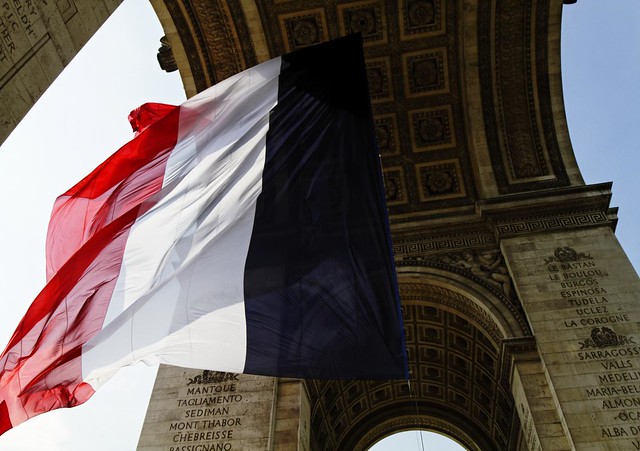
Le drapeau tricolore sous l'arc de triomphe; I have yet to find out why exactly this is done, but it is most certainly a sign of nationalism and it can be seen from so many places within the city.

Fleur-de-lis on the coat of arms of France from ancient times.  Harks back to ancient France, that history and the "legacy" involved.

Lady Liberty - Marianne is an important symbol of France, here she leads men into one of the Revolutions France underwent during the 16th-19th centuries.


Notre Dame, made famous by Victor Hugo after being more or less abandoned after the French Revolution.  A sign of Catholicism in France, but also a National symbol of Gothic architecture.

Blue Virgin Window at Chatres Cathedral - survived from the Romanesque Cathedral after Chartes burned down several times; the Cathedral was not looted during the French Revolution, neither was it destroyed during either of the World Wars.  Once contained the shroud of Mary, given to Charlemagne as a gift from Jerusalem.

Reims Cathedral where the Kings of France--starting with Clovis--were coronated.  This is the third Cathedral on the site, from the 13th century; the cathedral was made bigger for the crowds that would come to coronations.

Joan d'Arc has been a consistent symbol in France, her story being used by everyone from Liberals to conservatives, to the Vichy Regime to French Resistance fighters.
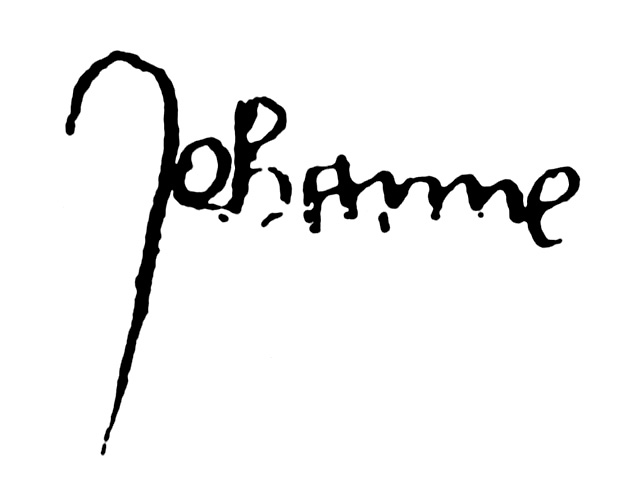
Her signature - 'Jehanne' or 'Johanne'  (I just thought this was awesome.)

In all honesty, when we visited the 'Beauty and Belief' exhibit, and we were asked about symbols from our Field Study sites, I had no idea what to say about France.  It didn't take me long when I really started thinking about it, but it did take me a little time to find out why France used some of these symbols to represent their values, ideals, or history.

There's a lot of nationalism in France, a lot of pride for being French and a LOT of history that gets them to those ideals, values and pride.  This doesn't really surprise me.  There are a lot of things not to be proud of in any country's history, but there's so much more to recognize in France as 'legacy.'  Marianne, France's equivalent to our 'Columbia' or Britain's 'Britannia' is the female personification of France, she is valiant and courageous, she is loyal and she is fiercely behind France and its ideals.  She, like Athena, is a warrior, ready to fight if necessary.

French history is also very important, and because of a rocky past, I think the French are big on ideals.  I think Americans are, too, so maybe that's something we can understand about each other.  The difference is the way we interpret or show those ideals, which is something I don't think we always understand about each other.  But in general, the French choose to remember about their history, the things that make them proud of that history, and I think that's par for the course for any country's national memory.  For France, this includes the Cathedrals, even though so much of France are no longer practicing Catholics; this includes Joan d'Arc, even though the French handed her over to the English to be executed.  This includes the values of the French Revolution: Liberté – Égalité – Fraternité, even though those ideals came at such a high cost.  It is interesting that sometimes a culture's most valued ideals are born out of their darkest moments, perhaps when they realize they need them most.

Charles de Gaulle - Regarded as the leader of the Resistance and 'savior' of France after WWII; in reality the history isn't that simple.
Terrein - see my post on Terrein, and the value of 'mon pays.'
The French Resistance during WWII was regarded as being widespread and entirely influential of the eventual dispelling of Germans from France, in reality, most French were not part of the Resistance throughout the occupation.
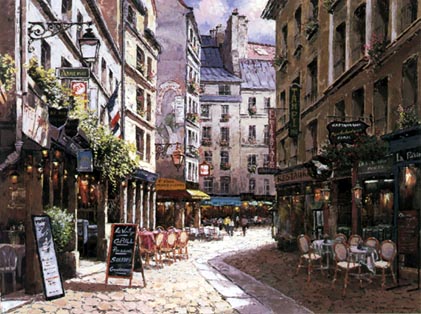
La rue - Community, and small shops; "small town life" is still important in France, even in big cities.  There is a lot of value put on what we would call 'Mom and Pop shops' or bakeries, and having places you frequent.
Conversation.  Need I say more?  The French will make reservations at a restaurant, and once the restaurant fills there is not 'wait' because guests are expected to stay until the close of the restaurant--doing what?  Talking.  I was born for this place.


Not all values are based off of history, though they are usually based in history.  One such value is the value of mon pays--where someone is from.  I think this comes from a long line of defining oneself as not 'French' necessarily but a Parisien or a Poitevin or a -- no, I'm not going to play this game.  Take a gander at this website which is awesome: (http://www.habitants.fr/index.php).  My point is, ultimately, that there's something to defining yourself against the land you've lived in, rather than the nation constructed around that land.

Furthermore, where did the French get their love for their language?

Acadamie francaise - it's main reason for being is to preserve the French language.  I like to think that this is why direct translations of the French language into English sound like old English--or how we USED to speak, and don't anymore.  Without Academie Francaise, I wonder what French would sound like.

The French are profoundly attached to and proud of their language, I think the existence of the Academie Francaise more or less proves that.  We don't have an English Academy making sure we Americans don't ruin the good language of English--though, I'm fairly certain the English DO think we've ruined their language.  The point is, we don't have one.  We might learn about old English, but that's just the point--it's old.  I'm not sure if the love of talking and conversing about anything and everything is where this pride of language came from, but maybe that's something I'll have to ask.

So how will knowing these symbols help me on my Field Study?  Well, there's something to knowing these values exist, and that they're different from our own.  I think there's something else to knowing the basics so that when you get to your chosen country of study you're not always asking the 'What is that?' question, but asking the 'Why is that?' question.  We waste a lot of time asking, 'What is that?' when the really interesting part is finding out "Why is that?" because that is where, in my opinion, the culture is found.

Thursday, March 1, 2012

Proposal: Methodology and Procedures

Entry
            I plan to find a host family that I might live with, who might help me enter some facet of the community in Paris where I might become more acquainted with Parisian-French culture.  Though I will do no formal interviews on French culture, I do expect the interactions and conversations I have to help me better understand the experiences of the expatriates I am studying.  Though I am aware that Parisian culture has changed in the last 100 years, given the length of time French culture has been developing, an hundred years will make little difference in the large scheme of culture, which has its roots in centuries of history.
            Furthermore, I hope to familiarize myself with the city, but particularly the parts of the city where African-American expatriates lived, worked, and socialized.  I hope to visit many areas in Paris with sufficient history and representation of French culture to help me gather a larger understanding of what the French value, and by association what many expatriates would have clung to as their own values.  I believe I will find these cultural insets within museums of art, history, monuments, churches and cathedrals, day-trips in and directly around Paris to important places.
            More specifically, I also plan to attend some of the most directly related areas where jazz and blues have been fostered in Paris, attend concerts, revues or small shows.  By making myself available to these activities, I hope to meet others who share these interests and might be willing to share their experiences and understanding of Jazz with me.

Informants
            I expect my informants to be musicians and writers of the period I study, and therefore will be reading and listening a lot, analyzing their work and my understanding of their work within their historical context.
            Though I don’t want to focus on contemporary Jazz and its modern expression in France, I will not turn down the opportunity to talk to others about jazz, soul, or blues, if they should want to.  In this way, I am sure my opinions and understanding will be altered by what is shared with me, but I do not plan on formal interviews.  If one should occur, or I find it necessary or beneficial, I will be explicit about the work and study I am doing, what part they play in it, and will most definitely share with them, if given the chance, the understanding they have helped me gain.

Sampling and Recruitment
            I will stick to those sources in American and French history and culture, and African-American music and/or literature.  Because my research focuses in history, few of those ‘sources’ will be living informants.  As such, conversations or interactions with living informants about these topics will either be informal and/or consented to.
            If interviews should be necessary or if they occur, I will have consent forms in French and English to help those informants be aware of my work, how they will influence it, giving them access to my final piece so they have an opportunity to be accurately and faithfully represented.  This is not the focus of my research, however, and so I do not expect it to be a time-intensive or significant part of my overall project.

Description of Method
            The methodology I will be using is primarily an American Studies methodology in which I will gather sources to help me with all four facets of the methodology: Textual Interpretation, Archive Building, Institutional Contextualization and Social Theory.  The intention of looking at all four facets of an event, a place, or an ‘artifact’ is particular to the American Studies field, as it is interdisciplinary in nature and seeks to regards facets of American culture more holistically than if one were to look at American culture through history, sociology, economics, or literary movements alone.
            Textual Interpretation will be gathered from autobiographies of the musicians and writers that lived in Paris and recorded their experiences in Paris.  It will include music recordings as well, and may include a close reading of certain areas of the city.  I will use theories of space and place to help me with this type of close reading.
            Archive Building will consist of everything I can get my hands on from an understanding of the city itself, and its history, African American history, but particularly the history of music and jazz, and the history of African Americans in Paris during the 1920s and 1930s.  A lot of this will be history of people and places.  I will glean much of this information from books, but I plan to use the city itself as a guide, as I visit historical monuments, museums that can share particular insights on archeology, history, culture (art, music, etc.) and other influences the city has sustained or inspired.
            Institutional Contextualization will primarily focus on the institution of jazz and its contextualization within the time period, however once one tries to contextualize an institution with regards to a particular cultural artifact—i.e. a song, a painting, a particular building, or a wall of graffiti—its application differs.  As such, my use of this methodology will change in regards to particular artifacts or places.  I hope my understanding of jazz as an institution, particularly in France will be aided by my attendance to jazz concerts in Paris and a better understanding of how the French took in Jazz as their own during and after the 1920s.
            Last, Social Theory plays a big part in American Studies methodologies and the few I will focus on include race, transnational studies, and urban studies.  Again, much of this information will come from reading, however, I will also try to glean information from the culture of Paris that I observe as I become familiar and acquainted with the city, and the cultures that have contributed to its diversity and culture.  Much of this social theory, however, will be taking place within a better understanding of how African Americans were treated in America and a comparison of how they were treated in France.  Since I cannot interview those who experienced the move from America to France during this time, I will have to rely more on history and a strong ‘archive’ to supplement my understanding.
edited 3/6/12

Tuesday, January 24, 2012

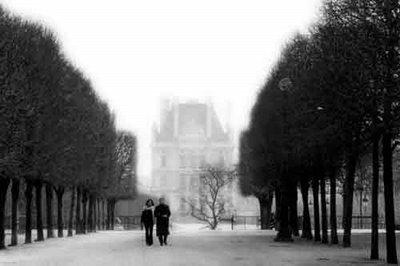
Here follows a series of pictures of the things I'm looking forward to about living in Paris and in France.  Towards the end of the semester, I plan to do another to see what has changed/if anything has changed as I learn more about the location, more about the history, more about my project, and more in general.  A lot of these things probably strike me as closer to a tourist's goals and aspirations for going to Paris, which there's nothing inherently wrong with.  But I would like to see what are some of the first things that come to mind later on in the semester.

L'art (in general)

Boating at Argenteuil - Monet @ Musee d'Orsay

Cinema (ou Jean Dujardin...)

The Views

Notre Dame

The bread

Versailles

The Seine

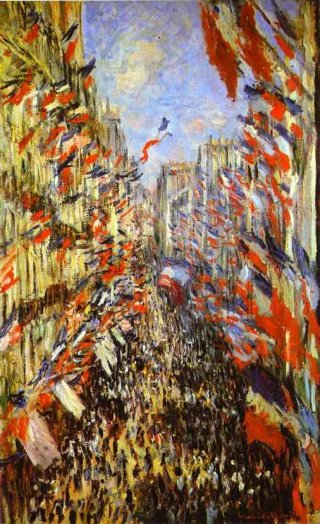
La Fete Nationale

The Museums (Musee d'Orsay)

(Musee du Louvre)

Walking in Paris

Creativity, Conversation, Innovation, Inspiration