Pages

Showing posts with label france. Show all posts

Saturday, April 7, 2012

Who you are.


You don’t seem very happy.  I think maybe a lot is worrying you.  I want to care, and I do care, but I’m afraid to show it, since there is so little I can do about it.

I want to be thoughtful, considerate, kind, but those things I associate with a prior me, a weaker me.  And so I will be those things, when I feel you understand me, but until then I’ll show you the roughness, and there isn’t a way for you to get in until you give me a reason to let you.

I’m eating cinnamon yogurt pretzels from the corner market. They’re not a terribly dignified food, I’ll give you that, but they’re addictive.  There might be cocaine in them.  Which brings me to another point: I think I do more eating in private than I do in public.  I hear this is a major difference between me and France.  We may not get along.

Honestly, how many people have this opportunity?  I’ve done this to myself, so to speak, and I know this is not something most of the people in the world, let alone most of the people in history get to do.  I need to stop treating this as difficult and start regarding it as a chance.  That’s what it is, a chance.  And I think there was a time and place for realizing how difficult this trip was/is going to be.  I don’t think that culture shock should be ignored; I don’t think that safety should be ignored.  However, I also think that I get to live in Paris for three months, and that’s exciting.

Americans have gone to Paris for a lot of different reasons; artistic endeavors, racial equality, social freedoms, a need for inspiration, a love of French culture.  But the great things about France were not introduced to me through war; nor am I escaping some terrible prejudice; neither am I facing financial or social ruin.

Turning 19 was hard for me.  Turning 20 was a million times worse.  I wanted to do something significant in my life because I felt I’d done nothing significant thus far, and that desire has led me down a lot of paths.  I turned 20, and then I went to London.  I turned 21 and I went back to college; moved in with new roommates; became a new person.  I turned 22 and I started planning my trip to France.  I’ll be 22 for a month and nine days before I turn 23.  Sometimes I just feel like time is passing too quickly, and if I don’t hold myself to doing something interesting or memorable, my life will pass without anything in it.  For my first two months of being 23 I’ll be living in Paris; I’ll graduate from university; I’ll hopefully get an internship in a Museum in LA county, I’ll hopefully get a job that makes me want to get up in the mornings.  Hopefully I’ll make enough money to move out to DC, take the GRE and begin applying to graduate programs back East.

But really, everything is in flux and none of these things could happen.  So what do I know?  I know that I’m a different person than I was when I was 18.  I’m a different person than I was in high school.  I’m meaner, I’m more abrasive, I’m more offensive, I’m less likely to give a crap about you or anyone else, I’ve been told I’m mysterious (that’s not really very true).  I’m less religious.  I’m less kind.  I’m less often loved and less often lovable.  I’m less patient.  But.— I’m also less likely to be used or manipulated.  I’m more spiritual.  I’m less likely to let other people dictate to me how I feel.  I’m more long-suffering.  I’m writing my own script for life, and so although the grammatical mistakes and bad cadence are mine, so are the jokes, and the sincerities.  The deep and abiding love which I am capable of feeling is better funneled into the people I know will appreciate it.  I love deeper and know better how to show it.  Some of my relationships are actually fulfilling.  When people say they like me, it’s because they actually like me.  I’m more relatable.  Mistakes don’t bother me.

And it’s not that I don’t have my problems, and it’s not that I don’t feel lonely most of the days of my life but that none of that matters, because it’s just the way life is and I might as well take those opportunities for joy that are so few and far between.  “Such is the life of a man.  Moments of joy obliterated by unforgettable sadness.” – Le Château De Ma Mère (1990).  But if you don’t look for and enjoy those moments of joy, you will have nothing to offset the sadness.

I feel like I should be writing something a little more epic, given this is my last blog post until I go to France, given that this is my last week and a half in Provo (at least for a while), given that I’m finishing up and undergraduate degree, and that I’m starting a whole new part of my life.  But I can’t think of anything at the moment.  As Don Draper of Mad Men says, “Fear stimulates my imagination.”  So I’m sure that when I become terrified again, something will come.  Until then, I’m leaving you with these thoughts, and perhaps to think about yourself and how much you’ve changed since you started school.  Are you better?  Do you like yourself more?  Because sometimes those answers are different.  I think the latter is more important, and let me tell you why: you are the only person you have to live with for forever.  If you like who you are better, chances are you’re more yourself.  And if you’re more yourself, you’ll have an easier time being better in the long run.

No worries, more to come.  Until then,
Signing off.
Jen

Friday, March 23, 2012

Symbols of France

Le Republique Francaise: Liberté – Égalité – Fraternité
These are three values not to be ignored in France: Liberty - Equality - Brotherhood.  I think these are probably the values France has ideally held onto most since the French Revolution.

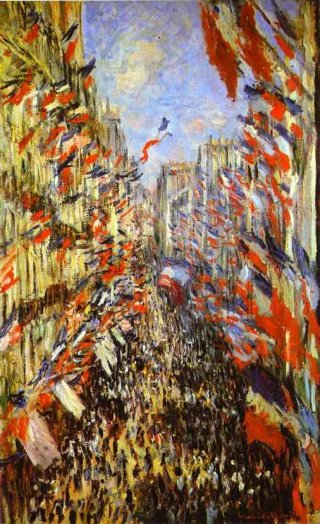
Le drapeau tricolore sous l'arc de triomphe; I have yet to find out why exactly this is done, but it is most certainly a sign of nationalism and it can be seen from so many places within the city.

Fleur-de-lis on the coat of arms of France from ancient times.  Harks back to ancient France, that history and the "legacy" involved.

Lady Liberty - Marianne is an important symbol of France, here she leads men into one of the Revolutions France underwent during the 16th-19th centuries.


Notre Dame, made famous by Victor Hugo after being more or less abandoned after the French Revolution.  A sign of Catholicism in France, but also a National symbol of Gothic architecture.

Blue Virgin Window at Chatres Cathedral - survived from the Romanesque Cathedral after Chartes burned down several times; the Cathedral was not looted during the French Revolution, neither was it destroyed during either of the World Wars.  Once contained the shroud of Mary, given to Charlemagne as a gift from Jerusalem.

Reims Cathedral where the Kings of France--starting with Clovis--were coronated.  This is the third Cathedral on the site, from the 13th century; the cathedral was made bigger for the crowds that would come to coronations.

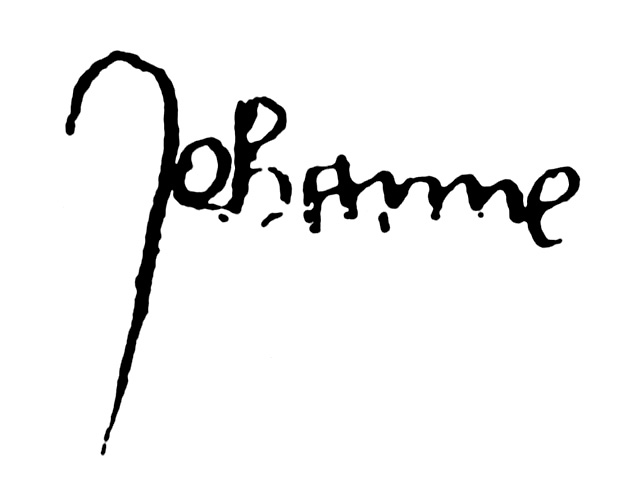
Joan d'Arc has been a consistent symbol in France, her story being used by everyone from Liberals to conservatives, to the Vichy Regime to French Resistance fighters.
Her signature - 'Jehanne' or 'Johanne'  (I just thought this was awesome.)

In all honesty, when we visited the 'Beauty and Belief' exhibit, and we were asked about symbols from our Field Study sites, I had no idea what to say about France.  It didn't take me long when I really started thinking about it, but it did take me a little time to find out why France used some of these symbols to represent their values, ideals, or history.

There's a lot of nationalism in France, a lot of pride for being French and a LOT of history that gets them to those ideals, values and pride.  This doesn't really surprise me.  There are a lot of things not to be proud of in any country's history, but there's so much more to recognize in France as 'legacy.'  Marianne, France's equivalent to our 'Columbia' or Britain's 'Britannia' is the female personification of France, she is valiant and courageous, she is loyal and she is fiercely behind France and its ideals.  She, like Athena, is a warrior, ready to fight if necessary.

French history is also very important, and because of a rocky past, I think the French are big on ideals.  I think Americans are, too, so maybe that's something we can understand about each other.  The difference is the way we interpret or show those ideals, which is something I don't think we always understand about each other.  But in general, the French choose to remember about their history, the things that make them proud of that history, and I think that's par for the course for any country's national memory.  For France, this includes the Cathedrals, even though so much of France are no longer practicing Catholics; this includes Joan d'Arc, even though the French handed her over to the English to be executed.  This includes the values of the French Revolution: Liberté – Égalité – Fraternité, even though those ideals came at such a high cost.  It is interesting that sometimes a culture's most valued ideals are born out of their darkest moments, perhaps when they realize they need them most.

Charles de Gaulle - Regarded as the leader of the Resistance and 'savior' of France after WWII; in reality the history isn't that simple.
Terrein - see my post on Terrein, and the value of 'mon pays.'
The French Resistance during WWII was regarded as being widespread and entirely influential of the eventual dispelling of Germans from France, in reality, most French were not part of the Resistance throughout the occupation.
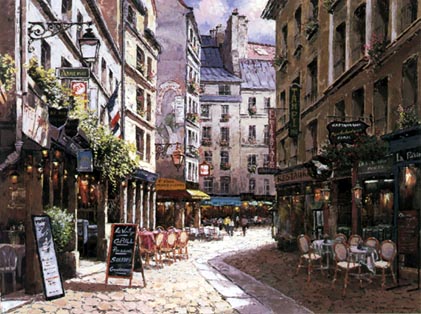
La rue - Community, and small shops; "small town life" is still important in France, even in big cities.  There is a lot of value put on what we would call 'Mom and Pop shops' or bakeries, and having places you frequent.
Conversation.  Need I say more?  The French will make reservations at a restaurant, and once the restaurant fills there is not 'wait' because guests are expected to stay until the close of the restaurant--doing what?  Talking.  I was born for this place.


Not all values are based off of history, though they are usually based in history.  One such value is the value of mon pays--where someone is from.  I think this comes from a long line of defining oneself as not 'French' necessarily but a Parisien or a Poitevin or a -- no, I'm not going to play this game.  Take a gander at this website which is awesome: (http://www.habitants.fr/index.php).  My point is, ultimately, that there's something to defining yourself against the land you've lived in, rather than the nation constructed around that land.

Furthermore, where did the French get their love for their language?

Acadamie francaise - it's main reason for being is to preserve the French language.  I like to think that this is why direct translations of the French language into English sound like old English--or how we USED to speak, and don't anymore.  Without Academie Francaise, I wonder what French would sound like.

The French are profoundly attached to and proud of their language, I think the existence of the Academie Francaise more or less proves that.  We don't have an English Academy making sure we Americans don't ruin the good language of English--though, I'm fairly certain the English DO think we've ruined their language.  The point is, we don't have one.  We might learn about old English, but that's just the point--it's old.  I'm not sure if the love of talking and conversing about anything and everything is where this pride of language came from, but maybe that's something I'll have to ask.

So how will knowing these symbols help me on my Field Study?  Well, there's something to knowing these values exist, and that they're different from our own.  I think there's something else to knowing the basics so that when you get to your chosen country of study you're not always asking the 'What is that?' question, but asking the 'Why is that?' question.  We waste a lot of time asking, 'What is that?' when the really interesting part is finding out "Why is that?" because that is where, in my opinion, the culture is found.

Tuesday, March 20, 2012

Watching a Field Study: Part 1 - Making a Dent

There are so many different ways of being good with people, or bad with people, we often get stuck in thinking one way is right, or that someone else's way is wrong.  I'm not sure why we do that.  It occurred to me how right I am for a Field Study, and how wrong I feel for a Field Study.

I am good with people, but perhaps in a different way than Field Studies tries to teach.  Asking questions, being so procedural, sincere people asking insincere questions to get sincere results.  It works, but was never the way I imagined doing it.  I know that once people get out into the field that's not necessarily the way they do it, either.  I was just thinking that the moment someone begins asking questions of someone else to get a particular answer, the question stops being sincere.  I do this everyday, don't I?

"How are you?"

But what I've been learning is perhaps how wrong I feel for a Field Study and yet how Field Studies is the only right program for the way I want to go about learning.  What other program would let me go to Paris to study African American expatriates?  What other program?  And what other program would let me go to France to live there, to study there, without being tied to someone else's agenda?  I could study in France doing some kind of Direct Enrollment, but I wouldn't be taking classes about things I want to study because the point would be studying in France, not WHAT I'm studying in France.  I could go on a Study Abroad, but again, the point wouldn't be to go to France for any particular purpose, but I'd be paying through the nose to go to places that have nothing to do with what interests me (or more likely, because everything interests me) have nothing to do with my focus of study, which is American Studies, American culture.

I keep harping on about American this and American that. Mostly because I don't believe in anything American; and I also believe in everything American.  I always liked the sentiment of Plato's: "I am from the world."  And I believe we can have world citizens, rather than American citizens or French citizens.  But, I don't know.  I'm still fiercely patriotic and I don't think anyone has the right to truly criticize this country unless it also loves it.  I am not this way because my country deserves it, or because my country is superior; maybe I am this way for the opposite reason.  Because it is home; because it's got so far to go in my approximation.  Because there's so far it could go.  And maybe I've got a little bit of that mon pays pride.

I teach the Family History class every week at church.  I think family history work is very important, but why the hell are we doing family history work for strangers?  I don't mean, why do we go to the temple and get baptized for strangers, one could consider that service for others.  I mean, why are we searching for names of people we are related to, birth dates, and then ask these people to be baptized and sealed to our families when we've done nothing else to find out who they are?  I mean--why would you want to be attached forever to someone you don't know?  For this reason, I find it so important to find out as much as you can about someone, not necessarily BEFORE you do temple work for them, but during and after as well.

A friend offered me tea  yesterday.  I tried it for the second time in my life.  The last time I tried it was probably about two and a half years ago.  I still don't like it, though this cup of tea had sugar in it, at least.  I still have a box of tea bags that Jake gave me my senior year of high school with a mug.  The mug I use every day, the Earl Grey tea I've never touched.  But I've also never been able to throw it away.  Because Jake was certain that someday I'd try tea.  I always said I didn't drink tea, it was a religious thing.  Now I don't care so much, and I'd drink tea if I liked it.  Two and a half years ago I finally broke down and told Jake I'd try some of his tea.  It was green tea.  He didn't put sugar or honey in it.  Grossest thing I've ever tasted.  But I remember when there was a time tea was just something I wouldn't do.  I thought I'd always feel that way.  Now I don't think I see any point.  Do you think I'll ever get to that point with alcohol?...Just kidding.  I think about Jake often, especially when I think about Family History work.  Because he's made such a big impression in my life and yet I'm not sure if anyone really knows it the way I do.  If someone were to ask my sisters about me, I'm not sure they'd have a clue who I was to anyone other than them.

Why does this matter?  Well, I just think about Field Studies, and how we have these experiences that take a fraction of a second that change who we are.  Or we meet these people that just leave these impressions we'll never iron out.  And who will know?  But worse, who will have those experiences if they aren't taught to appreciate them?  For I fear that every day I have experiences that could change me, if I'd let them, but so often I don't.  Field Studies is about teaching people HOW to have those experiences, and how to let other people make dents in you so that you'll never be the same.  Because what's the point of living life the other way?

I think this is one reason I'm sad to see Field Studies go.

Tuesday, March 13, 2012

Reciprocity, etc.

I'm not counting the days until Paris, I'm counting down the days until London where I get to spend a week and a half with my two best friends before my Field Study.  But if you tack on 9 days (which is 48 days), that's how many days until I'll be in Paris.  And, as it stands, with no place to live.  I'm nervous, but not nervous enough.

I've been spending some time looking at two blogs.  One of them is The Spirit of Black Paris which is not only fascinating but extremely helpful, and the other is Invisible Paris which has little to do with Black Paris, but has to do with places in Paris one isn't typically allowed to enter.  Invisible Paris gets me excited just to be in the city but The Spirit of Black Paris gets me excited to actually begin studying the people who I want to study.  I feel like I need to get started now, and I'm sure I could, but I just don't have the time.  Other classes and work and even attending classes seem very unimportant right now, as my mind begins shifting to a new perspective--that is, new for me--as I take into account a lot of the changes in my life that will be taking place in a little over a month.  And I have the most pounding headache.

The thing is, I'm not terribly excited, though people keep telling me I should be.

I've got two contracts set up, one called "Urban Studies in Paris" and the other "Writing Paris" and both are focusing on an American Studies methodology.  Urban Studies, in general is going to have an American Studies emphasis as I read about the Urban Studies theories, and then focus it a little into application of Paris.  The other class is going to help me hone my writing skills with an American Studies methodology for readers of any discipline.  This means treating places, art, music, food, etc. as 'artifacts' that are studied and written about from all four viewpoints of the methodology: its archive, the institution in which it was created or formed, textual analysis--the analysis of the piece itself sans all other influence, and the social theories surrounding it.

Been thinking about reciprocity since yesterday's lecture.  The lecture didn't become very interesting to me until the very end when the three types of reciprocity: balanced, negative, and generalized.  I couldn't help but think of this idea in terms of friendships, because that's what I think of most things in terms of.  Our culture is not one that practices generalized reciprocity in terms of "things," but we do practice it in terms of speech.  If someone continually compliments us, we tend to compliment back, and when we don't you can expect to have some rather offended or hurt people walking about.

For example, I remember my first year in college, when I'd come from a culture of generalized verbal reciprocity (also balanced verbal reciprocity) where compliments on dress, hair, makeup, general good-looking-ness etc. was always paid, particularly to those who paid it to you.  It was balanced in the sense that you did for others what they did for you, but it was generalized in the sense that you didn't worry about being nice to someone as many times as they had been nice to you, you just assumed that between the two of you the complements would even out over time. But I suppose that "services" were included in this, too: help with homework, giving of school notes, listening about boyfriend troubles, back rubs, etc.  No one only gave back rubs if the other had given them a back rub lately.  All these things were given easily, with the realization that it would be paid back eventually.  My first year of college was not like this.  Here I was, complementing people up the wazoo, because it was what I was used to.  Giving them service in one way or another, because it was what I was used to.  Hours of listening to issues, time spent making dinners or baking desserts, giving of notes, etc.  But after months I realized how tired I was.  And years later I realized that if one assumes in generalized reciprocity that you will be repaid and then at some point you realize that you aren't being repaid at all, you feel taken advantage of.  I think this occurs when you are operating in cultural norms that no one else is operating in.  Realizing that I was in a new, much more selfish, culture, I had to switch to 'balanced' reciprocity so I would be used up, taken advantage of, or simply tired out with no benefit to me.  You can only give so long before you've got nothing left, as it goes.

However, I think I most often experience the consequences of negative reciprocity, both because I often give too much, and because sometimes I am overwhelmed by others giving too much.  These friendships strain me.  Sometimes I give too much in a friendship, not realizing that that level of friendship cannot be repaid at the same rate as I am able to give.  I expect too much of my friends sometimes, and then I feel misused because I'm not being "treated right," whatever that means.  But the opposite happens, too, where someone is willing to give too much to me too soon for my comfort, and I don't feel I know them well enough to pay back the friendship in meaningful ways, therefore overwhelming me into feeling 'smothered' by them, or simply bothered by them because they're moving too quickly for me.  This is not specific to romantic relationships--this happens to me on all sorts of levels.

But this isn't to say that I think balanced reciprocity is necessarily the best of the three, for especially in friendships no one would be keeping tally.  All our best friendships should probably be some form of generalized reciprocity or a mix of generalized and balanced.  I am good with casual relationships that progress slowly and naturally.  This is one reason I'm not too worried about being the cause of negative reciprocity.  In 3 months I don't feel anyone will expect of me a life-altering friendship, and I also don't believe I will expect that of others.

Also, going to France, which is "western" in its mindsets, and living in Paris which is hardly a place where I might be expected to give more because I'm an American, or possibly give too much because I'm an American is less likely to happen.  I know that in some areas, bringing too much money in might make a family dependent on that money.  Though I don't yet know my living arrangement, I'm fairly certain this won't be the case.  If anything, people will see me as the poor student, much like is the culture in the states.  However, I realize this, too, can lead to some being overly generous, which is something not to take advantage of.

Anyway, these are some interesting things to give some thought to, which I'll continue doing.

Tuesday, February 21, 2012

Inquiry Conference

I've been helping at Inquiry Conference--being a Field Study employee and all--and though it's only been one day, attending Inquiry Conference has been a good experience.  It's helped me think about what kind of knowledge I could come away from my Field Study with, and what kind of things I might be able to present to people about the study I do.  A lot of people have field studies that require they ask questions of others.  So far, I haven't gotten around this aspect of my field study.  I honestly want to experience French culture for the purpose of finding out what kind of influence it would have on African American expatriates, but also just expatriates in general.  I'd love to interview people about music, and about their heritage and their history--especially if they're African-American.  But I don't know that I can count on finding expatriates who are interested in the music scene.  I'll be very curious to see if I kind find any french musicians who play jazz to know what they think about the history of the music they play.  But I just don't want to count on finding anyone, and honestly I'm more interested in the history anyway.  I'm interested in Paris, the culture of the city and the French culture in general, and really seeing where it all fits in to my understanding of the expatriate experience.  I feel like a lot of the reading I've been doing lately is giving me a really good idea of what it would have been like.  But I guess what I've been coming to lately is an understanding that no culture operates in a vacuum.  Of course I knew this before, but putting words to it makes it a lot easier to contextualize: we can't teach U.S. History the way we do, because it's ridiculous to think we became what we did all on our own.  We also can't keep teaching a white-washed U.S. History because it's simply not a true history.  I know that if I was really interested in studying black creative history I'd be in New Orleans, or Harlem or something.  I've honestly asked myself why I chose Paris.  But then I have to remember that I'm a multi-dimensional person, too.  And I have interests outside of black creative history.  French, France, writing especially.  And these are things I want to work on while I'm there studying what I'll be studying.

Which is where I'm coming to.  I want to write something.  I didn't want to admit it, because that puts a lot of expectations on me.  But I want to write something while I'm there--something creative, but true.  And why not Paris, honestly?  Why not go to the creative capitol of the world?  Why not listen to the best music ever made? Why not?  Why not?

When I think about writing, I really start to get excited about France.  Honestly, going out and interviewing people is going to keep me locked up inside, afraid.  But going out to experience things for the sake of writing will oddly enough get me talking.  So I need to stop feeling bullied by these anthropologist ethnographers and just be myself.

I love you anthropologists, by the way.  I'm just not one.

Wednesday, February 15, 2012

Language

I first fell in love with French when I was learning the phrase, 'Je suis enchantée de faire votre connaissance.'  I had been back at home in Los Angeles for six months from a study abroad in London and had another two months to go until I returned to Provo.  Learning is all that has ever made me particularly happy, and after six months of not being in school, I was reeling with dissatisfaction.  Perhaps sensing my displeasure with life, and aware I'd be taking French in the Fall, my parents gifted me one of those CD-ROM 'Learn a Language' programs for my birthday to get me started.

I worked about four to six hours every day at a Law Office, and when I came home, I'd practice French for hours, lying across my parents bed repeating words and phrases.  I loved it.  My roommate collects stories I tell her of my prayers with God; her favorite is the story of the week I prayed every night for God to help me get the pronunciation of the French 'r' down.  I can still remember the first time I said 'rouge.'

Fairly quickly, I familiarized myself with most of the disks of the program, and swapped them out depending on whether I wanted to learn phrases, 'Au secours!' (Help!) which is another great direct-translation, or vocabulary, 'souris' (mouse).

It was a phrase day when I found, 'Je suis enchantée de faire votre connaissance.'  I had NO idea what this meant.  I knew it was supposed to mean something about being enchanted, and maybe meeting someone, but I hardly understood the sentence syntax or meaning of the individual words.  I looked it up online.  It means "I'm pleased to meet you," but more literally, "I am enchanted to make your knowledge/acquaintance."  I was smitten.  Someone could tell me I was wrong now, and I'd probably agree with them, but at the time this phrase meant something a lot more than "I'm glad to meet you."  It was saying something more like, "I'm enchanted to know you exist."  What a glorious idea.  Because if Descartes is right, and 'Je pense donc je suis,' that means that I am my knowledge.  I'm only as good as my knowledge, and they're pleased they know about it.

French wasn't about learning another language that day, it was about learning a new way of thinking, a new way of seeing people, and a new way of seeing the world.  How could you ever have a bad day with people being pleased to know you exist and other such grandiose phrases?  Granted, I've now been studying French for almost two years and I don't know that I could make the same argument about this phrase, knowing what I know about the meaning of french words.  But it doesn't really matter that my direct translation was a little off, because I believed it, and it carried me through two years of learning a language that more often than not frustrates me, and makes me feel ridiculously incapable and inept.  I hate it.  I mean, I hate it.  I hate the homework, and I hate that I never know how to say what I want quickly enough.  I hate that I can't understand most people speaking the same language I've been studying for two years, and I hate that I understand concepts I can't put into practice.  I hate getting up in front of people and fumbling with the words and the grammar.  I really hate it.

But then--I'll accidentally forget time.  I'll forget the other homework I've got looming over my head, and I'll get stuck in my grammar book, and I'll marvel over this language that makes no sense some days, and all the sense in the world others.  I'll find a book written in french about the history of jazz, and I'll read seven pages of it before I realize I didn't once look up the definition of a word, or wonder what the hell a series of words in a particular order meant.  I'll forget about what needs doing and realize how long its been since I had to get the direct translation for "I'm glad to meet you," and I'm back lying across my parents' bed, pronouncing rouge for the very first time.

Monday, February 13, 2012

Privacy

The French close their shutters every night so no one can see into their homes.  They don't talk about money, they don't talk to people on the metro, they don't give out their names, and it doesn't matter what they do for a living.  But they'll invite you in to their dining room, feed you, have a conversation with you about their children, their house in the country, and give you a jar of fig jam if you show interest.  This is the gist of the chapter I read today.  And I love it.

It's privacy.  It's a different notion of what is private, and what isn't private.  The home, the family, personal decisions--those are all private, to the extent that 'scandals' aren't really scandals at all but simply not your business.  And yet arguing, disagreeing, eating are not private matters, but in fact more public than we as Americans would think.

Hospitality is expected on many accounts, but only if you do it the right way--the French way.  Saying bonjour and au revoir as you enter and leave a shop, for example, will get you good service.  What has this to do with privacy?  Well, you're coming into someone else's private domain, and in doing so, it is only polite to greet and give farewells to the person whose home or business you enter.  However, asking someone outright what their name is will create immediate barriers.  Why?  Because whether they want to be contacted by you again should be their decision--not yours.

Also, it seems to me, the French are not worried about finding and keeping people they like to share company with, or converse with, because they figure that those people will find and gravitate toward each other.  And they seem less worried about wasting time with the wrong sort of people, because I don't think there's a worry about wasting time, or a worry about "wrong people."

Nadeau and Barlow point out one interesting difference I really enjoy: that is, the conversation between couples.  "They typical American couple seeks to display harmony. . . . The French expect exactly the opposite: . . . a relationship should be strong enough to withstand differences" (43-44).  It's not that American relationships aren't strong enough to withstand differences, because in fact they withstand all sorts of differences all the time, but that arguments in public seem distasteful to them.  And thus the French seem to value idea-oriented discussion rather than relationship-oriented discussion.  Meaning, they attack ideas, not the person.  And in doing so, a little arguing is hardly anything to bat an eye over.

This is an interesting cultural difference to me and it reveals how to go about talking to people in different ways.  Knowing and remembering someone's name in our culture is not only a sign of respect, but engenders trust.  Not so in France, where asking for someone's name is a breach of privacy.  Eating in our culture is our business, we eat what we want when we want it.  Not in France.  Eating is important, and therefore is something you do a particular way, something you allot time for, something you do communally with others.  I don't think either is inherently wrong or right, but different for explainable reasons.  So I better master bonjour and au revoir if I want to make people in France happy, which I do.

Saturday, February 11, 2012

Terrien: french ideals in application

Still reading Sixty Million Frenchmen Can't Be Wrong.  This chapter was about the tie the French feel to their land.  Wherever they are, where they are from means more--they are never from 'France' but from a region of France, as if the region they are from is really the country they are from.  The equivalent would be to say, Mon pays est de Los Angeles.  And yet I've been thinking about this a lot in the last few years of my life: being an American means very little.

The book quotes an instance when Charles de Gaulle said in an interview, "'How can anyone govern a country that has 246 kinds of cheese?'  What he meant was, 'How can anyone be expected to govern 246 different kinds of French?'" (21).  We don't think of Americanness in these terms, though we really ought to.  Because there are 50 states, about 300 cities of a population of more than 100,000, and between 30,000 and 35,000 cities and towns, depending on how interested you are in population, whether its "incorporated" etc.  And there are 196 countries in the world (give or take a few, depending on the year, who is deciding, who is at war, and whether or not we're being politically correct), and at least one person from every country is most likely represented in the United States whether they have been here a day or their family has been in here for generations.  An American can be any, and several of all of these elements mixed into ONE person.  Point being, in what way can we say "I'm American" with an meaning at all?

I'm not even a complex example of this, but see what I mean: I'm not just an American, I'm an American from Los Angeles, born of a Californian and a New Englander, a Westerner and an Easterner, a Mormon and a Congregationalist.  My ancestors come from Massachusetts, Maine, Utah, Canada, and before that England, Denmark, France, probably a thousand other places.  And we could try to narrow it down by saying I'm an American from Los Angeles.  But I was born in Culver City, and I grew up in West LA, and I went to school in Santa Monica, and I commuted the 405 for years, and I lived in the San Fernando Valley.  I went to church in Van Nuys, and the movies in Winnetka, Northridge, and Burbank.  I went shopping in Glendale, and I spent time with my friends in Reseda, or Lake Balboa, or Granada Hills.  We went to Downtown LA or Hollywood for shows, and Westwood for day-trips.  And we're still in Los Angeles.  But I have to tell you--those kids from Granada Hills were not my favorite, and we had dances with the kids from Canoga Park, but whenever I meet someone from there I don't particularly like them, I never went to Beverly Hills on my days off, and the Sherman Oaks people were always a little snooty.  North Hollywood was kind of a sketchy place to go, and I never got to know Studio City.  Yeah.  We're still in Los Angeles.  It also matters where you go to school in Los Angeles--Did you go to your homeschool?  Because that's odd.  I went to Elementary school in Culver City and Sherman Oaks, and Middle School was in Northridge and High School was in Lake Balboa/Van Nuys/Reseda--you could put any of those names on the envelope and it'd get sent.  And did you go to a public school or a private school? Was it a magnet or a charter?  Did it have an honors program?  What about a swim team, or a football team?  A robotics team or a Humanities magnet?  I mean WHAT KIND OF AN ANGELENO WERE YOU!?  How long did it take to get to school, or to your best friends place?  Yes--including traffic.  Do you like Mexicans?  What about Armenians?  Blacks?  Did you have all white people at your school?  Or all sorts of people?  Did you mistake the Salvadorans for Mexicans?  Did that get you in trouble?--Hope so.  I'm even going to get started on food.  And every person from Los Angeles who could possibly be reading this post right now would tell me about the hundred things I missed that makes people from Los Angeles different.  AND I KNOW.

Breathe.

Maybe there's one thing we agree on: How do you feel about LAUSD?

Yeah...

Point being, I'm hardly an American, and maybe the French have it right.  Because I don't know what the heck I am.  But if we're going to start somewhere, 'American' just doesn't cut it.  What does it tell you?  About some national loyalty?  Patriotism?  And I don't know if you can tell but I love mon pays.  I particularly love the part of it I know really well--the part of it I'm from, Los Angeles.  And I don't love all parts of America equally.  Because they're not mine.  And so I can understand that while this desert I live in is far more beautiful that most of what I saw every day in Los Angeles, it still can't win and it never will.  But because Los Angeles resides in the United States of America--I love America too.  It's just that . . . it doesn't mean as much.

Thursday, February 9, 2012

un bonheur ordinaire, est-il possible?

Je sais que je ne comprendrai tous les chose.  Mais je peux essayer.

Elle me dit, qu'elle aimerait changer d'air
C'est vrai que par ici, les vies prennent la poussière

Elle me dit, qu'elle voudrait voir la mer
D'autres pays, un bonheur ordinaire

Elle me dit, qu'on pourrait se défaire
De ces utopies, qui rendent nos nuits amères

Elle me dit, ses doutes et ses colères
Comme aujourd'hui, lassée de toucher Terre

Même si notre histoire peine à s'écrire, j'ai le scénario
Même si l'on s'égare dans l'intro
J'ai, tu as tout ce qui me faut, j'ai tout ce qu'il te faut

Elle me dit, le pire et le meilleur
Le bleu et le gris, mes poches vide à toute heure

Elle me dit, que l'issue lui fait peur
Que je m'appuie sur trop d'apesenteur

"Elle Me Dit" - Ben L'oncle

God made this man for me.  A black, french, blues/soul chanteur.  Il n'y a rien de mieux.

I've been studying this song for a while now.  Je l'aime parce qu'elle lui disais "ses doutes et ses colères" mais il ne demande rien d'elle.  Within the first two lines he validates her doubts, her need for a change of scenery, "It's true, that here life gathers dust."  And with the rest of the song, he need not validate her, because you know he's listening, he respects her views, and is free to go along with them, because he believes she's right.  And why not?  For she has some beautiful ideas.  "She tells me, we could get rid of these utopias that make our nights bitter."  Une belle idée, n'est-ce pas?  Se défaire de ces utopies--les utopies qui n'existent pas--qui rendent les nuits amères.  Parce que c'est alors seulement qu'ils écrire leur propre scénario, et trouver "un bonheure ordinaire."

And I love her worries, her "doubts."  Tired of touching the ground.  Relying too much on weightlessness.  And he's going along with it.  Je l'aime parce qu'elle sait qui sait qu'elle peut lui dire ces choses, sans de jugement.  She's not holding anything back, you know?  And he, he's just telling us.

I think we fear that quite often--that when we tell others what we want out of something--life, maybe--that we will be judged for it.  I can't remember the last time I told anyone what I really wanted out of life, or why.  But the more no one asks, the less I care what my answer is.  The more I do what I can, what I want, without worrying that I'm pleasing anyone but myself, and God maybe.  I think that's an important part of this learning process.  That maybe it's not so much about the project I want to do but just being.  Finding that raison d'être as we would say the french would say.  Or maybe finding les raisons d'être pour les autres.

Isn't that what I really want? C'est la musique, non?  Pour tout le monde.  It's a big part of everything, I think.  And I take a long time to realize what its for.  Healing, maybe?  I'm just thinking now.  But what I mean to say, is that what I really want is to come back to the things that keep me sane.  Music.  Writing.  Curiosity.  Fairness.  Learning.  Exploration.  People.  And so maybe what I need to do is leave this "project" alone for a little while, and focus on what I want to get out of this experience, sans le projet.

Monday, February 6, 2012

"Feeling Bad for No Reason"

I know nothing about music apart from what I like.  I don't even think I could tell you what (and if there is anything) I don't like.  But lately I've been wondering maybe how I can be a little more specific in my work here, studying African-American expatriates in Paris and I've been giving some thought to what got me interested in African-American culture in the first place.

As a kid who grew up in Los Angeles I spent a good amount of my childhood in a car--in traffic.  You know, I'm sure my parents would report different, but I don't really remember minding, and as a child who grew up in a car--in traffic--my favorite pastime of traveling is still listening to music.  I would lie in the back of the van with my ear next to the car speaker while we were in bumper to bumper traffic listening to my dad's mix tapes and the oldies station.  I never got to choose what to listen to, and I don't think I ever expressed preference--except when I complained that the Classical music made my stomach hurt, which by the way is still the case, and my parents would change the radio station.  But there was one song in particular that was played often on KEARTH 101.1 which I have loved and never tired of.  "What's Going On" by Marvin Gaye.  I cried if my father tried to change it.  Alas, when I had no knowledge of skin color, no understanding of race, no preference for one or the other, Marvin Gaye was my first love.

It was years later, probably High School when I found a Marvin Gaye album on my father's shelf and found this song again, and never let it go after that.  My family can vouch for how often Gaye's "What's Going On" album was played in our house that year.  I followed Marvin Gaye straight into the history of Motown, into the legacy that was black music.  It didn't take long to find Big Band from there, and Swing, and Jazz, and for a little while I lost myself in Frank Sinatra, and Benny Goodman, and Artie Shaw.  This, by the way, is a nice place to loose oneself.  But I soon returned to what really got me going.  Duke Ellington and Count Basie emerged.  Then, I continued to pry into the music of African-American culture.  And I was in love again with these voices.  Lena Horne, Billie Holiday, oh, Louis Armstrong, and then I found Fats Waller, Bessie Smith--and I just kept going. Robert Johnson, Josephine Baker.

My sister caught on to the whole thing.  She started listening to some Soul, to some Gospel, and so my family were plunged into the world of African-American music.  I started studying French, and found through a professor here at BYU Ben L'Oncle, a French-Blues singer who I fell in love with.  I came home and stopped listening to anything else, other than this soulful, bluesy stuff that was melancholy and imperfect.  And I was thinking, why is this something I can't let go of?  Why is this something that is so much a part of me that I can't say "I'm going to study African American expatriates" without saying, "You know?  Josephine Baker... Ada "Bricktop" Smith.  And what I want to want is to study the writers, and the intellectuals, but I think I'm going to have to admit to myself sometime that its the collision of France which has always appreciated the melancholic with old African American blues and jazz which has rarely had reason to be anything other than melancholic, that really gets me.

Maybe that gives me a place to start.  I've been wondering--why France?  What's the point in going there?  Who will I talk to?  What will I study?  I don't know anything about music, but could I?  Could I do something right by Marvin Gaye?  Pay  him back for this gift he's given me.  And keeps giving me.

Friday, February 3, 2012

I am white and white is black and black is white and black is black

I need a post to do some thinking, or else the thinking just won't get done.  Lately I've been asking myself what I'm doing this for.  What's the point of doing all this work?  How does it apply to me when I'm looking at history and not necessarily interviewing people?  And who will I talk to, and what will I spend my time doing?  And what do I want to come out of this field study with?  What do I want to know?  Why do I have to go to France to know it?

People have written all sorts of things on the blacks in France, especially those who went there after the Great War.  And I think most of the people who have written biographies or histories of appreciating these people have far more authority and understanding than I do.  I'm not really trying to compete with them on any publishing level, and I'm aware that next to no one will read whatever it is I come up with in the end, but I have to do something that I find worthwhile.

What got me interested in this idea is that I haven't met a whole lot of people who know about the blacks in Paris the way they know about the whites in Paris.  The elephant in the room is Midnight in Paris in which no black expatriates are present apart from Josephine Baker in the back of the room.  Sure you see F. Scott Fitzgerald, and Zelda, Gertrude Stein, and Hemingway--all important American players in Paris at the time, but why the hell didn't he talk to Josephine Baker, and where were Ada "Bricktop" Smith, James Reese Europe and Gene Bullard?  Why wasn't he having conversations with intellectuals like Langston Hughes?  Or at the very least, why weren't they present the way they should have been?

This is what American Studies is about for me--why are we so certain that American=white when it doesn't?  What I want for myself is to put these people in an American context as Americans and I don't want the most famous of these people--Josephine Baker--to be a "who's that?" anymore.  Now I guess I can't change anything, and I'm more than aware of that.  So what's the point then?  What do I want out of this given that I can't make a difference?  If this is just a jumping off point, a place where I can learn how to develop some important skills.

More and more I'm thinking maybe I do want to find an African-American community in Paris and talk to the people I find.  In English, in French.  But whose to assume they'll let me if I do find them?  And that's why I want a backup plan.  What I would want to interview these people for is to put the people I'm currently interested in, in context.

Why I have to go to France is a harder question to answer because I could theoretically just study African-Americans in Paris and Paris itself and the 1920s and black history and then apply all the things I want to about American Studies to my book-learned understanding.  The reason I want to go to France is purely selfish.  I want to be an American in Paris.  I want to know what it's like, and I want to know how it differs from the things I read about these people going through.  I want to walk the streets they walked, and I want to learn they language they had to learn.  I want to live in the city that is well-known for racial equality, and I want to know if that's true.  I want to meet people, especially black Americans, and I want to know what life has been like for them in Paris.  Is it like the Paris of the 1920s in any way?  But most of all--what is it about France and Paris in particular that attracted these people?  Is it just the romance of the place, or is it something else?

I never believe that romance jazz about Paris.  Then I went there, and somehow I understood what people meant.  That's why I think I need to go for a longer period of time.  Because you can be told a lot of things about a place, but can you really put yourself in the context of it without experiencing it?  I don't think you can.

Why are we so set on not including the African-American experience in with the study of "America."  We talk about how slavery affected the black American population, but always with the intention of switching back to "white mode" and how it affects whites now.  Who the hell cares how it affects whites now when it's still something that's present in this country for blacks now?

I loved Midnight in Paris, but I remember thinking at the end of that movie, after thinking about how much I thoroughly enjoyed it, that it was still a white-washed American history, even if it was in Paris.  And I KNOW you can't tell every story at once, but I don't understand why it has to be a white story OR a black story, when we've been together, whites and blacks, all this time.  It's the 21st century.  Isn't it about time we started talking about how separate our histories are?  Isn't it about time we started melding them?  After all, I, a white girl from Los Angeles couldn't be American without the African presence, and a black girl from Virginia certainly couldn't be American without the Anglo presence.  That's kind of what makes us uniquely American.  Is anyone else willing to admit that?

This project idea still needs a lot of work, I guess that much is obvious.


Wednesday, February 1, 2012

Ah, Socialism. Or is that--what?--history?

I'm loving Sixty Million Frenchmen Can't Be Wrong by Jean-Benoit Nadeau and Julie Barlow.  It's helping me recognize some aspects of French culture that I might not have been aware of before reading.  In reading just a couple of chapters, I'd like to report that I'm fairly certain that at least outside of the business place, if not within the business place, too, the French operate on P-time unless otherwise directed.  This may explain what North Americans tend to categorize as "bad service" because the French take their time.  It may explain why they work only 35 hour weeks, or why they take entire months off of work.  Because working every second of every day is unimportant, is unproductive, in the end.

But what I really want to discuss is something French businesses do that the book discusses called Les soldes or "the sales."  Twice a year, once from the middle of January to the middle of February and once from the middle of June to the middle of July, the French have their "sales."  Anything can go on sale at this point in time from clothing to furniture.  "To hold a sale outside that period, merchants have to obtain special approval from the police.  The rest of the year, smalls hops and big retailers can't so much as offer a rebate without facing the wrath of the law" (11).  Honestly, when I read this, I thought of socialism.  Of bureaucracy.  The state decides when stores have sales for goodness' sake!  But then I continued reading.

"It dates back to practices of the merchants' guilds in the Middle Ages," the book reads (11).  Um...before socialism existed.  "At that time, guilds had two functions: they settled disputes among tradesmen of one town and protected the tradesmen against competition from other towns" (11).  Such a rule explains why France still has what we call "Ma-and-Pa" shops.  Because quality and pricing is protected and managed, allowing small stores the chance at survival.  And thus, in France, sales are regulated.

It's not socialism, which is easy to accuse a country of, but not so easy to prove.  It's history.  I like this little addition in the book, "The practice of regulating sales predates the discovery of America by at least three hundred years" (11, emphasis added).  I.e. before we feared socialism, before we worshiped capitalism, before we even existed, France had a system in place to protect its business men and women, by way of guilds, regulation, and police.

And that's why its important to know history, because politics, government, and therefore culture are innately connected to it!

Thursday, January 26, 2012

History is not Dead

I fell into the field of American Studies more by accident than on purpose.  And what a happy accident it turned out to be.  In high school History had always been my favorite classes, but my favorite subject was always American History and Literature, Government and Economics, and how they all fit together.  Hence American Studies sounded perfect.  Later in my college career, I discovered I hated the History Department and it's view of history, as though history was finished, complete, done with, over; dead.  For me, in my study of history, this is definitely not the case.

In 2010, while I was at home for an 8 month break from school, there was a day I can remember rather clearly when the Armenians in my neighborhood flew flags on their cars and outside of their houses, had parties, were celebrating something.  Most of the flags I saw were of an Armenian flag, which made me assume a holiday of some sort, but later in the day I saw the Armenian flag with the words 'ARMENIAN GENOCIDE' printed onto them.  I remember my younger sister asking my why the Armenians would be celebrating genocide--let alone genocide of their own people, and all I could respond with was, 'I doubt they're celebrating it, exactly...'

Then in winter 2011 when I took a Political Science class, I did research on my home congressman Brad Sherman, and looked at some of the Resolutions he had been involved in passing, and among them--in March of 2010--was the official recognition of the Armenian Genocide of 1915, despite the Turkish refusal to recognize it as such.  Sherman addressed the House saying, "We can not be cowered into denying the first genocide of the twentieth century, because genocide denial is not just the last step of the genocide is the first step in the next genocide.  That is why Hitler, when faced with wavering compatriots, could say 'We can get away with the Holocaust, for after all, who today speaks of the annihilation of the Armenians?'"  What the Armenians in my town were celebrating was the recognition that the massacre they suffered was in fact one of the first war-crimes of the Great War.

Over a decade ago, in 2001, France passed a law recognizing the Armenian genocide, despite the economic retribution promised them by the Turks.  Now, only 3 years from the 100-year mark of the Armenian Genocide, France is voting to pass a law making it illegal to publicly deny that the 1.5 million killed in Armenia was genocide.  Sarkozy is criticized for deciding to pass this law, as it is seen as an attempt to regain popularity among the Armenians for the coming elections, but regardless, the Armenian President, Serge Sarkissian wrote, "La France a réaffirmé sa grandeur et son pouvoir, son dévouement pour les valeurs humaines universelles."  ("France has reaffirmed her greatness and power, her devotion to universal human values.")

Recognizing the war crimes committed against the Armenians as genocide is an important subject to me, and is why I read up about it for my current-event newspaper article.  But what is more important to me is the idea of history in retrospect, that some great wrong committed in the past can still be acknowledged in the present, and that learning about it in the present changes the past in some small way.  History is not dead, for if it were, the world would not be moving toward the recognition of the Armenian genocide.  History is still being used to swing political favor, to validate economic goals, and to correct past "social wrongs."  And it's not just happening in a vacuum: Armenians affect Armenians and the French affect the French, and the Americans affect the Americans.  We're more connected than that, and history is more connected to our present than we give it credit for.

This is a small taste of what I would like my project to do: look at history in a new way with the intent of changing how we interpret the present.

More:
Brad Sherman: http://www.youtube.com/watch?v=qFCAXW7ta1Q&feature=colike
In English: http://www.france24.com/en/20120123-genocide-armenia-turkey-france-sarkozy-denial-sanctions
In French: http://www.20minutes.fr/monde/865854-loi-francaise-genocide-armenien-turquie-indignee-riposte-concrete

Tuesday, January 24, 2012

Here follows a series of pictures of the things I'm looking forward to about living in Paris and in France.  Towards the end of the semester, I plan to do another to see what has changed/if anything has changed as I learn more about the location, more about the history, more about my project, and more in general.  A lot of these things probably strike me as closer to a tourist's goals and aspirations for going to Paris, which there's nothing inherently wrong with.  But I would like to see what are some of the first things that come to mind later on in the semester.

L'art (in general)

Boating at Argenteuil - Monet @ Musee d'Orsay

Cinema (ou Jean Dujardin...)

The Views

Notre Dame

The bread

Versailles

The Seine

La Fete Nationale

The Museums (Musee d'Orsay)

(Musee du Louvre)

Walking in Paris

Creativity, Conversation, Innovation, Inspiration

Proposal: Statement of Intent

A. Statement of Intent

            Little care is often taken with American culture by Americans—or anyone else for that matter—but as an American Studies major, I find American culture essential to understanding those who come to the United States, the United States’ place in the world, and the changes that take place routinely within the country itself.  However, there are facets of American culture which are or have been very influential and yet are either rarely studied, or rarely given credence to as a significant part of a whole.  African-American culture is one such part which has altered the United States in astounding ways and yet is rarely given credit within American culture as a whole.
In 2011 I took an American Novels course which gave me a taste for black-American literature, which resonated with me further than the other American literature.  In this class I realized I was beginning to love a culture that was not only in part being lost, but was not being recognized as playing a larger role within main-stream American culture.  The fact that we need an African-American Studies field to augment American Studies is understandable but disappointing to me—American Studies itself should indicate in its every study the presence of black Americans, Latino Americans, Chinese Americans . . . the list could go on.  Separating the races is not a true study of American culture, because America is what it is because of the collision and/or melding of the races.
In 2010 I began studying French, and soon decided I wanted to go to France before I began a Graduate degree.  I wasn’t interested in being with a group of other Americans, since I wanted to be able to practice my language-speaking, but I would have gone any way I could have when I discovered Field Studies and realized it allowed me the opportunity to study my French, but more importantly, meld that interest with my study of American culture.  I fell upon an idea and decided I wanted to study something no one had talked about in my history courses or American Study classes: the African-American expatriates in Paris and how their presence in Paris can or has influenced our understanding of American culture.
I want to live in France for three months so I might be immersed in French culture, much like these American expatriates were, and so I might better understand what elements of French culture made Paris appealing for these Americans.  I do not feel I can understand the black American-Parisian culture until I understand the elements of French culture that brought musicians, writers, painters, and intellectuals out to Paris after the Great War.
            The men and women who I am interested in studying have been written about before, which is why my anticipated results are not a series of autobiographical sketches, so much as a creative linking of these cultures through the people to better understand African-American-Parisian influence on American culture at the time and it’s holdover in contemporary American culture.  I am not interested in new information but rather a new outlook, one that is particularly of the American Studies field and of an American Studies telling.

Tuesday, January 17, 2012

Worries & Preparations

The worries keep stacking up.  The initial worry was whether or not I'd be able to speak this language.  People are people.  That's a good thing.  But I think through every word I use when I'm speaking in English, let alone having to think through/figure out what I want to say in a French.


Ce pourquoi, j'ai decidé que je vais écouter un podcast par semaine en français sur l'histoire ou la culture.  Aussi, je vais faire une heure de travaille par jour en français--faire les devoirs, écouter les podcasts, lire les lectures, pratiquer d'écriture ou parler à les autres.


More about that another time, because I can force myself to believe that I'll be better at this language in four months.  My new worry I don't want to overlook this culture simply because it's "Western."  As preliminary reading, I've purchased Sixty Million Frenchmen Can't Be Wrong.  It had the best reviews on French culture for English reading that I could find, and I really don't have the stamina to read a book about French culture in french.  A project for another day.  I hope that this reading will give me an idea of where to go next about French culture.


Parce que je sais que la culture de  nourriture en français est importante, je vais essayer cuisiner une repas française chaque mois, et lire au sujet de la nourriture en « Around My French Table ».


Hopefully these few decisions will help me not only with the language, but with my steps into understanding the culture I'll be entering.  Although my field study 'question' will be important, and I'll want to be aware of a plethora of cultures evident in Paris, I don't want to overlook the main one simply because I'll be in a large city where culture can sometimes seem lost.

Wednesday, January 11, 2012

A Letter of Marque

Lettres de marque were given to french corsairs--also known as privateers or pirates--by the state to give them permission to act in the name of the crown.  Corsair is french for the italian coruso, or--in English--course.  I'll decide what metaphoric significance the pirate implication has later.  At the moment, it's the 'course' that really interests me.

It may mean little that I'm an American Studies major later in life, but right now it means quite a lot.  The fact that I want to study in France seems a little off the chart for someone who has spent four years studying America, especially when our readings so far have been somewhat clear that the typical "American" viewpoint of the outside world is destructive and ineffective.  But that's what I love about Field Studies--not only was it the only conceivable way to academically tie together a thousand interests that I just couldn't reconcile any other way, it's focus is on teaching us how to leave behind our natural tendencies when entering a new culture and instead enter a new culture ready to experience.

I like this because the truth is, I don't want to find a niche too quickly.  I want to know everything, but I don't want to know everything right now, I want to take my time learning it.  I like finding connections, and I like making them work as I put the world together.  I love paradigm shifts, having the way I think of the world and of people drastically altered.  It's an upheaval that I've always searched for.  As someone who likes to be comfortable, paradigm shifts is where I have always allowed myself to revel in discomfort.

The course I have in mind really will rely on the water and the wind but I have a general destination in mind.  I want to bridge the gap between my interests in American Studies, French, and writing.  Among the many considerations I've given to this project, what I've been most interested in for a couple of months now is a study of African-American expatriates in Paris.  Given the amount of attention given to "the Lost Generation" of Fitzgerald, Hemingway, Stein, Elliot, etc. I became interested in the story of those African Americans who served in the same Great War as many other young Americans and yet were not treated as heroes upon their return.  These African-Americans saw France during the war too, and they fell in love with it.  Many of them returned to enjoy some of the freedoms they were denied at home.  It's not that I know who all these people were, or what they did with their lives, or when and if they ever returned to the United States but that I intend to follow the course of their lives, how America shaped it, how France shaped it, where they found solace, how they understood their place as Americans, how they were changed by immersing themselves in french culture, and what Americans can learn in retrospect from their unique "american" experiences.