Pages

Showing posts with label assignment. Show all posts

Monday, August 6, 2012

Kinship Mapping -- or not?


In my attempts to complete a kinship map, I learned quite a bit about the structure and culture of family in France.  Initially I was frustrated by the assignment because I knew early on that questioning people about their families was contrary to French culture.  However, my inability to explain how I knew this sent me on a search that lasted my entire field study.

Ultimately, I didn’t ask any French people about their family.  To do so would have been to completely miss the point about understanding the French and the relationship to family.  Families are private, and you don’t ask about them in France.  I was talking to a woman who was telling me that she had been working with another woman for five years and had never known she was married or had a daughter about the same age until knowing her for FIVE YEARS.  Because you don’t talk about or ask about someone’s family.  They’re private; they’re not you’re business.  I was talking to another girl who said that you will never ever see pictures of a French person’s family on their desk at work.  Ever.  I thought that was odd, until remembering what the first woman said about never knowing.

I was talking to my landlady over coffee one day, telling her about how frustrated I was about this assignment because I had learned and understood that you just don’t ask people about their families in France (she’s American and married a French man).  She confirmed my understanding, she said that she had been married for eight years and she just felt like being an outsider having married her husband that her mother-in-law was only just beginning to trust her.  Now mother-in-laws are notorious for being difficult on their son’s wives.  But she said that she wasn’t sure she could even get her husband to share with me about his family.  And he was her HUSBAND.  She told me about how French people will talk to you about almost anything, but asking about their families is a serious breach of privacy.

I had experienced this before, with a boy I met.  My family is important to me, so I usually think of them often, and talk about them if given the chance.  He didn’t, and when I was sitting with him talking to him for the third hour, I finally asked about his family, and though he had been speaking with me rather openly about all sorts of things, he closed up and was tight-fisted about his family.  As soon as I moved away from the topic, he opened up again.

I knew that cutting corners and doing a kinship mapping with some American family at church was perhaps possible, but would kind of defeat and miss the purpose of the whole Field Study and learning about another culture.  I can tell you that my landlord is French, that he has an Ameriacn wife, and a young daughter.  He has a mother out in the country where he takes his daughter often, and a sister living in Paris, which I know because she had to collect my key from me when I left.  But these are all things I deduced over three months, and by talking to his wife, an Amerian, who is much more open about family than he was.

It sounds like I just didn’t do an assignment, but I honestly tried for three months to find someone I felt I could ask about their family, but I just wasn’t willing to ruin a perfectly good conversation by asking them about their family when it was something that just wasn’t done.  When in Rome, as they say.  And so I gleaned my understanding of family by watching and paying attention to the people around me.

I learned children are very important.  I learned that the family is the responsibility of mother and father, not just mother.  There were children everywhere, much more a part of the streets of Paris than I’ve ever recognized in London, or Los Angeles or even Provo.  In American cities and towns, children are hidden away at home; but Parisians live their lives and let their children be a part of them.  They take them everywhere, in strollers, and on walks, and they listen to their every word, and take them to play afterschool in the park down the street.  So attentive.  Parisian children are so very loved and encouraged in that love.

I saw fathers in parks with their children always; children are not the woman’s responsibility, but a family responsibility.  At home it seems you only see American fathers with their older sons—when their sons are old enough to play a sport, be taken to the park.  This does not seem the case in Paris.  Rather, fathers take their daughters and their very young children out into the city.  Fathers have a place, even with babies.  And they are attentive to their daughters as well as their sons.  They really play with their children, too, which I hadn’t seen very often elsewhere.

On several occasions while sitting in the tube in London during the months I spent living in London, a child would call out to their parent (you rarely saw children on the tube, but when they were there, I had seen this happen) and the parent would entirely ignore them.  The child wasn’t complaining, they just wanted to tell their parent something, and they were ignored leaving everyone in the carriage wondering why they’re not just answering the child so she’ll stop saying, “Daddy, Daddy, Daddy, Daddy.”  Children are on the metro in Paris often, and when they call after a parent, they are listened to and typically answered.  Chances are I always saw the circumstances in London in which children were ignored, and always saw circumstances in Paris in which children were given some heed.  But regardless, it shaped my idea of how children were regarded in Paris, in ways I hadn’t seen them regarded elsewhere.

Though the family is not typically spoken of, it is very apparently an important structure in Paris.  Grandparents are just as important as they are in the closest families here.  Weekend visits to Grandparents was a typical occurrence for my landlady’s husband and daughter.  In a world where people are not let in very often, family members become necessary and indispensable parts of life.

Thursday, August 2, 2012

Education

April
Learning through Personal Growth: On several occasions I met with April, the wife of my proprietor, at a café for some conversation and coffee.  She is American, but has been living in France for 14 years, married a French man and has a daughter with her husband.  Having worked in France for 14 years and having a growing daughter in France, she had some interesting things to say about the French education system, and learning in general.  She and her husband were moving apartments in Paris, to an apartment closer to the school where their daughter attended.  They had put her in a school in this area of Paris with the knowledge they would want to move to a larger apartment soon.  Now that they had an older daughter (she was an old toddler, by this point, about 5) April was concerned about her daughter having her own space, and some semblance of privacy, and being able to lead her own life.  This was very important to April, and indeed is an important value in France.  The autonomy of children is of a different caliber in France, and as such, as a five year old, her daughter would begin to need things like a room away from the dining room where her parents might entertain guests, so she could sleep.  She might need a door, which could be left open or closed at her daughter’s desire.  When I was in high school, living in a very small house where my parents did not have the ability or means to give me my own room as the oldest of three, my mother decided to give up her work area so that I might have a desk and a computer; this became my domain until I went to college.  But this autonomy and domain that was given to me was not afforded to me until much older than is typical in France, where April said she had recognized very young children were treated not as cogs in a system, or even members of a family, but downright entities of their own being.  There were things she both liked and disliked about this.  It fed into her American belief, she said, that every person is an individual and deserves treatment as such.  But it was of a different variety, and oftentimes she had noticed French children were unkind to each other, each of them believing life should go their way.  (This she had noticed in dealing with her daughter going to school with other French children.)  French children learned, she said, that they were their own person, very early in life, not in the way that they were individuals with spirits and wills all their own, but that they were entities with the right to have what they wanted.

Values of Learning: She mentioned this again when talking about how this translated to the work place.  The French were not good at working in groups, she said.  Whereas in America, children are forced to do group projects and learn how to work with other people, how to split up that work, and how to keep each other on the ball, in France the education system is so individualized—and is a series of test-taking—that they often never learn how to work with other people on projects, and when it is asked of them at work, they go about it in odd and inefficient ways.  I found it interesting that someone was making the assessment, basically, that though the French education system is efficient, sometimes that doesn’t the most efficient student create.  The American school system, railed on constantly, is more then inefficient, but, she said, often makes for very efficient workers.  Trial by fire, she assessed.  Americans learn how to get through all the crap of American school system and float or sink; they become efficient, or they don’t become anything.  The French learn facts through their school system but they oftentimes don’t learn much else.  I thought this shed, whether entirely true or not, a very interesting light on values of French education and values of American education.  Indeed, for better or for worse, neither has changed in a long while, and that reveals what each culture values in the end.

Naomi
Formal Education: I spoke to Naomi today.  She’s been in France for eight months, doing her International Relations study-abroad year.  She was in Toulouse for 6 months, and now will be in Paris for 6 months.  Her mother is Swiss, so she has been speaking French in the home since she was a child, and knows the language well, like she knows English well.  At University in the UK, which is usually a 3-year program, apart from the study abroad, they study one to two languages, and if their emphasis requires it, they go abroad in the country of their language study for a year.  She’s also been to Spain for six months, to learn Spanish, which was her other language.  The way she explained it is less as a requirement, and more as a step.  You do your first year and university, and if you pass (40% or higher), you do your year abroad, and if you do that, then you go on to your last two years and university which determine how well you do.  The first two years are not factored in, but are just marked as ‘done’ more or less.  Because she grew up in Africa as the daughter of missionaries she grew up with a lot of Americans, speaking French in the home and English at the mission school.  When she was 16 and all the Americans were preparing to take SATs, her parents decided it was time to move to England so she could take the correct tests and go to University.  They now live in Northampton, which is not terribly “home” to Naomi, but she enjoyed her first year at University and did well in Spain and is doing well here, but is excited to go back to the UK and go to “Uni” as she calls it—University.

Spiritual Learning: Another interesting aspect of education for Naomi, however, is that of a religious education.  Growing up as the daughter of missionaries, she believes very strongly in a relationship with God, rather than blank beliefs in him which require attendance to church but no particular life-style choice.  She identifies very strongly as a Christian and sees that as being a very good and righteous thing.  She questions and doubts, but not God.  She roots her spiritual knowledge in the Bible, and in her experiences with God, with others, and with her family.  She believes God is good, and merciful, and doesn’t believe in church authority the way Latter-day Saints do.  When I speak with her, I connect with her on levels of identifying myself as a Christian, and even by identifying as a Protestant, on most counts, though we usually abstain from identifying ourselves as Protestant—because it implies reformation—our history most closely relates to that of a Protestant, and is something she better understands.  She’s open to talking about religious beliefs, even ones we disagree on, and she gives them thought.  I try to ask her, too, what she believes, and we find we agree on most things.  I think that she considers part of her knowledge and education to be spiritual is rare in people our age, but shows a multi-faceted understanding of where knowledge is found, and how it can be used.

Thibaut
Learning by Living: Thibaut is French, and went to lycée (high school) which finishes around 18, then went to University.  He was involved in Amnesty International at University, and is about 25/26.  He seems to have gone to school because it gives him something to do, and though he said he was interested in making the world better, getting rid of guns, stopping war, I couldn’t decipher if he had a passion for education, though he had done University, a masters, and was about to do a second masters.  It is cheaper to go to school in France because much of it is subsidized, very much like BYU for church-members; French universities for the French.  Thibaut was particularly adamant about travelling being the crux of his education.  He’s lived all over the world for months at a time.  He talks about them as vacations, but its apparent that the people he met, talked with, and partied with in the cities and countries he visited has shaped what he thinks of the world, and has shaped why he wishes for peace.  He thinks everyone is different, but in thinking that believes that everyone is more alike that we give them credit for, and therefore war is ridiculous to him.

Living by Loving/Spiritual Love vs. “Just Benefit”: Being French, he believes strongly in love, affection, and in some ways this manifests itself in terms of learning.  He said his mantra is “Just Benefit.”  Of course this is the opposite in many ways of a religious or spiritual mindset, but in ways where Naomi and I agree that spiritual knowledge can be a large portion of where our learning and reasoning centers are housed, the idea of “Just Benefit” implies that one need not overthink anything, but go with the flow, and love others, and let things happen.  There is no reasonable argument against this.  It is a sound and reasonable mantra to live by when one lacks a sense of spiritual learning, and I think in the place of spiritual learning, it serves many people well.  In many ways, he taps into human learning sans religious institution, and that reveals basics of human nature that are God-given, which he understands and many religious people do not.  He believes showing love equates to treating people well; this is of course true, when coupled with respect and intent to understand.  Unfortunately the former is usually held only by non-religious, and forgotten by those who value the spirit, while the latter is one that is forgotten by the non-religious, and with which the religious still struggle.

Tuesday, July 3, 2012

Bourgeoisie Mentality


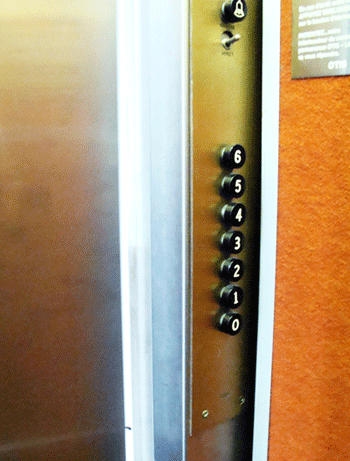
I live on one of Haussman’s boulevards in Paris in an old bourgeoisie building which fits Haussman’s charming “street-wall” façade regulations splendidly.  The ground floor is for storefronts mostly—pharmacies, bakeries, boutiques, and the like—but amidst the storefronts is a large double-door that acts as the entrance to the apartments on the floors above the magasins.  The first floor apartments have proper balconies with iron railing while the following second through fifth floors (in France, the floors start at 0) have similar façades as the first floor, sometimes with, but often without, a balcony or railing of any kind.  The apartment façade is completed by a mansard roof with a 45° angle and dormer windows.

At the end of the hallway from the street-entrance to the apartments is where the concierge lives, and where a lavishly carpeted staircase leads up to the bourgeoisie apartments.  There are two bourgeoisie apartments on each of the first five floors, one on the right of the staircase, and one on the left of the staircase.  These apartments each take up half of the floor and contain several rooms, much like any apartment would.  Whereas in the western United States, one might rent an apartment only until a house can be purchased, a Parisien is a little more like a New Yorker and rents or owns an apartment for the mere sake of living in the city.  And owning an apartment in this part of Paris is what one considers “well-off.”  There is no ill connotation to the word apartment, here.  Furthermore, it’s apparent by the red-carpeted staircase and the extravagant hallways and the red doors of the first-five stories of apartments that you are standing on the doorstep of someone who lives in Paris like one might live in Beverly Hills: no qualms about social status.


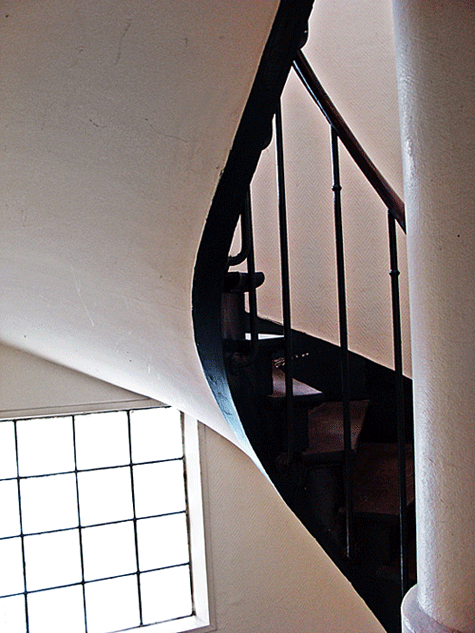
Yes, this is the apartment building where I live.  Only, I don’t take that main staircase to one of those nice bourgeoisie apartments.  Instead, I walk through the small inner courtyard off of the hallway on the ground level, where they keep the trash bins, to a door that leads to the old servant’s staircase: narrow, damp, wooden, dark—no carpet.  The staircase winds up to each floor of the building, leading to servant’s entrances to each apartment, until it comes to two floors of servant’s quarters.


(Rachel, notice apparition.  The team has debunked this as a dust particle.)

I was intrigued by the history of these old staircases before I was struck by their blatant separation of the classes.  After living in Paris for even a short amount of time the mentality one adopts concerning architecture and old buildings changes.  Though the 21st century inhabitant of my building can take an elevator up to the sixth floor and follow the hallway to the servant’s staircase up to the seventh, the elevator is such an unabashed ‘addition’ to the building, one is immediately aware that it exists for the pure sake of convenience than as a statement of social status.  I didn’t realize it until I came to Paris, but that’s what an elevator is in the United States: a sign of social status.  In America, for cultural reasons of our own, the newest and best technology is expected of the rich; but in this bourgeoisie building, the elevator is not efficient, nor is it fast, nor is the building the proud owner of the elevator (assuming buildings can feel pride).  So what one understands, as she uses the elevator every day, is that if Parisien’s could have gotten away without adding an elevator to their old buildings in the latter half of the 20th century, they would have.


As a resident of the seventh floor, I am quite pleased with the advent and addition of the elevator.  It took the maintenance of the elevator for me to understand just how pleased, for without it, all those living on the two upper floors of the building have to take all six or seven flights of stairs up to their floor.  As there is no electricity in the servant’s stairwell, it is impossible to see the steps, the wall, the handrail, or even your own hand—even during the day-time—until you get to the fourth or fifth floor, where seventh-floor skylights and glass blocks affixed into wall afford some light.  In addition, whereas the bourgeoisie staircase grants its climber a steady and gradual ascent to their floor, the servant’s stairwell is steep and too narrow to heft even groceries comfortably.  In my exodus to the seventh floor, I couldn’t help but imagine building maids, leaving their rooms on the seventh floor five minutes before their day began so they could stop outside the servant’s entrance to their employer’s apartment and catch their breath.

Servant's entrance
An American might ask, Why not take the main staircase up to the fifth floor—enjoy the climb, at least—and then take the servant’s staircase the last two levels up?  Our misunderstanding of any sort of class system makes this a fair question, albeit a non-applicable one.  There is no access to the sixth and seventh floors from the main staircase—you must take the servant’s staircase.  Furthermore, there is no secret door or hidden hallway connecting the two staircases.  Here, I get images of some young maid cleaning the steps of the main stairwell on the fifth floor, only to realize she’s forgotten something, have to go down all the steps to ground floor, out to the servants staircase, up all seven flights of stairs to grab what she needs, only to come down seven flights of stairs and up another five to get the job done.

After my own hike up the staircase, I was entirely aware of the class differentiation endured by those living atop the sixth and seventh floors.  And to be honest, the structure of the building ensures that not much has changed.  At best, the elevator was an attempt to equalize the social status of the buildings occupants, particularly in the case of the upper floors.  But even with an elevator which services the sixth floor as well as the first five, the lives of the two types of inhabitants are quite separate.  Much like what one would expect of the bourgeoisie and servants of late 19th century Paris, there is no crossing paths by way of staircase; nowadays the only interaction is the occasional ‘Bonjour’ when exiting the elevator on the ground floor.  No one is treated poorly or looked down on—it is the 21st century—it’s just the way the whole staircase/elevator system works.  But the history of bourgeoisie apartment owners and their servants who once lived above them explains the reason for that system.

While the seventh floor was most certainly the old servant’s quarters, the sixth floor of this building is an anomaly.  The hallway of the sixth and seventh étage is floored by red-clay hexagon tiles, rather than wood or carpet, the walls are textured white, and the doors are painted dark green, the color of Paris’s park benches.  On the first five floors of the building, there are two apartments per floor, each with multiple rooms; on the seventh floor there are sixteen individual doors to sixteen individual apartments.  Given that the seventh and final floor of the building has roofs angled in at 45°, the space for these sixteen apartments proves even smaller than any other floor.  These apartments are mere rooms; even ‘studio apartment’ fails to express their size, for when an American thinks of an old studio apartment, she thinks of Joe Bradley’s quaint living space in Roman Holiday, not an apartment the size of a guest bathroom.  The sixth floor has seven green doors, meaning the apartments are larger than that of the seventh floor, but still significantly smaller than that of the apartments below.  Though the exact capacity of the sixth floor is not formally documented, some old bourgeoisie buildings had one or two upper floors for middle-class families, merchants, or perhaps head-of-staff employees.  Now, the apartments on the sixth floor have been altered to create three larger apartments.

I had my mother ask me about my apartment when I first moved in, which despite my scathing review of their size, I am quite fond of.  I described it to her.  The man, who bought the old chambre de bonne, repainted it, installed a shower, a desk, and a small kitchenette.  I sent her pictures.  I received an email from my sister later in the week with connotations of the belief I was living in squalor, for, “Mom saw no toilet in the pictures.”  I explained that my toilet was across the hall in a separate room, which I had a separate key to.  In other buildings, the toilet is often shared between many tenants of the old servant’s quarters.

My own apartment
The view out of my window

Later, when I met a neighbor who moved in across the hall from me, and I started spending some time in her apartment, my suspicions of each apartment on the floor being owned and renovated separately were confirmed.  While each one of the sixteen green doors used to lead to a separate room, now, many of the rooms have been combined to create appropriate livable square-footage.  I recounted the size and shape of my neighbor’s apartment to my family, and expressed how interesting it was that three of the old chambres were combined to create her apartment.  My family asked several questions about her apartment—Why is her apartment the size of three rooms, and yours the size of one?  Why does she have a toilet, and you have to walk to a separate room?  Why does she have a shower with a curtain, and yours is merely an alcove?—all of which confused me; they were hardly applicable to the interesting fact I had just relayed about the history of the apartments.  Weren’t they more interested in the living conditions of someone living in a room a third of the size of my neighbors?  Weren’t they curious about how the old maids would have kept clean, or used the toilet?  Instead my family was preoccupied with why my neighbor’s apartment was so different from mine.

Then I realized the misconception at work in my family’s questions.  American apartment buildings are typically several stories high, and no matter which level you live on, each floor has the same blueprint.  Furthermore, each individual apartment typically has the same layout.  The structures are built to fit a certain number of apartments which apartments will house a certain number of families which families consist of a certain number of family members.  The person across from you has an apartment with a mirrored layout to yours; the person under you has an apartment with the exact layout as yours.  It wasn’t that they didn’t understand why my neighbor’s apartment was different from mine, they didn’t even fully comprehend the whole system of bourgeoisie apartments: the fact that the lower floor you inhabit, the better-off you are, the fact that the main staircase doesn’t even go to the sixth and seventh floors, the fact that in order to get to the top of the building, you are forced to take the servants entrance.  Hearing I had a studio apartment sounded more like I lived in an apartment complex with several other studio apartments, not that I lived in the top floor of a well-to-do bourgeoisie home where social class was separated by floor levels.


And it runs deeper than that.  It’s not that Americans don’t understand class and social status, in fact, our class system is just as complicated as others’.  It’s that in the United States, the poor, the middle-class and the rich don’t live together in any capacity.  The person living across the hall from you, above you, or below you, is usually at the same economic status as you are.  Even if the person who lives across from you is an immigrant, or if your child goes to a better school than the children of the family living below you, your economic status is accepted as being in the same range.  And when it isn’t anymore, and an American believes that the people moving in around them are of a lower class than they are, they move.  Take Harlem as America’s best-known example: what used to be an area inhabited by the wealthy and old-Dutch families of New York, in the 20th century became a place renowned for crime and poverty.  It’s also true that there are poorer parts of Paris, where the well-off do not live, but the difference is that they never lived there.  The difference is that the French would never consider moving out of the Luxembourg Quarter just because their new neighbors might seem to be of a lower class.  After all, the Luxembourg Quarter is the Luxembourg Quarter.

The American culture of capitalism was another road-block for my family to truly understanding my living situation.  Surely, someone realized the profit to be made from renting the top floor apartments to young students, bought up the entire floor of sixteen rooms, and renovated them to create eight apartments—for there are eight tenants currently living on this floor.  Each of the apartments would be affixed with a kitchenette, and a shower, and use a bathroom down the hall.  The fact that my neighbor’s apartment was different meant that someone made the two apartments noticeably and intentionally inégal.  This makes no sense to an American—and probably wouldn’t make sense to the French either, if the argument were presented that way.  Except this idea of snatching up this real-estate city space, improving it, and renting it out for a profit is an American mindset, not necessarily a French one.  The French might be more likely to think, “They’re just the old servant’s quarters, after all.  Writers, students, and the elderly sometimes rent them because they can’t afford anything else, but the rooms are probably better suited for storage space,”—which is perhaps true. 

But this doesn’t answer the question: If the area is unfit for living, why doesn’t someone gut the whole thing and make it fit for living?  This is, after all, what an American would do to a nice bourgeoisie apartment building like this one, in the middle of a nice area like the Luxembourg Quarter.  The French wouldn’t.  The French wouldn’t gut any building built before 1915—if they’d consider gutting any building at all.  They’ll demolish them, and tear them down, and build up around them.  But they won’t tear out the insides of a building that is just fine the way it is.  Recall my explanation about the elevator; how if the Parisien’s could have gotten away without adding one, they would have.  They are not the proud owner of the contraption, it is just a convenience.  Similarly, gutting out the servant’s quarters to create nicer apartments would be like fixing something that isn’t broken.  Let me also use my own apartment as an example: the apartment may have been wholly renovated to include electrical outlets, a kitchenette, a shower and a heater, but the floor remains the red-clay hexagon tile.

Consider the idea that it’s in the blood of American culture to improve on what isn’t broken and to consider broken what is merely less efficient.  Europeans in general—particularly when dealing with domestic buildings—are not this way.  The British have a saying they use often, “I couldn’t be bothered.”  It’s not a thoughtless, rude or dismissive statement—it is recognition that there are some things there is no reason to doing, like turning the page of  newspaper when there’s still a story on the front page that interests you, or getting up for a chocolate when there are almonds in a bowl beside you.  It’s not that the idea isn’t worth doing, or that there wouldn’t be a point to doing it, or even that doing it is a significant amount of trouble.  It’s just that it works fine the way it is, and no one is really complaining, and individual proprietors are improving the apartments little by little, so why should anyone be bothered?


I lost my audience long before I could accurately explain these cultural differences I find so fascinating: something as simple as a staircase or whether or not an apartment has a toilet is attached not only to history but to mentality—a mentality which runs deep.  Buildings aren’t just about form or function; they aren’t just about changing and being changed.  In fact, it’s a little more than that.  Carl Jung afforded to artists the responsibility of tapping into the collective unconscious and presenting its truths to the world, but it turns out that cultural experience is organized not only by painting or tapestry, but by the very halls we walk in, and the very stairs we climb.  The detailed truths of how we consider the world around us are presented to us by small inefficient elevators, by the remnants of old doors in the hallway, and by whether or not we would gut our seventh-floor servant’s quarters for a profit.  The very fact that an American would do something so differently than it has been done here is proof that our histories have a place in our cultures, that our cultures have a place in our mentality, and that our mentality shapes the world we inhabit.

Wednesday, May 30, 2012

On the Street Where I Live


Vic Damone – On The Street Where You Live

Voici une carte.  Drawn by yours truly.  This is where I live, the streets I most often frequent, the places I most often go, and a few landmarks to help you place it all.  (All pictures taken by me.  I suppose that'll be rather obvious and you'll ask me to return to my google searched images.)

1. Boulevard Raspail - The Street Where I Live.  I couldn't help but think of the song, so I decided to link a version of it to all of you.  Surprisingly, I have not been up and down this street much further than what is drawn here.  I must put that on my to-do list.  But it is a nice street.

2. Jardin du Luxembourg - Left out of my door, Left on Rue Sainte-Beuve, Right on Notre-Dame-des-Champs, Left on Vavin and tout droit until the garden.  I spent at least an hour here every day, writing, watching, giving myself an excuse to leave the apartment.  I usually sit in the sun down by the "lake" or up in the shade where the little #2 is.


3. Boulangerie - Here is where the boulangerie I frequent is.  I have officially been going there long enough to have been given a warm baguette yesterday.  Hurrah for me.

4. Monoprix - This is the grocery store I most often go to, to get the essentials.

5. St.-Michel - Boulevard St.-Michel is one of the roads I use most often to get to the other side of the Seine.  I've since been looking for other ways to get there, however, because there are so many people on this street and at least 70% of them smoke.  I love walking this street at 9am on a Sunday morning.  Empty and beautiful.

6. Boulevard St.-Germain - An important boulevard in Paris, but also for my time here.

7. Hotel de Cluny - On St.-Germain is the Hotel de Cluny where the Musée du Moyan Age and the jardin l'agrément médiévale (Medieval Pleasure Garden) is.  Despite how sinful this garden sounds--there is a history that lessens the sound of scandal and I reserve judgement until the hereafter when I learn more about who used them and why--it is a beautiful and well-kept space.


8. Cinéma - Also on St.-Germain are several cinema's, which I go to...to see movies.  Does this really surprise you?

9. St. Sulpice - Included on the map is rue Bonaparte which runs straight through to St. Sulpice and St.-Germain-des-Prés.  St.-Sulpice may be my favorite church in Paris, though don't hold me to the decision until I've seen them all.  This is the one I most often come back to, to sit, write, and attend concerts/mass.


10. Village Voice - At the behest of rem who informed me about this gem of a bookshop, I have gone to Village Voice several times as my go-to for books in English.  I plan to make another trip today.  It's just off Rue du Four, a medieval road off of St.-Germain.

11. St.-Germain-des-Prés - The oldest church in Paris written about in a prior blogpost.

12. franprix - I consider this larger franprix a reward for aimless wandering, as I decided to go down rue Mazarin one day instead of a street I was already familiar with.  It has a larger selection of fresh produce.  I buy fruit here.  Mangoes.  Strawberries.  Wonderful, wonderful things.

13. 56 rue du Jacob - More on this later, when I write about American Paris.  This is the site of where the treaty for American Independence was signed with Britain by Benjamin Franklin.

14. Crepes - Here on St.-Germain is where my favorite crepes are made.  Also, they are cheapest here.

15. Notre-Dame - On Ile-de-la-Cité.  I walk past Notre-Dame on my way to church on Sundays.  I love walking by and sitting in this area because of the sheer number and diversity of people who come every day.   Good memories here.

16. Pont Neuf - "New Bridge," named because it was the newest bridge at the time it was built.  It is now the longest standing bridge connecting the "Right" and "Left" rivers.  Made of stone, the older medieval bridges were made of wood and had houses built into them.

17. Hotel de Ville - I walk past Hotel de Ville to get to church.  It's the "City Hall" of Paris.


18. l'Église de Jésus-Christ des Saints des Derniers Jours - Where I go to church.  Down Hotel de Ville, down rue du Temple, Left on St. Merri, #12, you're there.

19. Louvre - Because I know you've been wondering where it is in relation to everything, and its surprisingly close.  There are several museums here, including the well-known Musée du Louvre.  Also here is the Musée Art Decoratifs where you are not allowed to take pictures.  But I snapped one--as a gift to Rachel.  Pending.  Also behind the Louvre is the Jardin Tuileries.


20. Place de la Concorde - More about this place later when I write about the Revolution.  But it's the largest open area in Paris, I believe, and right in the middle of it.  If you walk down through the Tuileries Garden, and past Place de la Concorde you find the Avenue Champs-Elysées and eventually the Arc de Triomphe.


--

Some tidbits (things I've noticed, rules--or lack thereof--of spaces, how areas are used, etc.)
1. Most streets in Paris are one-way.  This is usually because most streets are too narrow to be two-way.
2. Pedestrians in Paris are--by far--the most inconsiderate pedestrians in existence.  Blame it on tourists, if you like, but I really don't think they're the ones to blame.
3. Large open areas unused by cars are always used for football (soccer) by children, teenagers or young men.
4. It is not strictly kosher to eat while walking.  However, there is enough sitting space throughout the entire of Paris for you not to have to walk too long before you can sit down and eat.  Among those who are sitting, there are always several eating.
5. Using two chairs at the Garden of Luxembourg is expected.  One for you and one for your feet.  This is not considered rude, no matter how crowded the garden is.
6. The gypsies who say they are deaf and mute are not deaf or mute.  Charitable donations are expected to be at a minimum 25 euros.  My happiness is showing, I'm sure.
7. There is no such thing as jaywalking in Paris.  You may walk wherever you like, whenever you like so long as there are no cars/bikes/scooters coming your way.
8. You have fifteen to twenty seconds after the crosswalk tells you to stop crossing before cars get a green light.
9. You are expected to frequent a boulangerie.  They do eventually recognize you, and they treat you better for it.  Tried and true.
10. Parisians frequently walk around the city listening to music on their iPods.  I know you think this doesn't surprise you because in theory it doesn't surprise me either.  But in practice, it is a bit strange.
11. There are no large one-stop shops anywhere in Paris.  Nothing like malls with department stores, nothing like Target.  There are areas like the Promenade in Santa Monica--outdoor malls, so to speak.  But I have not found anything like a Macy's or a JC Penneys.  There are a lot of little boutiques for clothing instead, most of them seemingly specializing in shoes.
12. 'Bonsoir' is for after about 5pm and they really do say 'Au revoir' after every transaction.  Reciprocation is, I think, appreciated.
13. There are no rules about which side of the sidewalk to take when coming head to head with other pedestrians.  Anglo's are more aware of pedestrian patterns than others (which I judge purely off of who is speaking what languages) and will move off to the side so others can get by or will made enough room on sidewalks for two-way foot-travel.
14. Men are allowed to call you out on how you look.  Or at least say, "Ah, Mademoiselle."  They usually expect a smile, and not much else. (To date, anyway.)
15. No one minds if you stand in front of a menu or a choice of grocery items for a long time to make a decision.  Are the French indecisive?  I don't know, but they don't mind taking their time making a choice.
16.  Sun bathing is still a "thing."  Old men do it in French gardens.  They remind me of the body-builders on Venice beach.
17. The gendarmerie are the best-looking group of men in Paris.  Also, harmless.  Smiling at them will not wind you up with a $132 ticket.  (Though, I wouldn't really put the harmless comment to the test, particularly when they're on the job, because some of them are also the largest men in Paris.)  They stand outside of important government buildings, on streets during demonstrations and political rallies, on many of the bridges in groups of twos or threes, and occasionally direct traffic.
18. Tickets for film showings sell ten minutes before the film starts.  If it starts at 10:40am, they sell tickets at 10:30am.  If its the first show of the day, the cinéma does not open until 10:32am.  Yes.
19. The consumer/client is not God in France like they are in the US.  If it's inconvenient for you that your grocery story closes early, opens late, or is closed for entire days at a time, too bad.  Deal with it.  Stop by when they are open, or memorize their schedule, or stop expecting to eat what and when you want.  Be flexible.
20. Old women and middle-aged men are the most likely to let you practice your French.  True.

Monday, May 21, 2012

Noticing the Culture of Paris: Consumption


Being eco-friendly is important to the French from their toilet paper to their café menus.  Now you think I’m talking about the paper the makes the menu itself, but I’m not.  I’m talking about the food offered on the menu.  But let me start with toilet paper.  Toilet paper, cleaning products, hygiene products—all the things you can buy, use and then throw away, are and advertise themselves as being earth-healthy and safe.  I thought this meant they were ahead of the curve.  It turns out, yes, by a couple hundred years.  It’s not that France knows we need to save the earth and so they are creating earth-safe products—no.  This is the way the French have always lived, and earth-safe products just kind of make sense.

Let me tell you another detail.  I was having un chocolat with my landlady over two hours of conversation and she asked me about my living arrangements and how it was all working out for me.  So I told her all the great things and then mentioned the sauté man in my apartment.  “The sauté pan I’m having a difficult time with, I told her.  It has a waffle pattern on the bottom, I have no idea what kind of pan it is or what it’s used for.”  (I doubt if she’s seen the particular pan in question, and I’m sure a pan that would work better for me exists, but her choice of response was that her husband was very conscious of health risks and so rest-assured all the pots and pans were healthy to cook with.  “He doesn’t even like me painting my fingernails, he says, ‘That is TOXIC!  Why are you putting it on your body!?’” and she laughed.  This idea was so interesting to me I abandoned my plea for a legitimate sauté pan to follow it.  Apparently it’s his line of work in some way or another, though I wasn’t sure if she meant this literally or as a serious interest, “it’s what he does,” kind of thing.  Olivier is a through-and-through Parisian, she followed up with.  This is one example of a health conscious mindset that I am surprised by, not because it seems odd, but because for this woman at least, it was attached to being a Parisian.

I’m not going to even try to explain (for clarity’s sake: because I can’t) the obvious hypocrisy of cigarette smoking in Paris, especially among the young, but let’s go to food because if anything could offset the smoking, it’s eating.  Its not the way Parisians eat, but what they eat that’s particularly life-saving.

Q. How is it that French food is characterized by butter and they’re not all grossly fat?
A. Yes, it is.  But no, it’s not.  Also, yes it is, but it’s FRENCH butter, from FRENCH milk, from FRENCH cows.  It’s fresh.  It’s local—as in within France, if not the area surrounding Paris.  Regarding the “no, it’s not” of the statement above: It’s an ingredient.  And if they were eating 12 croissants a day like a tourist they might be fat, but given they eat consciously and sparingly, they are not fat.

A. The main ingredient of French cuisine is “fresh.”  I mentioned French butter from French milk from French cows.  Now pair that with French bread from French grains.  French in-season fruit.  French in-season vegetables.  French meat—fresh meat.  Most ingredients for cooking food in fromageries, boucharies, boulongeries were never frozen, they are never shipped from another country, let alone another continent.  They were most likely baked that day, or cut that day, or in the case of cheese, are portioned and categorized down to the day or hour you want that cheese to taste best.

Then the Parisians go on a run.

Healthy.  Absolutely nutrient-rich food.  There are certain markets in Paris (in France) where you do none of the selecting of food.  You go up to the vendor and you tell them what you’re eating and when, and THEY pick the perfect mango for tomorrow morning.  They’re in touch with their trade, and proud fo it.  I’m not sure if you can find this everywhere, but I know it can be found, and it’s a good rule of consumption: fresh, healthy, and perfectly timed.


Friday, May 18, 2012

Noticing the Culture of Paris: Waste


Depending on the part of Paris you’re in, Paris is a very clean or surprisingly dirty city.  The average Parisian—non-immigrant—is concerned with eco-friendly products and good recycling habits.  In immigrant laden areas of Paris, this is not always the case, though still is for some.  Regardless, there are trash recepticals everywhere throughout Paris, and one sees trashmen going about to collect this trash on a daily basis.  The center of Paris is usually very clean and it’s nearly impossible to find trash on the ground, though one my find the occasional box filled with empty wine bottles from the night before, if walking around in the early morning hours.  However, cigarette butts are not trash.  One cannot regard them as garbage.  Given this, cigarette butts line Paris in an astonishing way.  In any given square foot there are 1-15 cigarette butts in places near where people can sit or street curbs.

Their trash men are not “underlings” of French society the way they are in the United States—service jobs where you do your job unseen.  In fact, they talk to and joke with people on the street as they pass by picking up full trash bags and replacing them with new bags.  People have conversations with them and they do their job well.  Despite relative cleanliness of the inner-city and the well-doing trashmen, France is not afraid of trash and not afraid to admit trash/rubbish exists.  Today I walked out onto my street—a nice street in the 6th arrondisement—to see two LARGE mounds of trash in the middle of the street.  Perhaps the truck broke down, perhaps that’s how they collect trash (I’ll watch out for this again) but no one seemed in a rush to move the trash, and people walked past it without the slightest worry.  It was being taken care of, I imagine.—This is not something you would ever see on an important, well-to-do street in the United States.  Someone would have complained the second it happened, someone would be scrambling to get it off the street and out of the area, someone would be fired.  In Paris, it was life as usual, only a giant mound of trash was accompanying it.