Pages

Wednesday, June 20, 2012

Medieval Garden piece


In the center of one of Paris’s busiest quarters—the Latin Quarter, near Boulevard St.-Michel and the Sorbonne—is the Musée National du Moyen Age and Hotel de Cluny.  This area is so busy, in fact, that one can only be alone on the intersection of St.-Michel and St.-Germain, where the museum is located, early on a Sunday morning, before Paris has awoken.  The museum is an important one for France, and also for the sharing of medieval history; inside are the famous La Dame à la licorne (The Lady and the Unicorn) medieval tapestries, numerous religious sculptures, illuminated manuscripts, and an uncovering of the site’s history back to its Roman founders.  Less celebrated, however, is a garden, which adjoins the museum, modeled after what little is known about gardens of the medieval ages.  Although open to the public, it, unlike its surrounding area, is rarely busy; there is always a place to sit.


If you know about the history of gardens, then you know that the gardens of the medieval ages were slight and humble compared to later royal gardens like those of Versailles or Luxembourg. Neither were they wild and expansive, like the now-protected Bois de Boulogne—the remnants of the old forest that spanned western Paris up to Normandy.  Instead, medieval gardens were small and manicured. Most were for growing food, but the rich kept “pleasure gardens,” specifically for the pleasure of the senses, which grew flowers and herbs.  These gardens’ various uses were usually sectioned, included seating, and sometimes—if large enough—areas for musicians or entertainment.

The park adjoining the Hotel de Cluny is separated from the busy streets of the quarter by fences and surrounded by trees, not dissimilar from most other Parisian parks.  It has a lookout area where park-visitors can see the old ruins of the Roman thermes—or baths—and another area with sand and “jungle gyms” for children to play.  This park along-side the garden is always open to the public and usually populated.  Further secluded behind a wooden enclosure or gate are le préau and la terrasse, the two areas of the park created by the museum most closely modeled after what little is known of medieval gardens.  Though its hours are regulated by the museum, it is usually open to the public.  The wooden enclosure around the garden gives less of a sense of further barrier or separation from the street and instead confirms intimacy and quiet thereby retaining its instructive quality as part of the Musée du Moyen Age.

There are two entrances to le préau and la terrasse: one through the park by way of the children’s play area and up a wooden ramp, and the other I quite prefer, by way of a small cobble-stone walk separated from but alongside Rue de Cluny.  The walk’s pragmatic utility is slight: it only gives entrance to le jardin or gives exit onto Rue du Sommerard.  Unless one is using the walk to get to the garden, it serves no purpose different from Rue de Cluny.  If used as an entrance to the garden, however, it is particularly effective in preparing the visitor for their experience of the garden.

The narrow walk has a Secret Garden spell to it: the trees and plants which line the walkway and its surrounding fence muffle the city sounds, or else the visitor intentionally forgets them.  Birds live in this area of green—not just pigeons, but sparrows, and robins and songbirds—they live throughout Paris’s gardens, however hard to believe.  The area is shaded; it’s secluded.  And all of these things make nature more important than the city—not unbridled, sprawling nature—but the kind of nature placed, grown and cared for by human hands.

Though the view of the pleasance garden and the terrace are far more man-made than that of the walkway, the walkway is only a preparatory step to transporting you into an older time.  Before you walk up the steps to the wooden walkway of the garden, you see the Hotel de Cluny, a seamless blend of Gothic and Renaissance architecture bursting with medieval acknowledgment.  A townhouse in Paris for the abbots of Cluny, the building was later owned by several other religious figures, an astronomer, the Revolutionary state, and Alexandre du Sommerard, an art collector.  It was finally purchased by the state and converted into a museum, which it has remained for 170 years.

As you ascend the steps, in front of you is le préau or, the pleasance.  This is a garden of various flowers and grasses surrounded by clear baths of water.  This area most closely resembles what one might expect from a pleasure garden, while off to the right sits the terrace, “evoking the domestic nature and diverse facets of a medieval garden” (translation my own, www.musee-moyanage.fr).    Every aspect of the garden has a meaning or dedication.  A ménagier aligns and separates the different potted areas: basic medicinal herbs are planted in one, vegetables in another.  One potted area contains only flowers which symbolize the Virgin; a sunken path and its surrounding flowers are dedicated to the ancient Sainte-Geneviève, patron saint to Paris; another flower bed evokes l’amour courtois—courtly love—the expression of which, so the stories and poetry say, gave pleasure gardens their utility.  No area of the garden goes without purpose: pleasing to the senses, useful for survival, or in memory of beloved religious figures—all important and vital aspects to medieval life in France.  For a moment, it feels you might exist alongside an older realm.


It is curious to me, why, then, erected in the center of le préau, is a shiny, metal, modern-art installment, impossible not to be seen from anywhere in the garden.  Spanning half of le préau are several narrow strips of shiny metal, bent into elegant and clean swirls and lined up beside each other.  It isn’t that the installment in and of itself is something laughable, but that it so obviously out of place.  It is not a stone sculpture of a saint, neither is it a recognized commemorative art piece.  These obtrusive sheets of bent metal disturb one of the few places in Paris that has the potential to be somewhere truly apart and outside of modernity.  It is not the unfulfilled desire for such a place, but the sheer attainability of the space to have that unique charm which makes the breaking of that charm so disappointing.

Yes, there are children in sneakers and backpacks traipsing down the wooden walks after their teachers who are explaining about the vegetable garden.  And yes, the man sitting across from me in the park is rolling and lighting a cigarette; we’re eating lunch out of plastic bags; we’re texting on cellphones, we’re changing the song on our iPods.  Each visitor is aware we’re living in the 21st century, but apart from the people themselves, there is very little to indicate that within the garden, or amongst the trees, or beside the stone building—except those ill-fitted pieces of metal.  The garden itself is an edifice dedicated to a different time, place, and people.  There is no need for a commemoration inside of a commemoration; there is no need for a reminder of modernity; there is no need to apologize that the garden was a creation of the 21st century instead of the 14th.

With the dedication and study put into the gardens creation as a place inspired by medieval places of beauty, why not hold the illusion?  Let garden visitors believe for a moment, even in the busiest quarter of Paris, that experiencing a space the way it might have been experienced by that different time, place, and people, is possible.

Wednesday, June 13, 2012

23 in Paris

I just got home.  As I was walking home it began to rain, and when I got in, I saw a package on the doorstep.  This was the one Mom told me about.  Have I told you how much I love getting packages?

It started pouring outside as I came in and I opened the envelope and carefully pulled out two parcels wrapped in brightly-colored tissue paper, which of course only reminds me of the boxes in Mom’s room filled with Christmas and Birthday wrapping papers and tissues.  And that reminds me of the time I pulled a box out onto my head one Christmas and Caitlin was laughing so hard she still bursts into fits of laughter every Christmas.

The CDs and the card fell out separately, so I carefully opened each letter and read them.  Caitlin’s came first, and I kept thinking how much it looked like I was reading my own writing.  Apart from a few letter differences, she’s practically got the same penmanship!  I had a good laugh at the picture of the grizzly bear.  Rachel’s came next—I was Loki’d.  But are you surprised?  Thank you, Caitlin and Rachel, for your letters.  They were similar in some ways, and individual in others.  But I want to tell you how much it means to me, and how much your approval keeps me going.  I hope you both do the greatest of things with your lives, and I can only hope that someday I can get a smidgen of the credit for helping you believe you could.  I opened Mom’s and Dad’s next.  Both of your letters had a thing or two in them that I really needed to hear; just the right amount of encouragement and pride.  I hope you know that even though you’ve never asked for me to make you proud, that’s all I ever try to do.  Thank you for those letters, family.  You are truly exactly what I need in life; I hope I do the same for you sometimes, at least.

I’m listening to The Lumineers, and it’s thundering—really thundering—loud and long.  It’s still bright outside, but flashes of lightning come into the apartment, and it pours.  God has blessed me for keeping my half of the promise.

It’s funny, I was thinking the other day that I should have brought more sleep-shirts, because I only brought two and (as you all know) I spend more time in my pajamas than I do in regular clothing!  So when I opened the parcel with the blue Idyllwild t-shirt, I laughed at how perfect it was.  I stripped off my wet clothing and put it on right then and there.  It smells of some herb that I can’t place.  The large t-shirts that I inherited from Mom and Dad for sleep shirts are among my favorite comfort clothes, and I didn’t bring any with me.  It’d odd what kind of things you regret not bringing when you leave the country.

The second shirt is perfect, also.  I love it.  I’m always wishing I had more casual shirts that aren’t t-shirt in style.  And as I’m getting my childhood tan back from wandering these streets, yellow was the perfect color.

Thank you for the package.

Let me tell you about my Birthday.


Naomi, my neighbor across the hall, and I watched Guys and Dolls together, as she had never seen it.  She found out my birthday was on Saturday and offered to spend the day with me.  Later in the week she suggested Versailles.  I've been meaning to go but haven't wanted to go alone.  I thought it was a great idea. On Friday, I met up with Brigitte, a girl I knew in one of my French classes, and a friend of hers.  She found out I was going to Versailles and decided to tag along.

Saturday morning, I met Naomi in the hallway and Brigitte down by the Metro stop.  We took the Metro to Musee d'Orsay RER station and bought tickets to Versailles and back.

It took a while to get through the line to buy tickets, but once we did we decided to go to the gardens first, as we were uncertain how long it'd be nice out.  (June gloom takes place in Paris, also.)  Also, the last time I came to Versailles I didn't go into the extensive gardens, so it was a new experience for me, and I quite enjoyed it.


I also missed Marie Antoinette's small "Hameau" when I came to Versailles in 2009.  It was quite a ways a way but Brigitte, Naomi and I all decided we wanted to see it.  We followed the map to where it said the Hameau was (hamlet) but the gate was locked, so we had to go around.  I daresay, it was the "scenic tour" as we always say.


 And we did get there eventually.


Marie Antoinette would often come to the little home away from Versailles to get away from customs and guests.  She would only invite close friends to visit with her here, opposed to people with high rank, which greatly upset the upper classes of France at the time.  While here with friends, she would often wander the house and gardens in her chemise--her white underdress, rather than wearing the big, heavy, hot and extensive fashionable dresses all the time.  As she was with friends, I don't think anyone minded but those who weren't invited.  It made her quite revolutionary for her time, which many didn't like, but somehow makes me like her even more.  She valued people for their friendship to her, rather than for their place in society, and freely showed how she felt.


We next resigned ourselves to waiting in the enormous line to get into the palace and walked all the way back to it from the Hameau.

Brigitte - Me - Naomi


It was quite a walk, and Brigitte was pretty tired, so when we got into the palace after the long wait in line, she told us she was going to go through at her own pace and then get back tot he city.  Naomi and I still planned on going back out to the gardens to see the fountains turn on (they're on at only certain times of the day), so we said our goodbyes and continued through.

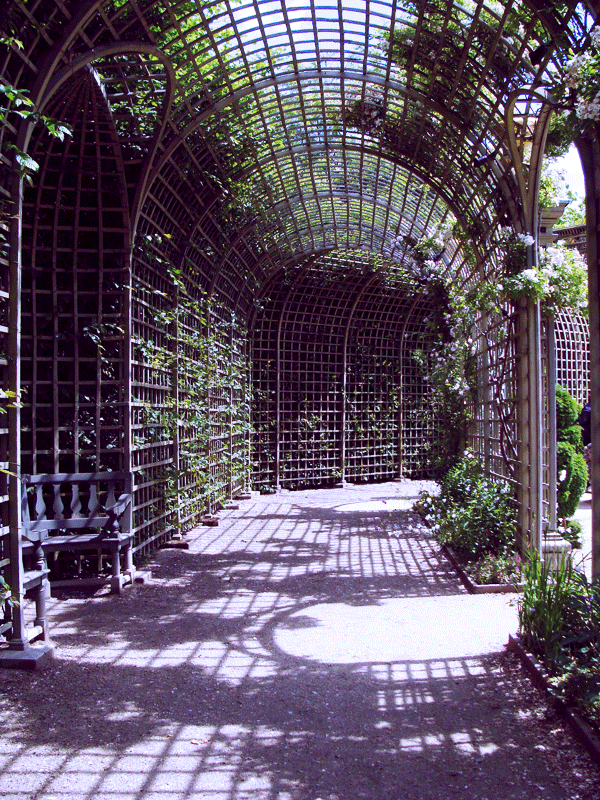
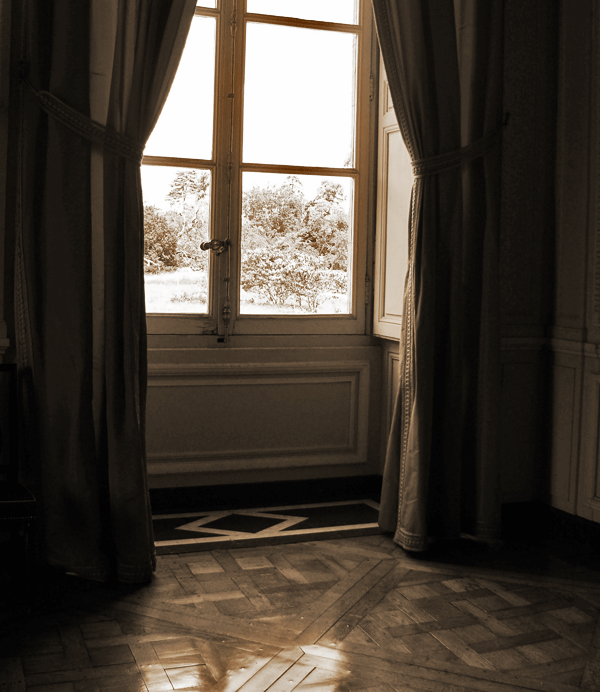
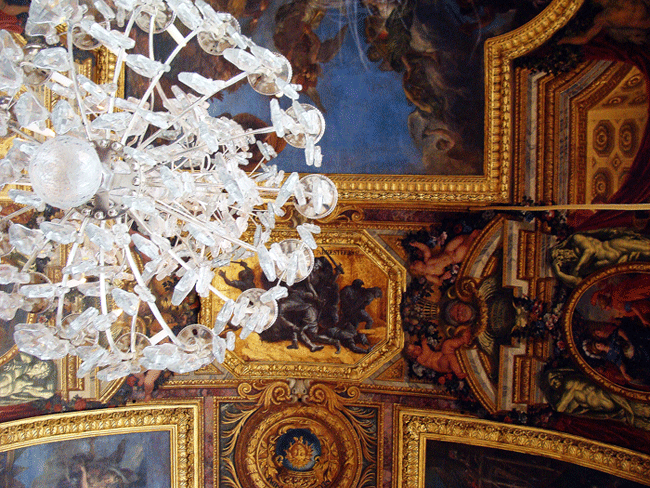
Now I've been through the palace before and have some good pictures of it, because it was markedly less busy the day I first went than it was on my birthday this trip, so I'm including below only some details which I really appreciated this time around.  I know you've never seen my Versailles pictures--I've hardly even seen them--but that's how it'll have to be.  (There are a lot here anyway, so don't fret.)  In no particular order--and I can't remember the order of the rooms.  Here are some interior shots.


The grandeur gets me.  Also, this is the door Marie Antoinette ran out of when she heard the people of Paris were coming to take she and the King back to Paris from Versailles.


Oddly enough, this is one of my favorite paintings ever.  Well this picture here is just a small part of the painting.  It's a huge painting.  It's the coronation of Josephine, wife of Napoleon.  This is the original.  There is a copy in London.


Remember me telling you I like the ceilings and the floors of places?  People forget to look up in most places.  It would be a real shame if you forgot to look up in Versailles.  They also forget to look down at the floor.  I like to look at the floor because no one ever thinks of it, and therefore it is the one part of many buildings that goes untouched or unchanged.  You are often stepping on the very same stones/marble/wood that were laid down or installed at the building of the original building.  And I find that fascinating.  So, here are too many pictures of the ceilings and the floors at Versailles.


At the Hameau.


Naomi humoring me in the last two photos.


After we walked through the palace, Naomi and I returned to the gardens with some hot chocolate and walked through a little bit more before the fountains turned on.  This is where I found my favorite fountain.


There was a 'spectacle' supposed to happen at the big fountain in the North gardens, so we walked there and got a seat on a green piece of grass.  It turns out that it was just music playing as they turned the fountain on.  Naomi and I had a good laugh about that.


We took our time getting back to the RER station, and walked around a bit in Versailles, a lovely little town.  Versailles looks like the child of Paris and a small coastal California town like Carmel-by-the-Sea.  No joke.  It's beautiful, a bit quaint, and does have a bit of a ocean-side feel to it.

Naomi and I returned to Paris.  We had Italian for dinner--as is only right on my birthday and then saw Salmon Fishing in the Yemen which is called "Les Saumons dans le desert" here -- Salmon in the Desert.  A bit more poetic in English, if I do say so myself.

It was a good birthday.  And I'm back on track with my outings since turning 23.  Thank you, family, for your support.  I love you, and appreciate your messages and the package.  It was just what I needed.

Also, Mom & Dad gave me $75 for my birthday.  That's about 60 euros.  I spent 18 on dinner at that Italian restaurant.  The rest I spent on a creperie--a crepe pan which I am most certainly packing to bring home with me.  A french measuring cup, so now I can bake with grams without issue.  And a book of photography by Eugene Atget which should come in the mail soon.  I will write more about Atget soon, it's quite a story, and he's been one of my favorite photographers for years.  It'll be a surprise.  Thank you for the gifts, its been a lovely birthday, and I wish all of you were here to celebrate with me.