I loved the ideas presented in this reading by Rachel Remen, the difference between helping, fixing, and serving. To merely "help" someone is to see them as weak, when you try to "fix" something you see someone as broken, but when you "serve" you see them as whole, and deserving of strengthening, or I'd like to add, see yourself as deserving of strengthening, which is why you spend the time to serve at all.
But sometimes people aren't strong, and sometimes they are broken, and so what do you do then? I'm thinking of times in my life when I was most certainly in need of healing, and usually no one came around to help me with the process. If we're talking about a Field Study, I'm aware of the point this reading is trying to make, and I'm aware that it isn't our place to assume that we are the ones who can strengthen, or "fix" others. I think that's a good assumption to make because to see something in need of fixing is to see something broken, and many an unbroken cultures have been "fixed" to their and the worlds' detriment. I don't even begin to think that the relationships I will have with people in the Field will be of any great benefit to them.
But, to me, I think there is great potential.
I think every being is in great need of healing. Nothing particularly traumatic has ever happened to me, but I live in trauma every day. I've been profoundly hurt. I've been left bleeding, figuratively speaking. And I don't think it's wrong for someone to see me bleeding and come to help me along as the wound heals. Or, in that case, when we see a wrong being done to someone, our own beliefs should never get in the way. How many times has someone been hurting me, and someone could have said something, stood up for me, helped, but they didn't, afraid it would offend, afraid it would be misconstrued, afraid of being hurt themselves. That's fair. But fear should never get in the way of doing right. This reminds me of a scripture, Hebrews 2:15 saying that Christ would come "and deliver them who through fear of death were all their lifetime subject to bondage."
This scripture, the first time I consciously read it, screamed at me "The Holocaust." It was the 20th century when this evil happened, when this profound lack of humanity took place. The Holocaust. But people were so afraid of death that they were "all their lifetime subject to bondage" which really probably isn't too much better than death. I can't say that death is better than bondage because I don't think that's necessarily true. I think it depends on the death, it depends on the bondage, it depends on the person, and it depends on the hope at the end of the road. But I do think that we can't let fear, no matter how small a matter, bind us to silence while others suffer, no matter how small we perceive the suffering.
For this reason, I think our presence can heal people we don't know are hurt or in need of healing. What I mean to say, is that we can make a profound difference in the lives of individuals, like Remen mentioned about the woman to treated her as a human being, who spent time on her, rather than treating her like a patient. I think if we operate under the assumption that no one needs to be fixed, or aided out of weakness or brokenness, but instead assume that everyone is deserving of our respect, our time, and our care, we are "serving" and maybe doing a little healing at the same time.
In tenth grade I had a close friend hurt me rather badly. She didn't stay around to watch the hurt, and certainly didn't stick around to try to mend the hurt. But that year I met someone who probably didn't notice I was hurting, but spent time on me, treated me as whole, and through him I became whole again. He has always treated me that way, as a whole person, even when he himself has hurt me. This can be damaging sometimes, for someone who cuts into you without noticing and then treats you as if you are unhurt, but the point of the matter is that because he treats me as whole, I know I will be again, someday. And that's why I don't think that helping, fixing and serving are wholly separate. I think they are all one thing but three ways of going about doing it and only one of them can be done with humility.
Having said all this, however, I understand the point being made, and I emphatically agree that we need the point to get through to our heart. I like what Remen says about service, that when we "help" it is our strength that helps anothers' weakness. But when we "serve" it is our limitations, our wounds, and our darkness' which we draw on to be of comfort and to help us understand the people around us.
Showing posts with label superiority complex. Show all posts
Showing posts with label superiority complex. Show all posts
Saturday, March 3, 2012

Saturday, February 25, 2012
When you're talking to yourself, who are you talking to?
I want to talk about my father. Not for any particular reason, I suppose, just who he is.
My father was born in Washington State, of New England stock, the fourth--and last--child of Richard and Marjorie Plaisted, who are individually their own stories. From his mother, my father inherited abounding generosity, or at least I imagine it was from his mother because that is mostly what I remember about her. From her he inherited a love of mystery, a love of movies, a love of reading, a love of cooking. From his father I imagine he inherited a stoic and admirable work ethic which dictates that his family always comes first. I remember little of my grandfather, but this I imagine to be true above all else.
I think I am more like my father than I am my mother, which it took a long time for me to figure out. I think perhaps I have more of him in me. Not necessarily his good qualities, though if I can live up to those some day, I most certainly will, but a lot of his interests, a lot of his tendencies, a lot of his ideas. My father got me hooked on hauntings, on mysteries that can never be solved--I always imagine his favorite is Stonehenge. Because of my father I sit through the credits of every movie. I love cities. I love art and museums. I don't like camping. I write. And I don't think these are things I necessarily chose. In some ways I think they were born into me. Because I never thought, "I want to be like him, so I will do A. B. and C." I never thought that at all. I'm just becoming who I am, and that happens to be a whole lot like him.
My mother would probably disagree with me, but I can't recall either of my parents ever telling me I was beautiful. My father doesn't say things like this. My mother said once, "How did I get three such beautiful girls?" I nearly cried for thinking that maybe she really did think I was beautiful. But on two occasions my father has said to me in public and in private that he thinks I look like his mother. I have never heard him say that he thinks his mother was beautiful, but it's in his voice that he thinks she was one of the best women that ever existed. I think he knows I think that too. So when someone said to my father in public, "Your daughters all look like your wife," which was most certainly meant as a compliment because my mother is beautiful, he said, "Well, I think Jennifer looks more like my mother." And though I do think my mother and I looked quite similar at certain points in our lives, this comment wasn't just observational, but meant something more, it meant he thought I was beautiful. Funnily enough, I think if he'd said, "Yes, I think my daughters do look like Paula," I would have interpreted it the same way--that he thought we were beautiful. It was the comment he made on my looks at all that made me think--maybe he really does think this about me.
I want to tell you something else about my father. He learned French when he was in grade school, which he attended in New England. He also, I believe, took French classes in High School. He never spoke french, except for every once and a while we'd ask him to recite some french literature he'd memorized as a kid, which he did gladly. When I decided I'd be taking French, he started saying things to me like 'Allons-y' when he wanted us to leave the church building after church. Or 'Je ne sais pas' (said: J'une say pah) when he didn't have an answer to things. When I'd try to say things in a french accent, he'd correct me. He'd say words over and over and over again until I heard the difference between the way I was saying it and the way it was mean to be pronounced. The word 'beouf' (beef) comes to mind. When I came back from my first few semester of taking french, my father started buying French films. Oh, dozens of them! When he'd never owned a french film before. He spoke to me in french when I came back for breaks, and he watched french films with me in the evenings when everyone else was out of the house. He'd done this before, when I started listening to Frank Sinatra, he suddenly bought a hundred Sinatra albums he didn't own before, which he still buys and listens to, and gives to me when I come home so I can load them onto my computer. No one else in my family has ever done that for me and I don't ask it of them, but he did it on his own, and that's something that still impresses me.
Now, why is beauty so important? Why is sharing collective interests so important? Or why is what we say and how we say it so important? I feel something I've been fighting against in this class is this idea that other cultures are so different from ours. And I keep screaming from the rooftops, "Ours isn't so easy to figure out either!" and I just need someone to say, "Yes, you're right." I guess what I'm saying is, I'm not sure if I believe in hegemony. Because I think about my family and how many different types of people I've had to learn how to communicate with--people who consider themselves American through-and-through, who have put me through the wringer! I mean, how often have you tried conversing with a New Englander? It's freaking hard! But I grew up around that, and there are ways my father communicates that remind me of Hemingway's iceberg (so I call it--where he discusses in his writing that only the bare essentials need to be said to get across a larger meaning) and I find more comfort in one word from my father than I do in twenty sentences from a friend across the hall. Because I understand what he means, and who he is, and what he's saying.
My mother's communication is not so easy for me to navigate, and yet I've been living with her for just as long, and have been communicating with her effectively for longer. But as I change, and as my culture changes, she and I have a harder time understanding one another. Well what does that mean? For me, it means culture changes. It means that we can't go in to another culture thinking that "These people are French so they will act this way, this way and that way." No. Because if someone said, "Oh, Jennifer is American, which means she think this, this and that," chances are they'd be dead wrong about me. Because they're communicating with someone who has created their own culture, who comes from two cultures that are worlds apart even if both American.
But, something I find great interest in is the ideas of values. I think you can make more general blanket statements about cultural values. As an American, I am bound to value certain things. It doesn't mean that other cultures don't value those same things, but that there are some I can pick out for certain. If the French value eloquence, and grandeur, and family then I can safely say that as an American I value independence, individuality and simple pragmatism. The interesting thing about values is that one need not embody the values they hold dear. Not every American is pragmatic, just like not ever Frenchman is eloquent, however we sometimes value things we do not embody ourselves. And this is an extremely interesting idea to me.
My father is not a particularly mysterious man. But he values the unexplained and the uncertainties of life and of other people. Furthermore if we talk about politics in the house, he's rarely in favor of propositions that will make him pay more in taxes--he believes in independence, he believes in sustainability--and I think he believes others should be able to support themselves. And yet I know no one more generous than my father. Without me perhaps my father would have never bought those french films, and we'd be 24 french films poorer in the Playstead household, but my father seems to value shared experiences. And though my father values the time he spends on his own, no one else in the family thinks of as many things as he does for things we can do together. Watching movies, going to plays, driving up the coast for the weekend, seeing museum exhibits. The rest of us would sit in separate rooms of the house if he didn't pull us together to sortir. Where do these values come from? They could be American, they could be values of the Pacific Coast, or of Los Angeles, or of New England. But more likely--as any good American would believe--they're the values of an individual, who is all of those things, and is also himself.
That's culture.
My father was born in Washington State, of New England stock, the fourth--and last--child of Richard and Marjorie Plaisted, who are individually their own stories. From his mother, my father inherited abounding generosity, or at least I imagine it was from his mother because that is mostly what I remember about her. From her he inherited a love of mystery, a love of movies, a love of reading, a love of cooking. From his father I imagine he inherited a stoic and admirable work ethic which dictates that his family always comes first. I remember little of my grandfather, but this I imagine to be true above all else.
I think I am more like my father than I am my mother, which it took a long time for me to figure out. I think perhaps I have more of him in me. Not necessarily his good qualities, though if I can live up to those some day, I most certainly will, but a lot of his interests, a lot of his tendencies, a lot of his ideas. My father got me hooked on hauntings, on mysteries that can never be solved--I always imagine his favorite is Stonehenge. Because of my father I sit through the credits of every movie. I love cities. I love art and museums. I don't like camping. I write. And I don't think these are things I necessarily chose. In some ways I think they were born into me. Because I never thought, "I want to be like him, so I will do A. B. and C." I never thought that at all. I'm just becoming who I am, and that happens to be a whole lot like him.
My mother would probably disagree with me, but I can't recall either of my parents ever telling me I was beautiful. My father doesn't say things like this. My mother said once, "How did I get three such beautiful girls?" I nearly cried for thinking that maybe she really did think I was beautiful. But on two occasions my father has said to me in public and in private that he thinks I look like his mother. I have never heard him say that he thinks his mother was beautiful, but it's in his voice that he thinks she was one of the best women that ever existed. I think he knows I think that too. So when someone said to my father in public, "Your daughters all look like your wife," which was most certainly meant as a compliment because my mother is beautiful, he said, "Well, I think Jennifer looks more like my mother." And though I do think my mother and I looked quite similar at certain points in our lives, this comment wasn't just observational, but meant something more, it meant he thought I was beautiful. Funnily enough, I think if he'd said, "Yes, I think my daughters do look like Paula," I would have interpreted it the same way--that he thought we were beautiful. It was the comment he made on my looks at all that made me think--maybe he really does think this about me.
I want to tell you something else about my father. He learned French when he was in grade school, which he attended in New England. He also, I believe, took French classes in High School. He never spoke french, except for every once and a while we'd ask him to recite some french literature he'd memorized as a kid, which he did gladly. When I decided I'd be taking French, he started saying things to me like 'Allons-y' when he wanted us to leave the church building after church. Or 'Je ne sais pas' (said: J'une say pah) when he didn't have an answer to things. When I'd try to say things in a french accent, he'd correct me. He'd say words over and over and over again until I heard the difference between the way I was saying it and the way it was mean to be pronounced. The word 'beouf' (beef) comes to mind. When I came back from my first few semester of taking french, my father started buying French films. Oh, dozens of them! When he'd never owned a french film before. He spoke to me in french when I came back for breaks, and he watched french films with me in the evenings when everyone else was out of the house. He'd done this before, when I started listening to Frank Sinatra, he suddenly bought a hundred Sinatra albums he didn't own before, which he still buys and listens to, and gives to me when I come home so I can load them onto my computer. No one else in my family has ever done that for me and I don't ask it of them, but he did it on his own, and that's something that still impresses me.
Now, why is beauty so important? Why is sharing collective interests so important? Or why is what we say and how we say it so important? I feel something I've been fighting against in this class is this idea that other cultures are so different from ours. And I keep screaming from the rooftops, "Ours isn't so easy to figure out either!" and I just need someone to say, "Yes, you're right." I guess what I'm saying is, I'm not sure if I believe in hegemony. Because I think about my family and how many different types of people I've had to learn how to communicate with--people who consider themselves American through-and-through, who have put me through the wringer! I mean, how often have you tried conversing with a New Englander? It's freaking hard! But I grew up around that, and there are ways my father communicates that remind me of Hemingway's iceberg (so I call it--where he discusses in his writing that only the bare essentials need to be said to get across a larger meaning) and I find more comfort in one word from my father than I do in twenty sentences from a friend across the hall. Because I understand what he means, and who he is, and what he's saying.
My mother's communication is not so easy for me to navigate, and yet I've been living with her for just as long, and have been communicating with her effectively for longer. But as I change, and as my culture changes, she and I have a harder time understanding one another. Well what does that mean? For me, it means culture changes. It means that we can't go in to another culture thinking that "These people are French so they will act this way, this way and that way." No. Because if someone said, "Oh, Jennifer is American, which means she think this, this and that," chances are they'd be dead wrong about me. Because they're communicating with someone who has created their own culture, who comes from two cultures that are worlds apart even if both American.
But, something I find great interest in is the ideas of values. I think you can make more general blanket statements about cultural values. As an American, I am bound to value certain things. It doesn't mean that other cultures don't value those same things, but that there are some I can pick out for certain. If the French value eloquence, and grandeur, and family then I can safely say that as an American I value independence, individuality and simple pragmatism. The interesting thing about values is that one need not embody the values they hold dear. Not every American is pragmatic, just like not ever Frenchman is eloquent, however we sometimes value things we do not embody ourselves. And this is an extremely interesting idea to me.
My father is not a particularly mysterious man. But he values the unexplained and the uncertainties of life and of other people. Furthermore if we talk about politics in the house, he's rarely in favor of propositions that will make him pay more in taxes--he believes in independence, he believes in sustainability--and I think he believes others should be able to support themselves. And yet I know no one more generous than my father. Without me perhaps my father would have never bought those french films, and we'd be 24 french films poorer in the Playstead household, but my father seems to value shared experiences. And though my father values the time he spends on his own, no one else in the family thinks of as many things as he does for things we can do together. Watching movies, going to plays, driving up the coast for the weekend, seeing museum exhibits. The rest of us would sit in separate rooms of the house if he didn't pull us together to sortir. Where do these values come from? They could be American, they could be values of the Pacific Coast, or of Los Angeles, or of New England. But more likely--as any good American would believe--they're the values of an individual, who is all of those things, and is also himself.
That's culture.
Monday, January 30, 2012
Healing Time
Our most recent reading about Monochronic and Polychronic time of course made me begin to wonder which I adhered to most, or best. Before reading Hall's article I stumbled across a post written by Averyl Dietering--who is going to the UK--and agreed with her about Monochronic time.
For those of you who don't know Hall's theory about the two different times, M-time is best described as compartmentalizing your time into a schedule. It's what you imagine the President's day is like, with everything from meetings with ambassadors to time for tucking his children into bed mapped out for him. Or, if you knew what my last semester was like, where I had every day to the half-hour mapped out just so I could get everything done, it's like that. The idea of M-time is that the only way to complete things is to compartmentalize them, to schedule them, to do only one thing at a time and then be completed. Hall says that those who adhere to M-time often refer to time as being wasted, killed, saved, lost, or made-up (266). P-time is organic, fluid, and chaotic to someone who operates in M-time, but it is most like a mother's schedule, Hall says. "How else can one raise several children at once, run a household, hold a job, be a wife, mother, nurse, tutor, chauffeur, and general fixer-upper?" If that example doesn't work for you, think of how you learned the Native-Americans treated time. It's about people, Hall says, and the people who deal in P-time are usually never alone, very little is private, and rarely are people excluded or is time compartmentalized. P-time is about keeping people informed, getting people the things they need, and rarely keeping to a schedule, or a queue, etc.
Before knowing this, and just reading Averyl's post, I was certain I was an M-time person. It's what I've done my whole life. School starts at this time, and work starts at that time. Lunch with someone and this time, and a review meting at this time. It's how I've learned to operate, and the way I show I care about people is by not wasting their time. And I definitely think of time as possible to waste if and when I have much I have to do. I, for example, do not appreciate when someone is late to a noon meeting we set up, when I have a lunch planned with a friend at 1. Because I know that lunch friend is operating on M time, and being late is rude. The person I had a meeting with who shows up at 12:45 is even worse because what they're telling me is that they have no respect for my time. But that's ONLY because I have something planned at 1. If I was going to be at work until 4 with no other meetings or plans, I care very little that the person showed up at 12:45. It doesn't matter to me, because I got things done in those 45 minutes and an hour from 12 is just as productive as an hour from 12:45.
So, I realized that I adhere to M-time, and prefer M-time when I know others are keeping me to M-time. But I also realized in reading this article that if it were up to me, I would much rather adhere to P-time. Saturday's, for example, I have always treated as my days. I hate when people schedule things on Saturdays because I like to be in charge of it as my only day. It's my healing day. Yes, I may be doing homework, or I may be sleeping in, or I may be cooking for a crowd, but it's my day and when you M-time schedule my day, I am not a happy person. This is because P-time heals. I couldn't give you a scientific reason why I believe that P-time heals, just that you need time where what time it is doesn't matter to feel like you're just human and not a piece of a machine. And I imagine it's the way life is probably supposed to go, but "civilized" first-world countries can't operate on P-time, or else we don't believe they can and so we don't value it as much. P-time looks lazy, and maybe from some frame of reference it is, but you don't have to be unproductive within P-time, it's just that when you complete things means means little; the clock means little.
I look forward to this Field Study which I feel will consist of the best of both times. I expect M-time to get me up in the morning, and P-time to let me wander. I expect M-time to help me meet people and keep appointments and P-time to let me converse with them with no worries of how long it will take, or how late it is. I expect M-time to catch a train and expect P-time to let it take as long as it needs to. M-time is for initiation into life-experiences, but P-time is for living them. P-time is for healing.
For those of you who don't know Hall's theory about the two different times, M-time is best described as compartmentalizing your time into a schedule. It's what you imagine the President's day is like, with everything from meetings with ambassadors to time for tucking his children into bed mapped out for him. Or, if you knew what my last semester was like, where I had every day to the half-hour mapped out just so I could get everything done, it's like that. The idea of M-time is that the only way to complete things is to compartmentalize them, to schedule them, to do only one thing at a time and then be completed. Hall says that those who adhere to M-time often refer to time as being wasted, killed, saved, lost, or made-up (266). P-time is organic, fluid, and chaotic to someone who operates in M-time, but it is most like a mother's schedule, Hall says. "How else can one raise several children at once, run a household, hold a job, be a wife, mother, nurse, tutor, chauffeur, and general fixer-upper?" If that example doesn't work for you, think of how you learned the Native-Americans treated time. It's about people, Hall says, and the people who deal in P-time are usually never alone, very little is private, and rarely are people excluded or is time compartmentalized. P-time is about keeping people informed, getting people the things they need, and rarely keeping to a schedule, or a queue, etc.
Before knowing this, and just reading Averyl's post, I was certain I was an M-time person. It's what I've done my whole life. School starts at this time, and work starts at that time. Lunch with someone and this time, and a review meting at this time. It's how I've learned to operate, and the way I show I care about people is by not wasting their time. And I definitely think of time as possible to waste if and when I have much I have to do. I, for example, do not appreciate when someone is late to a noon meeting we set up, when I have a lunch planned with a friend at 1. Because I know that lunch friend is operating on M time, and being late is rude. The person I had a meeting with who shows up at 12:45 is even worse because what they're telling me is that they have no respect for my time. But that's ONLY because I have something planned at 1. If I was going to be at work until 4 with no other meetings or plans, I care very little that the person showed up at 12:45. It doesn't matter to me, because I got things done in those 45 minutes and an hour from 12 is just as productive as an hour from 12:45.
So, I realized that I adhere to M-time, and prefer M-time when I know others are keeping me to M-time. But I also realized in reading this article that if it were up to me, I would much rather adhere to P-time. Saturday's, for example, I have always treated as my days. I hate when people schedule things on Saturdays because I like to be in charge of it as my only day. It's my healing day. Yes, I may be doing homework, or I may be sleeping in, or I may be cooking for a crowd, but it's my day and when you M-time schedule my day, I am not a happy person. This is because P-time heals. I couldn't give you a scientific reason why I believe that P-time heals, just that you need time where what time it is doesn't matter to feel like you're just human and not a piece of a machine. And I imagine it's the way life is probably supposed to go, but "civilized" first-world countries can't operate on P-time, or else we don't believe they can and so we don't value it as much. P-time looks lazy, and maybe from some frame of reference it is, but you don't have to be unproductive within P-time, it's just that when you complete things means means little; the clock means little.
I look forward to this Field Study which I feel will consist of the best of both times. I expect M-time to get me up in the morning, and P-time to let me wander. I expect M-time to help me meet people and keep appointments and P-time to let me converse with them with no worries of how long it will take, or how late it is. I expect M-time to catch a train and expect P-time to let it take as long as it needs to. M-time is for initiation into life-experiences, but P-time is for living them. P-time is for healing.
Tuesday, January 24, 2012
Here follows a series of pictures of the things I'm looking forward to about living in Paris and in France. Towards the end of the semester, I plan to do another to see what has changed/if anything has changed as I learn more about the location, more about the history, more about my project, and more in general. A lot of these things probably strike me as closer to a tourist's goals and aspirations for going to Paris, which there's nothing inherently wrong with. But I would like to see what are some of the first things that come to mind later on in the semester.

L'art (in general)

Boating at Argenteuil - Monet @ Musee d'Orsay

Cinema (ou Jean Dujardin...)

The Views

Notre Dame

The bread

Versailles

The Seine
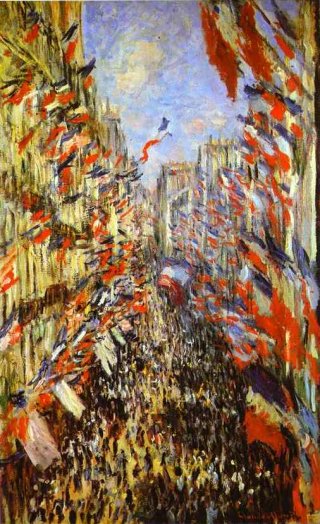
La Fete Nationale

The Museums (Musee d'Orsay)

(Musee du Louvre)

Walking in Paris

Creativity, Conversation, Innovation, Inspiration
Wednesday, January 18, 2012
In defense of American culture.
He who knows others is learned;
He who knows himself is wise.
-
Loa-tzu, Tao
te Ching
If I write this, I’ll be able to write anything after
it. In defense of American culture.
Last Thanksgiving, I spoke to my cousin who is half Filipino
about his mission, which he had just returned from. I told him about Field Studies, and I told
him that he should consider doing one—maybe Tonga? Maybe Fiji?
“What about South America?” he asked.
I said, “There, too.” We talked a
little longer, and I told him why I liked the idea of Field Studies—it was the
chance to be immersed in a culture different from your own and I mentioned that
doing that sometimes helped us realize there were things about other cultures
we might like better than our own—that might be better than our own. To
which he smiled and replied, “Yeah, everything.”
I’m not in the habit of letting people get away with telling
me my culture is no good, so I said, “Well, I’m an American Studies major, so I
don’t quite believe that.” And what I
meant was that my whole life I’ve been studying American culture. And I’ve loved every minute of it. Studying a culture doesn’t inherently mean
that you think it’s better. And true to
that statement, I don’t believe American culture is better than other cultures, but I do think it’s fascinating, and I
also think we don’t give it enough credit for being just as interesting and
complex as any other. I am past grateful
that there was something I’ve enjoyed doing all these years that they had a major for. How lucky is that? And all my life people have been telling me
that my love for American history and American literature and American government
and American leadership and American “proverbs,” American values, American music,
American geography, American economics, American—you get the idea—is boring. But it’s not boring at all! And I’ve learned that best through my study
of other cultures.
I don’t know if I believe in the melting pot theory, but I
know that without the search for a passage to the Indies, America wouldn’t be
the same. Without the turmoil of the
Tudor household, America might not be the same.
Without the French Enlightenment philosophers, America would not be the
same. Without wars and slavery in Africa
and the people who brought slavery to the Americas, America would not be the
same. Without trouble in the Balkans, America
would not be the same. Without a
shattered Germany, America would not be the same. Without Coca-Cola, America would not be the
same. Without communism in the Far East,
America would not be the same. Etc.
etc. This might be sounding a bit vague,
or perhaps you’ve begun to cringe, so I’ll stop there. The point is, I’m not saying that these
things made America better, or that America was right about its stance
concerning some of these issues, but that America does not stand alone or apart
from other world cultures. We are the
Irish, and the Mexicans, and the Italians and the Chinese, and the Armenians,
and the English, and the Nigerians, and the El Salvadorians, and the Tongans
and the Turks, and the Ghanaians, and the Chileans, and the Vietnamese, and the
Russians. All of that is here in our
history, and in our culture and who we are is very dependent on who we’ve been.
I love American culture, not because I think it’s better,
not because I think it’s exceptional in comparison to another culture, but just
the opposite—because I think American people and American history and WORLD
history says a heck of a lot about who Americans are and what we value. We are
not the tabula rasa. We are not the blank slate on which others
take away or add values, insert traditions, alter and shift customs or speak alternate
languages and thereby make a culture different from ours. Aha! Samoans!
Thinking that way is like thinking that Western Americans are the ones without
an accent when in fact we did not come first, and so ours is not the absence of
accent, but just a different accent. Furthermore, a Chinese housekeeper might tell
us we have the most interesting accent on the planet. We are a culture all our own. We are a culture which has taken some
languages, added some customs, adopted some traditions, retained some values
and in doing so have created this bizarre culture that most don’t even try to
figure out. But for a long time, trying
to piece together what makes us who we are is all that has interested me and I’m
not about to throw that away because someone else has decided quite erroneously
that we are a blank, and therefore boring, slate.
Subscribe to:
Posts (Atom)