
I live on one of Haussman’s boulevards in Paris in an old
bourgeoisie building which fits Haussman’s charming “street-wall” façade
regulations splendidly. The ground floor
is for storefronts mostly—pharmacies, bakeries, boutiques, and the like—but
amidst the storefronts is a large double-door that acts as the entrance to the
apartments on the floors above the magasins. The first floor apartments have proper
balconies with iron railing while the following second through fifth floors (in
France, the floors start at 0) have similar façades as the first floor,
sometimes with, but often without, a balcony or railing of any kind. The apartment façade is completed by a
mansard roof with a 45°
angle and dormer windows.
At the end of the hallway from the street-entrance to the apartments
is where the concierge lives, and where a lavishly carpeted staircase leads up
to the bourgeoisie apartments. There are
two bourgeoisie apartments on each of the first five floors, one on the right
of the staircase, and one on the left of the staircase. These apartments each take up half of the
floor and contain several rooms, much like any apartment would. Whereas in the western United States, one
might rent an apartment only until a house can be purchased, a Parisien is a
little more like a New Yorker and rents or owns an apartment for the mere sake
of living in the city. And owning an
apartment in this part of Paris is what one considers “well-off.” There is no ill connotation to the word
apartment, here. Furthermore, it’s
apparent by the red-carpeted staircase and the extravagant hallways and the red
doors of the first-five stories of apartments that you are standing on the
doorstep of someone who lives in Paris like one might live in Beverly Hills: no
qualms about social status.

Yes, this is the apartment building where I live. Only, I don’t take that main staircase to one
of those nice bourgeoisie apartments.
Instead, I walk through the small inner courtyard off of the hallway on
the ground level, where they keep the trash bins, to a door that leads to the old
servant’s staircase: narrow, damp, wooden, dark—no carpet. The staircase winds up to each floor of the
building, leading to servant’s entrances to each apartment, until it comes to
two floors of servant’s quarters.


(Rachel, notice apparition. The team has debunked this as a dust particle.)
 I was intrigued by the history of these old staircases
before I was struck by their blatant separation of the classes. After living in Paris for even a short amount
of time the mentality one adopts concerning architecture and old buildings
changes. Though the 21st
century inhabitant of my building can take an elevator up to the sixth floor
and follow the hallway to the servant’s staircase up to the seventh, the
elevator is such an unabashed ‘addition’ to the building, one is immediately
aware that it exists for the pure sake of convenience than as a statement of
social status. I didn’t realize it until
I came to Paris, but that’s what an elevator is in the United States: a sign of
social status. In America, for cultural
reasons of our own, the newest and best technology is expected of the rich; but
in this bourgeoisie building, the elevator is not efficient, nor is it fast,
nor is the building the proud owner of the elevator (assuming buildings can
feel pride). So what one understands, as
she uses the elevator every day, is that if Parisien’s could have gotten away
without adding an elevator to their old buildings in the latter half of the 20th
century, they would have.
I was intrigued by the history of these old staircases
before I was struck by their blatant separation of the classes. After living in Paris for even a short amount
of time the mentality one adopts concerning architecture and old buildings
changes. Though the 21st
century inhabitant of my building can take an elevator up to the sixth floor
and follow the hallway to the servant’s staircase up to the seventh, the
elevator is such an unabashed ‘addition’ to the building, one is immediately
aware that it exists for the pure sake of convenience than as a statement of
social status. I didn’t realize it until
I came to Paris, but that’s what an elevator is in the United States: a sign of
social status. In America, for cultural
reasons of our own, the newest and best technology is expected of the rich; but
in this bourgeoisie building, the elevator is not efficient, nor is it fast,
nor is the building the proud owner of the elevator (assuming buildings can
feel pride). So what one understands, as
she uses the elevator every day, is that if Parisien’s could have gotten away
without adding an elevator to their old buildings in the latter half of the 20th
century, they would have.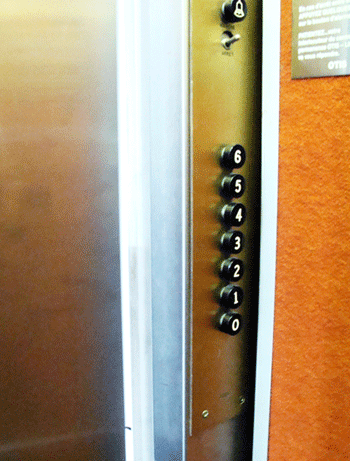
As a resident of the seventh floor, I am quite pleased with
the advent and addition of the elevator.
It took the maintenance of the elevator for me to understand just how
pleased, for without it, all those living on the two upper floors of the
building have to take all six or seven flights of stairs up to their
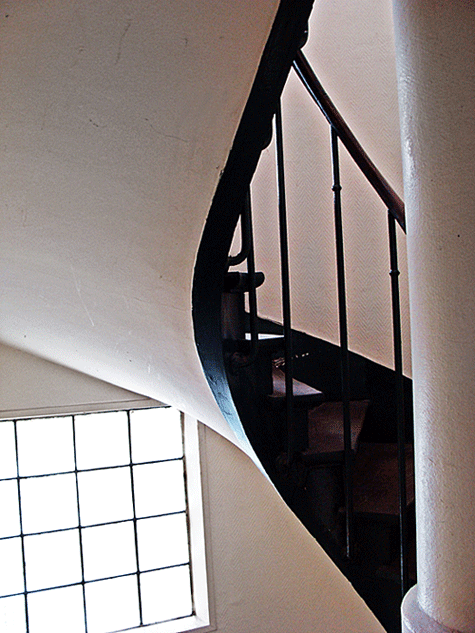
floor. As there is no electricity in the
servant’s stairwell, it is impossible to see the steps, the wall, the handrail,
or even your own hand—even during the day-time—until you get to the fourth or
fifth floor, where seventh-floor skylights and glass blocks affixed into wall
afford some light. In addition, whereas
the bourgeoisie staircase grants its climber a steady and gradual ascent to
their floor, the servant’s stairwell is steep and too narrow to heft even groceries
comfortably. In my exodus to the seventh
floor, I couldn’t help but imagine building maids, leaving their rooms on the
seventh floor five minutes before their day began so they could stop outside
the servant’s entrance to their employer’s apartment and catch their breath.
 |
| Servant's entrance |
 An American might ask, Why not take the main staircase up to
the fifth floor—enjoy the climb, at least—and then take the servant’s staircase
the last two levels up? Our
misunderstanding of any sort of class system makes this a fair question, albeit
a non-applicable one. There is no access
to the sixth and seventh floors from the main staircase—you must take the servant’s staircase. Furthermore, there is no secret door or
hidden hallway connecting the two staircases.
Here, I get images of some young maid cleaning the steps of the main
stairwell on the fifth floor, only to realize she’s forgotten something, have
to go down all the steps to ground floor, out to the servants staircase, up all
seven flights of stairs to grab what she needs, only to come down seven flights
of stairs and up another five to get the job done.
An American might ask, Why not take the main staircase up to
the fifth floor—enjoy the climb, at least—and then take the servant’s staircase
the last two levels up? Our
misunderstanding of any sort of class system makes this a fair question, albeit
a non-applicable one. There is no access
to the sixth and seventh floors from the main staircase—you must take the servant’s staircase. Furthermore, there is no secret door or
hidden hallway connecting the two staircases.
Here, I get images of some young maid cleaning the steps of the main
stairwell on the fifth floor, only to realize she’s forgotten something, have
to go down all the steps to ground floor, out to the servants staircase, up all
seven flights of stairs to grab what she needs, only to come down seven flights
of stairs and up another five to get the job done.
After my own hike up the staircase, I was entirely aware of
the class differentiation endured by those living atop the sixth and seventh
floors. And to be honest, the structure
of the building ensures that not much has changed. At best, the elevator was an attempt to
equalize the social status of the buildings occupants, particularly in the case
of the upper floors. But even with an
elevator which services the sixth floor as well as the first five, the lives of
the two types of inhabitants are quite separate. Much like what one would expect of the
bourgeoisie and servants of late 19th century Paris, there is no
crossing paths by way of staircase; nowadays the only interaction is the
occasional ‘Bonjour’ when exiting the elevator on the ground floor. No one is treated poorly or looked down on—it
is the 21st century—it’s just the way the whole staircase/elevator
system works. But the history of
bourgeoisie apartment owners and their servants who once lived above them
explains the reason for that system.
While the seventh floor was most certainly the old servant’s
quarters, the sixth floor of this building is an anomaly. The hallway of the sixth and seventh étage is floored by red-clay hexagon
tiles, rather than wood or carpet, the walls are textured white, and the doors
are painted dark green, the color of Paris’s park benches. On the first five floors of the building,
there are two apartments per floor, each with multiple rooms; on the seventh
floor there are sixteen individual doors to sixteen individual apartments. Given that the seventh and final floor of the
building has roofs angled in at 45°,
the space for these sixteen apartments proves even smaller than any other floor. These apartments are mere rooms; even ‘studio
apartment’ fails to express their size, for when an American thinks of an old
studio apartment, she thinks of Joe Bradley’s quaint living space in Roman Holiday, not an apartment the size
of a guest bathroom. The sixth floor has
seven green doors, meaning the apartments are larger than that of the seventh
floor, but still significantly smaller than that of the apartments below. Though the exact capacity of the sixth floor
is not formally documented, some old bourgeoisie buildings had one or two upper
floors for middle-class families, merchants, or perhaps head-of-staff
employees. Now, the apartments on the
sixth floor have been altered to create three larger apartments.
I had my mother ask me about my apartment when I first moved
in, which despite my scathing review of their size, I am quite fond of. I described it to her. The man, who bought the old chambre de bonne,
repainted it, installed a shower, a desk, and a small kitchenette. I sent her pictures. I received an email from my sister later in
the week with connotations of the belief I was living in squalor, for, “Mom saw
no toilet in the pictures.” I explained
that my toilet was across the hall in a separate room, which I had a separate
key to. In other buildings, the toilet
is often shared between many tenants of the old servant’s quarters.
 |
| My own apartment |
 |
| The view out of my window |
 Later, when I met a neighbor who moved in across the hall
from me, and I started spending some time in her apartment, my suspicions of
each apartment on the floor being owned and renovated separately were
confirmed. While each one of the sixteen
green doors used to lead to a separate room, now, many of the rooms have been
combined to create appropriate livable square-footage. I recounted the size and shape of my
neighbor’s apartment to my family, and expressed how interesting it was that three
of the old chambres were combined to create her apartment. My family asked several questions about her
apartment—Why is her apartment the size of three rooms, and yours the size of
one? Why does she have a toilet, and you
have to walk to a separate room? Why
does she have a shower with a curtain, and yours is merely an alcove?—all of
which confused me; they were hardly applicable to the interesting fact I had
just relayed about the history of the apartments. Weren’t they more interested in the living
conditions of someone living in a room a
third of the size of my
neighbors? Weren’t they curious about
how the old maids would have kept clean, or used the toilet? Instead my family was preoccupied with why my
neighbor’s apartment was so different from mine.
Later, when I met a neighbor who moved in across the hall
from me, and I started spending some time in her apartment, my suspicions of
each apartment on the floor being owned and renovated separately were
confirmed. While each one of the sixteen
green doors used to lead to a separate room, now, many of the rooms have been
combined to create appropriate livable square-footage. I recounted the size and shape of my
neighbor’s apartment to my family, and expressed how interesting it was that three
of the old chambres were combined to create her apartment. My family asked several questions about her
apartment—Why is her apartment the size of three rooms, and yours the size of
one? Why does she have a toilet, and you
have to walk to a separate room? Why
does she have a shower with a curtain, and yours is merely an alcove?—all of
which confused me; they were hardly applicable to the interesting fact I had
just relayed about the history of the apartments. Weren’t they more interested in the living
conditions of someone living in a room a
third of the size of my
neighbors? Weren’t they curious about
how the old maids would have kept clean, or used the toilet? Instead my family was preoccupied with why my
neighbor’s apartment was so different from mine.
Then I realized the misconception at work in my family’s
questions. American apartment buildings
are typically several stories high, and no matter which level you live on, each
floor has the same blueprint.
Furthermore, each individual apartment typically has the same
layout. The structures are built to fit
a certain number of apartments which apartments will house a certain number of
families which families consist of a certain number of family members. The person across from you has an apartment
with a mirrored layout to yours; the person under you has an apartment with the
exact layout as yours. It wasn’t that they didn’t understand why my
neighbor’s apartment was different from mine, they didn’t even fully comprehend
the whole system of bourgeoisie apartments: the fact that the lower floor you
inhabit, the better-off you are, the fact that the main staircase doesn’t even
go to the sixth and seventh floors, the fact that in order to get to the top of
the building, you are forced to take the servants entrance. Hearing I had a studio apartment sounded more
like I lived in an apartment complex with several other studio apartments, not
that I lived in the top floor of a well-to-do bourgeoisie home where social
class was separated by floor levels.
And it runs deeper than that. It’s not that Americans don’t understand class
and social status, in fact, our class system is just as complicated as
others’. It’s that in the United States,
the poor, the middle-class and the rich don’t live together in any capacity. The person living across the hall from you,
above you, or below you, is usually at the same economic status as you
are. Even if the person who lives across
from you is an immigrant, or if your child goes to a better school than the
children of the family living below you, your economic status is accepted as
being in the same range. And when it
isn’t anymore, and an American believes that the people moving in around them
are of a lower class than they are, they move.
Take Harlem as America’s best-known example: what used to be an area
inhabited by the wealthy and old-Dutch families of New York, in the 20th
century became a place renowned for crime and poverty. It’s also true that there are poorer parts of
Paris, where the well-off do not live, but the difference is that they never
lived there. The difference is that the
French would never consider moving out of the Luxembourg Quarter just because
their new neighbors might seem to be of a lower class. After all, the Luxembourg Quarter is the
Luxembourg Quarter.
The American culture of capitalism was another road-block
for my family to truly understanding my living situation. Surely, someone realized the profit to be
made from renting the top floor apartments to young students, bought up the
entire floor of sixteen rooms, and renovated them to create eight
apartments—for there are eight tenants currently living on this floor. Each of the apartments would be affixed with
a kitchenette, and a shower, and use a bathroom down the hall. The fact that my neighbor’s apartment was
different meant that someone made the two apartments noticeably and
intentionally inégal. This makes no sense to an American—and probably
wouldn’t make sense to the French either, if the argument were presented that
way. Except this idea of snatching up
this real-estate city space, improving it, and renting it out for a profit is
an American mindset, not necessarily a French one. The French might be more likely to think, “They’re
just the old servant’s quarters, after all.
Writers, students, and the elderly sometimes rent them because they
can’t afford anything else, but the rooms are probably better suited for
storage space,”—which is perhaps true.

But this doesn’t answer the question: If the area is unfit
for living, why doesn’t someone gut the whole thing and make it fit for living? This
is, after all, what an American would do to a nice bourgeoisie apartment
building like this one, in the middle of a nice area like the Luxembourg
Quarter. The French wouldn’t. The French wouldn’t gut any building built
before 1915—if they’d consider gutting any building at all. They’ll demolish them, and tear them down,
and build up around them. But they won’t
tear out the insides of a building that is just fine the way it is. Recall my explanation about the elevator; how
if the Parisien’s could have gotten away without adding one, they would
have. They are not the proud owner of
the contraption, it is just a convenience.
Similarly, gutting out the servant’s quarters to create nicer apartments
would be like fixing something that isn’t broken. Let me also use my own apartment as an
example: the apartment may have been wholly renovated to include electrical
outlets, a kitchenette, a shower and a heater, but the floor remains the
red-clay hexagon tile.
Consider the idea that it’s in the blood of American culture
to improve on what isn’t broken and to consider broken what is merely less
efficient. Europeans in general—particularly
when dealing with domestic buildings—are not this way. The British have a saying they use often, “I
couldn’t be bothered.” It’s not a
thoughtless, rude or dismissive statement—it is recognition that there are some
things there is no reason to doing, like turning the page of newspaper when there’s still a story on the
front page that interests you, or getting up for a chocolate when there are
almonds in a bowl beside you. It’s not
that the idea isn’t worth doing, or
that there wouldn’t be a point to
doing it, or even that doing it is a significant amount of trouble. It’s just that it works fine the way it is,
and no one is really complaining, and individual proprietors are improving the
apartments little by little, so why should anyone be bothered?

I lost my audience long before I could accurately explain
these cultural differences I find so fascinating: something as simple as a
staircase or whether or not an apartment has a toilet is attached not only to
history but to mentality—a mentality which runs deep. Buildings aren’t just about form or function;
they aren’t just about changing and being changed. In fact, it’s a little more than that. Carl Jung afforded to artists the
responsibility of tapping into the collective unconscious and presenting its
truths to the world, but it turns out that cultural experience is organized not
only by painting or tapestry, but by the very halls we walk in, and the very
stairs we climb. The detailed truths of
how we consider the world around us are presented to us by small inefficient
elevators, by the remnants of old doors in the hallway, and by whether or not
we would gut our seventh-floor servant’s quarters for a profit. The very fact that an American would do
something so differently than it has been done here is proof that our histories
have a place in our cultures, that our cultures have a place in our mentality,
and that our mentality shapes the world we inhabit.
