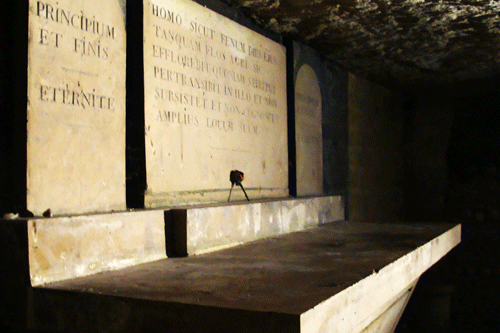
Pages

Showing posts with label history. Show all posts

Friday, June 1, 2012

The Catacombs of Paris

This post is dedicated to my family, each member of which has a fascination for the creepy, a dedication to the dead, or a penchant for the morbid; and especially to my parents, who always let Rachel, Caitlin and I discuss our funeral arrangements at the dinner table.  Also, this post is dedicated to Chris Fortuna who good-naturedly sat through an episode of Ghost Adventures with me on a Friday night and then requested I visit the Catacombs, as he was never able to.


All pictures were taken and edited by yours truly.  Also, excuse the translation of French poetry;  I did most of it on my own, as I wanted it to retain the meaning in English it has in French, so translation is not always direct.


Où est-elle la mort? toujours future ou passée.
A peine est-elle présente que déjà elle n'est plus.


Where is death?  Always future or past.
Hardly is she present than already gone.


The walk to the catacombs is a longer one than you would expect once you go down the one-hundred and thirty-something stairs underneath the city.  The tunnels where the catacombs are housed is just a small section of an entire network of tunnels that were excavated beginning in the middle ages for the Luticien limestone under the city.  The Cathedrale Notre-Dame is built out of such Parisian Luticiene limestone.  Much later, when the tunnels were rediscovered, they became what is now the metro.

Many of the passageways have street names.


Walking through the narrow passageways of the tunnels to the catacombs is eerily satisfying; dark, damp, a particular scent of water and wet stone.  The floor is covered in pebbles, but where the feet of traveling pilgrims has revealed a soft, clay-like dirt which has a consistency that begs to be kneeled in and dug up by curious fingers.  The ceilings are low, carved out of the rock haphazardly and while some halls are lined with carefully-cut and placed stone, others are merely chinked out of the ground as if intended to be temporary--never seen.

Once far enough into the journey through the passageway, a thick line, black like coal, and gradient of chalk appears above your head.  Meant to guide visitors to the catacombs through the dark halls, particularly before the advent of electricity.  I imagine one could hold a lantern above their head and keep their eyes on the line and arrive safely to a tomb of death, which, while sounding ominous, is a better option than being lost in a tomb of death, so one can see the appeal.

An example of one type of wall.

Not an appealing picture, but you can see the black line I mentioned up on the ceiling.
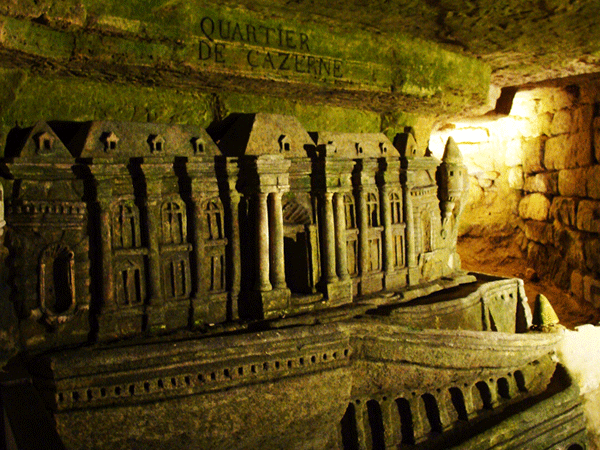
The walls change in  stone and consistency but there is one look of stone that is more tempting to touch than the others, and despite the smell of wet stone and the faint dripping of water and that the stone feels of wet chalk, when you bring your fingers away from the wall, rubbing them against each other, they are dry.  Just another mystery of stone and geology I will always be aware of and never master, for this is where the water table meets man-made endeavors, and yet all is simultaneously wet and dry.


The first thing you see of any particular note are these sculptures, carved out of the rock.  They were carved by a veteran soldier of l'armée Richelieu who was injured during the conquest of Minorque.  He turned quarryman to supplement his salary after recovering from his wounds.  His name was Décure, dit Beauséjour--or something like that--and at one time was imprisoned at Port Mahon (on Minorque), which is what this carving replicates.


According to French wikipedia, Décure wanted to perfect his work and so began to "undertake the creation of a staircase."  Unfortunately, his quarrying cause a sinkhole which collapsed on him and killed him instantly.  No word on where he was buried.

Le bain de pieds des carriers.
A well for the feet of the quarrymen; used by the workers of the ossuary.


Finally; a long walk and there is faint darkness creeping across the floor, though shadows are superfluous.  The entrance to the actual catacombs is hardly grand.  Carved across the lintel in capital letters:

ARRÊTE! C'EST ICI L'EMPIRE DE LA MORT
Stop.  This is the empire of death.

Now, I know I believe in ghosts.  I know that though cemeteries are alluring they always keep me on the edge of fascination and discomfort so that I'm too intrigued to leave immediately and yet always so relieved when I finally do.  I know that watching me in a graveyard (or old country church) is like watching a seven-year-old play hopscotch as I try to avoid stepping on the graves; I would rather step around them.  And I know mass grave-sites are particularly troubling to me, particularly when I'm told about one after I'm already standing atop it.  But--no way in all get-out the empire of death is stopping me.

So I stepped in, of course.

"Et comme tous meurent en Adam, de ême aussi tous revivront en Christ"
For as in Adam all die, even so in Christ shall all be made alive.
                                                                                        1 Corinthians 15.22


Ainsi tout passe sur la terre
Esprit, beauté, grâce, talent
Telle est une fleur éphémère
Que renverse le moindre vent

Thus, everything passes on earth
Spirit, Beauty, Grace, Talent
Such is an ephemeral flower
That reverses the slightest wind

The story of the catacombs I don't think is well known, but is also not as gruesome as one would imagine (or, dare I say, morbidly hope?); it begins with understanding the growth of Paris as a city.  For centuries, Paris was merely the size of Ile-de-la-Cité--the islands in the middle of the Seine.  More of a town, than a city, it was surrounded by farm land, meadows, fields and the like.  During the 16th century, coming out of the Middle Ages, and moving into the Renaissance, the size of the city had hardly changed from when it was run by the Romans.  Even the abbey of St.-Germain-des-Prés, which is but a ten minute walk from the islands now, was outside of the city center.  Of course the city was far more compact then, with narrower streets and houses built on bridges, to accommodate for the growing population.

A model at the Musée Carnavalet of  what16th century Paris would have looked like.

It stands to reason, then, that churches for the towns outside of the city center would ahve their own cemeteries--much like the ones you would imagine surrounding the countryside churches in England.  Likewise, Paris, too, had its own cemetery called Cimetière des Innocents and was located in what is now the area of Paris known as Les Halles.

But as my History of France professor would say, "Cities eat people."  Though by the Revolution the size of Paris was still not even a twentieth of what it is today, the city was taking an influx in population, and thus beginning to grow in size.  Surrounding villages were swallowed up by the city boundaries, and people flooded those areas--areas like Les Halles.  What used to be an outlying area perfectly suited to bury Paris's dead, was becoming overrun with people.  As Paris's population increased, so did its death toll; Cimetière des Innocents became crowded not only by the living, but with the dead.  By the late 1700s, near the eve of the Revolution, Cimetière des Innocents was a public health issue.

The project of the catacombs was realized as a solution soon after, the old quarry tunnels already in existence.  The bones of the cemetery were dug up out of le cimetière in Les Halles and moved across the river then dumped into the quarry tunnels.  Other churches, which used to have space for their parishioners after they died also became crowded, and the bones were also moved to the present area of the catacombs of Paris.  The project took years, and at the time were merely piled, not stacked or arranged.


Tout nait, tout passe, tout arrive
Au terme ignoré de son sort
A l'océan l'onde plaintive
Aux vents la feuille fugitive
L'aurore au soir, l'homme a la mort

All are born, all pass, all arrive
To the end of their unknown fate
To the plaintive ocean wave
To the winds the fleeting leaves
Dawn 'til Evening, man has death


A la mort on laisse tout.
At death, we leave everything.

Among the first visitors to the catacombs was future king Charles X (he would not be king until decades after the Revolution), who was then le comte d'Artois, in 1787.  Curious about the place, he is rumored to have gone down into the catacombs with a company of "women of the Court."  However, not long after the bones were moved, and the areas which used to be cemeteries were developed and covered up--swallowed by the city--the Revolution broke out and the bones in the catacombs were forgotten.

By most.

In fact, during the Revolution many of those who died during certain uprisings or in prison massacres were buried straight in the catacombs, a practice largely hidden from the people.  Those remains and years are marked clearly now.

After the Revolution the interment of bones from local church cemeteries continued until the early 19th century when Louis-Étienne Héricart de Thury inherited the duties of overseeing the quarries of Paris, and thus the Catacombs.  It was he who organized the first visits to the Catacombs in the second decade of the 19th century.  It was also he who had the bones, previously 'dumped' in the quarries, organized and aligned in decorative motifs, including plaques for when the bones were moved, where they were moved from, and bits of poetry about death and it's impending certitude.

Croyez que chaque jour est pour vous le dernier.
Believe that each day is your last.
                                                      - Horace


Hopefully his gives you some indication of how many bones are down in the catacombs of Paris.


Quels enclos sont ouverts! quelles étroits places
Occupe entre ces murs l'a poussière des races!
C'est dans ces lieux d'oubli, c'est parmi ces tombeaux
Que le temps et la mort viennent croiser leurs faulx
Que de morts entasses et presser sous la terre!
Le nombre ici n'est rien la foule est solitaire.

What enclosures are open!  What narrow places
Occupied between these walls, the dust of the races of men!
It is in these neglected places, it is among these tombs
That time and death come to cross their scythe
That of the dead, piled up and pressed under the earth.
The number here is nothing; the crowd is solitary.


Venez gens du monde venez dans ces demeures silencieuses et votre âme
alors tranquille sera frappée de la voix qui s'élève de leur intérieur;
«C'est ici que le plus grand des maîtresle Tombeau tient son école de vérité.»

Come people of the world, come into these silent mansions
Then will your soul be struck by the quiet voice which rises from within;
"It is here that the greatest of masters, the Tomb, holds his school of truth."

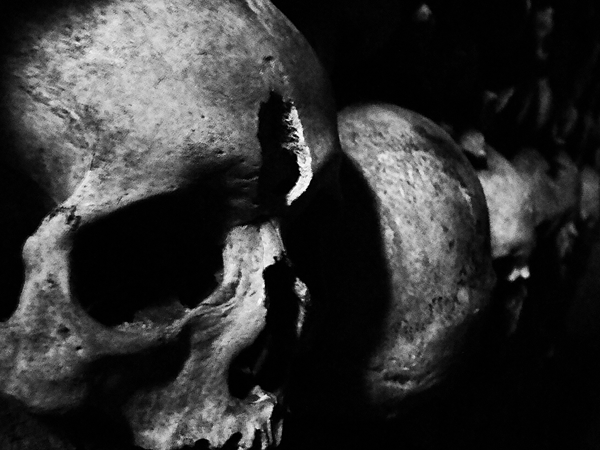
The basin below used to hold a torch kept lit by the quarrymen to encourage airflow.
Behind it gives an indication of the number of bones and the artistic ways they were stacked.

There are six million bones down in the Catacombs.  Coming from cemetery's and churches of Paris that existed long before the catacombs did.  Some of the bones date from the Revolution--the 18th century.  But others are much older, having been in the ground of the old cemeteries long before they were dug up and moved here.  While the Catacombs of Paris is the largest necropolis in the world, the area it covers is merely 1/800th the area of Paris's modern city limits.


Mass was once held in the catacombs.

Quarry reinforcement arch, to keep it from caving in.

Credits.  The Catacombs brought to you by:
M. Thiroux de Crosne
M. Guillaumot, inspector of the quarrymen in 1786
restored and augmented by order of M. Frochot
and M. Hericart de Thury, inspector in 1810. 


 Chaque mortel parait, disparait sans retour;
Mais par d'illustres faits vivre dans la mémoire
Voilà la récompense et le droit de la gloire.

Each mortal appears then disappears without return;
But by illustrious acts lives in human memory.
In this is the reward and the right to glory.

Wednesday, May 16, 2012

Heaven on the Quai

If truth cannot be found or arrived at, but merely given, what will the philosophers talk of in heaven?

I no longer believe in one truth.  If it were so, conversation would have no healing power.

This is how my thought came to be.


Île de la Cité

I was walking around  Île-de-la-Cité , having decided I’d see for myself what this little island was about, strolling along the Quai aux Fleurs when a beautiful red-headed man asked me where St. Michel was and I pointed—with my hand—down the road, realizing I did not know the word for ‘straight’ or ‘ahead.’ (For future reference: Continuez à marcher tout droit.—WHAT THE HECK? ‘straight’ and ‘right’ are the same word!?!  How confusing is that!)  He thanked me and continued on his way.


I continued, too, down a little quai named Quai d’Horloge.  So, naturally, I was thinking of clocks and clock makers (horloge = clock) and wondering if there was any eternal significance to me walking around memorizing this city.  Then it occurred to me how much and how often I wish I could time travel.  All I want to do is walk down Quai d’Horloge when it really was the Quai of horloges, is that so much to ask? and I realized the closest I may ever get is when God calls those lectures in heaven together and I get to talk to the Parisians of the 16th century—no joke I really think these things—and know, when they say ‘Quai d’Horloge,’ where in the city they mean.  Fist pump in heaven, lording it over all my friends who will have NO clue where Quai d'Horloge is.  (Except for you, now, grâce à la carte--thanks to the map--I've included above.  See on the top left of the island--Quai de l'Horloge?)

Back to thought about knowing where Quai d'Horloge is when all my friends don't.--Neat.

But of course THEN I was thinking about who I’d really like to be with in heaven, and of course (of course) the French Enlightenment philosophers came to mind, and I figured that probably Jefferson would be there too, so I’d be killing two birds, so to speak, and then—I hit a brick wall.


It really hurt.  Metaphorically.  I nearly stopped RIGHT there on Quai d’Horloge thinking, “Oh no!  What will they TALK about?” Because French Enlightenment thinkers were–well every artist ever (yes, conversation is an art) has been—about finding truth.  Talking around (or painting, or writing, or sculpting, or whatever around) the truth in circles until you nearly come to the center of it, trying to figure it out and understand it .

We talk about, and I had largely accepted that once we die, we will be informed of the truth, and then we’ll be happy, because we’ll have the truth.  But the problem is that people think that now!  And it’s certainly not the case for me.  What I mean is, people think, “If only they had the true and everlasting gospel, they’d be happy.”  And I’m not saying that the true and everlasting gospel can’t make you happy, I’m just saying it’s not a cure-all and it doesn’t solve all problems and it DOESN'T make me happy all the time.  It doesn’t even answer half of my questions.  The gospel would have never quelled the minds or the spirits of Enlightenment philosophers—it certainly doesn’t come close to quelling mine—and even if they'd believed it, they'd still be talking about what truth is and where to find it!  So geometry--that great mathematical enlightenment of my youth--and its proofs have taught me that if some people say we have the truth now and it should make us happy, but it isn't the cure-all, it stands to believe that even if we have the truth in heaven, it may not be the cure-all, and thus we will still be having conversations in heaven about truth.  This brought me to the conclusion that perhaps how we can better define the truth we have on earth is "necessary and saving truth" rather than "truth" as a catch-all.  Furthermore, this begs the question, “Will we ever have ALL truth?” and my desperate realization, “I hope not.”

Ah!  It slipped out!  I had no control over the desperation.  Am I going to burn in hell?  (If so, I might as well continue:) Then I thought, maybe even God does not have all truth, but still discovers it every day, through us, through his work.  I mean, "necessary and saving truth" he has, knowledge he has, but maybe there is still truth to be had, even for him.  That’d make life interesting again. (I’ve also wondered if God is bored up there and am desperately hoping not--for his sake.)

And all of these thoughts in combination—or more in conflagration, perhaps—brought me to my disbelief in one truth.

Heaven (No joke.)

We think heaven will be a perfect place full of light, truth, perfection.  But if it’s much different than life on earth, it could be hell.  And honestly, hell sounds boring.  I mean people who don't care about food talk about a heaven where we won’t need to eat—but then what will the chef’s do with their passion?  People who don't notice the buildings that surround them talk about a heaven where the elements will have no power to hurt or kill us and we'll live on clouds—but then what will the architects do with their life passion?  Most of us imagine a heaven without pollution or cars or dirt or rocks—but what will the mechanics do, or the engineers, or the geologists?  And a heaven where no one is sick, no one is ailing—what will the nurses and the doctors and the surgeons do?  We talk too often about a heaven where truth is known—but then what will the archeologists, and the philosophers, and the physicists do?  And what about the linguists, and the historians, and the chemists, the personal trainers, the movie producers—what will they do?  Certain types of people decide that certain things in heaven will be unimportant, and continue to disregard all the human beings who have made that thing their life-work, have found it as their passion.  You can’t tell me history won’t matter, it’s the only thing that gets me out of bed in the morning.  You can’t tell me language won’t matter—I know too many linguists for that to be possible.  You can't tell me movies don't matter, they've taught me more empathy than every church meeting combined.

I keep thinking of circumstances in which heaven could be the most boring place on earth—if all things, especially intellectual and spiritual truths, were just given to us.  And I realize how much I hope for a heaven that is a lot like earth.  Maybe earth is that great university of life where we are taught not what to think, but how to think, not what to do, but how to do it.  In heaven, I don’t want people to have to scrape for survival, but perhaps we should always have to scrape for truth.  That way, it means a little bit more.


For now, back to the Quai.

Monday, May 14, 2012

Paris au Moyen Age

You can slap my wrist later because I haven't done anything even remotely related to my project for almost a week.  For now, you can be proud of me because I got out of the apartment before noon today without the excuse of having to meet my landlady or the necessity of going to a church meeting.  This is what got me out and about today:


Yes.  That's right.  Medieval Paris.  I think I'm in love, and also, I should have known that 1920 isn't long enough ago.  I was walking through the Montparnasse Cemetery the other day, disappointed that all those people had died between 1875 and 2011.  "Isn't there anyone who's been dead LONGER?"  I'm going to Montmartre Cemetery one of these days to see if people there have been dead longer.  After I get my bearings in the parts of Paris I can walk to, I'll start venturing out to the parts I have to Metro to and walk back from.  I'm hoping my shoes will be nice and worn in by then.

Anyway, Medieval Paris.  I went to St.-Sulpice the other day and just about died


(of happiness).

It's just about that beautiful in person, except all that open space around it is a lie.  There's a nice big square out in front of it, where some boys were playing football before I went in to attend messe and they were still there when I got out an hour later, so I sat and watched them for a while.  I have to admit, Catholic mass feels different from an Anglican service, which I've been to half a dozen of.  Even in the center of Paris, there are local paroissiens/parissioners--um, I don't know the spelling in either English or French, so you'll have to take a cross between the two--and its much like it must have been a hundred years ago: a community church service.  Only there are less people than there used to be (or so I assume) and several of the people attending are tourists (I'm going to count myself as one of them for the time being).  I do prefer the church when its silent and I get to walk around and sit and worship God in my own way, but I'm glad to have had the experience of mass, regardless.

St. Sulpice opened doors.  I decided to do some research on it because I want to write an architecture piece on it for one of my classes.  I started with wikipedia, which is really a lot more useful than academia gives it credit for.  And I found this.


And this is what I thought: "Holy Hell.  Streets.  That existed then.  That might exist now."

So it started a long and involved internet search for Medieval maps of Paris in which one of the maps I found was the first one I posted above.  I encourage you to click on the picture and see it at full resolution, if it lets you.  It's awesome.  Well, I'd been wanting to go to St. Germain-des-Prés, when what should I find out but that it's the oldest church in Paris, founded in the 6th century by the SON OF CLOVIS (relaying this information makes me want to cry--seriously).  ARE YOU HEARING ME?!  CLOVIS!  (Also, a Medieval side-note: Clovis-->Clouis-->Louis.  The French have been using that name for a long time.  Is your mind blown?)  Anyway, the tower of the Abbey of St. Germain-des-Prés was finished in 1014.  You're probably one of those people to whom dates mean nothing.  1014 was almost 1000 years ago.

0 0 0 0 0 0 0 0 0 0 0 0 0 0 0 0 0 0 0 0 0 0 0 0 0 0 0 0 0 0 0 0 0 0 0 0 0 0 0 0 0 0 0 0 0 0 0 0 0 0 0 0 0 0 0 0 0 0 0 0 0 0 0 0 0 0 0 0 0 0 0 0 0 0 0 0 0 0 0 0 0 0 0 0 0 0 0 0 0 0 0 0 0 0 0 0 0 0 0 0 0 0 0 0 0 0 0 0 0 0 0 0 0 0 0 0 0 0 0 0 0 0 0 0 0 0 0 0 0 0 0 0 0 0 0 0 0 0 0 0 0 0 0 0 0 0 0 0 0 0 0 0 0 0 0 0 0 0 0 0 0 0 0 0 0 0 0 0 0 0 0 0 0 0 0 0 0 0 0 0 0 0 0 0 0 0 0 0 0 0 0 0 0 0 0 0 0 0 0 0 0 0 0 0 0 0 0 0 0 0 0 0 0 0 0 0 0 0 0 0 0 0 0 0 0 0 0 0 0 0 0 0 0 0 0 0 0 0 0 0 0 0 0 0 0 0 0 0 0 0 0 0 0 0 0 0 0 0 0 0 0 0 0 0 0 0 0 0 0 0 0 0 0 0 0 0 0 0 0 0 0 0 0 0 0 0 0 0 0 0 0 0 0 0 0 0 0 0 0 0 0 0 0 0 0 0 0 0 0 0 0 0 0 0 0 0 0 0 0 0 0 0 0 0 0 0 0 0 0 0 0 0 0 0 0 0 0 0 0 0 0 0 0 0 0 0 0 0 0 0 0 0 0 0 0 0 0 0 0 0 0 0 0 0 0 0 0 0 0 0 0 0 0 0 0 0 0 0 0 0 0 0 0 0 0 0 0 0 0 0 0 0 0 0 0 0 0 0 0 0 0 0 0 0 0 0 0 0 0 0 0 0 0 0 0 0 0 0 0 0 0 0 0 0 0 0 0 0 0 0 0 0 0 0 0 0 0 0 0 0 0 0 0 0 0 0 0 0 0 0 0 0 0 0 0 0 0 0 0 0 0 0 0 0 0 0 0 0 0 0 0 0 0 0 0 0 0 0 0 0 0 0 0 0 0 0 0 0 0 0 0 0 0 0 0 0 0 0 0 0 0 0 0 0 0 0 0 0 0 0 0 0 0 0 0 0 0 0 0 0 0 0 0 0 0 0 0 0 0 0 0 0 0 0 0 0 0 0 0 0 0 0 0 0 0 0 0 0 0 0 0 0 0 0 0 0 0 0 0 0 0 0 0 0 0 0 0 0 0 0 0 0 0 0 0 0 0 0 0 0 0 0 0 0 0 0 0 0 0 0 0 0 0 0 0 0 0 0 0 0 0 0 0 0 0 0 0 0 0 0 0 0 0 0 0 0 0 0 0 0 0 0 0 0 0 0 0 0 0 0 0 0 0 0 0 0 0 0 0 0 0 0 0 0 0 0 0 0 0 0 0 0 0 0 0 0 0 0 0 0 0 0 0 0 0 0 0 0 0 0 0 0 0 0 0 0 0 0 0 0 0 0 0 0 0 0 0 0 0 0 0 0 0 0 0 0 0 0 0 0 0 0 0 0 0 0 0 0 0 0 0 0 0 0 0 0 0 0 0 0 0 0 0 0 0 0 0 0 0 0 0 0 0 0 0 0 0 0 0 0 0 0 0 0 0 0 0 0 0 0 0 0 0 0 0 0 0 0 0 0 0 0 0 0 0 0 0 0 0 0 0 0 0 0 0 0 0 0 0 0 0 0 0 0 0 0 0 0 0 0 0 0 0 0 0 0 0 0 0 0 0 0 0 0 0 0 0 0 0 0 0 0 0 0 0 0 0 0 0 0 0 0 0 0 0 0 0 0 0 0 0 0 0 0 0 0 0 0 0 0 0 0 0 0 0 0 0 0 0 0 0 0 0 0 0 0 0 0 0 0 0 0 0 0 0 0 0 0 0 0 0 0 0 0 0 0 0 0 0 0 0 0 0 0 0 0 0 0 0 0 0 0 0 0 0 0 0 0 0 0 0 0 0 0 0 0 0 0 0 0 0 0 0 0 0 0 0 0 0 0 0 0 0 0 0 0 0 0 0 0 0 0 0 0 0 0 0 0 0 0 0 0 0 0 0 0 0 0 0 0 0 0 0 0 0 0 0 0 0 0 0 0 0 0 0 0 0 0 0 0 0 0 0 0 0 0 0 0 0 0 0 0 0 0 0 0 0 0 0 0 0 0 0 0 0 0 0 0 0 0.

That's a thousand 0's.  For you.  To see how many 0's it would take to make a thousand.  One 0 at the end of every year.  That's a LOT of years.  Okay.  So here I am just looking at this map of this ancient church that used to sit on this one street in--and I realize, it still does.  I can GO.  I can GO.  It's like...a 20 minute walk.  So I decided to make it a Medieval Monday.  I woke up, got ready to go out, and started on my Medieval Monday adventure.  I walked down to Luxembourg Gardens, then down St. Michel, and ancient Roman thoroughfare, past the Abbey Cluny, now the Musée du Moyen Age, left on Blvd. St-Germain, and down, down, down the street until I got to St. Germain-des-Prés.  St. Germaine of the Fields.

I walked in.

Choeur Des Moines De L'abbaye De Saint Benoît Sur Loire – Fantaisie En Do Mineur

I wish you could hear my laugh.  The happy laugh I get when I walk into really old cemeteries.  That kind of laugh.  The "Yes, I really AM here," laugh.  Because the organ was playing.  It reverberated through the entire church.  I don't know if you know what that sounds like.  These old stone churches were made for noise: for singing, for the organ; for soft chattering.

Sometimes one of your senses takes over, disallowing any other from experiencing a space.  I'm fairly certain I was blind for a few moments after I walked into the church because my ears were taking in the surrounding.  But eventually my ears gave in to my eyes.  Not many people know that the ancient statues outside of the medieval churches like Nôtre-Dame and the old Greek and Roman statues used to be painted.  (At the musée du Moyen Age at the Hôtel Cluny/Abbey Cluny (Hôtel-->Hostel, just another word in French for Mansion, basically) they've got some of the heads of the old statues that used to be part of Nôtre-Dame before they were broken off and destroyed in the revolution, and the ancient statues still have red on the lips and cheeks, and green in the eyes, left over paint from long ago.)  In ancient-style, nearly every inch of Saint-Germain-des-Prés is painted.  The columns, the archways, the walls, the ceiling--everything but the floor.

St-Germain-des-Prés
(Cette image est tirée de simplyparis.org)

I didn't take this picture, and it is a beautiful picture, but it doesn't do the place justice.  The inside of the church is darker than this, so much darker.  And the light is not so soft.  It's creepier, somehow.  And yet still, the color comes through, not like a shine, or a punch, but a resonance, refusing to wear away, though it fades.  I have no idea how often they've restored the paint, and I have no idea if it looks anything like what it looked like when it was painted in antiquity, but the point is certainly gotten across.  No other church I've gone in to is painted this way on the inside, though it gives a good idea of what many of the churches must have been like before they were destroyed during the Revolution.

That's another thing to think about.  Here in Paris, the Revolution happened, but no one in particular started it, carried it out, or even felt the effects of it.  It is almost always spoken of in the passive tense.  "Destroyed during the Revolution," but not destroyed by whom?  Destroyed for what reason?  The Revolution is spoken of like a force of nature that came through Paris, destroying the things people miss most about how Paris used to be: the history, the age, the culture; but blame is attached to no one in general reference to the Revolution.  That's very interesting to me.  I can't tell yet, but will get back to you about whether I deem it shame, reverence, respect, a knowledge of happenstance, a statement of fact, or something else entirely as a reason why they speak of the Revolution this way.  In America we kind of think of the French Revolution as this interesting point in history.  Here...the scar isn't interesting, it's just a reminder of pain.  I'll get back to you on this.

Most of the abbey of St.-Germain-des-Prés was destroyed during the Revolution, but the little church still stands, par la grâce de Dieu, I'm sure.  This reminds me of St. Paul's Cathedral in London.  I do believe God saved that place from ruin; why not these churches in Paris?

So I walked in.  Organ playing, making the place creepier than it would have been in silence.  Entire inside of the church painted, making it darker than St. Sulpice.  Smaller than Nôtre Dame, but still with plenty of Chapelle's around the nave and transept.  Candles burning--I lit one in L'Eglise St.Etienne du Mont the other day, so decided not to light one here.  It's less crowded than Nôtre-Dame, or even St. Sulpice; it's easy to misread as a small parish and decide to walk past after seeing the likes of those other churches.  And I know I keep comparing these churches.  Here's why: they told me when we went to London that I'd get sick of going into the Cathedrals and churches, that after a while they'd all start to look the same, or feel the same.  I'm not saying I'm special or anything, I'm no cathedral-whisperer, but that's never happened to me.  They're all so different, they've all got a very particular feel.  Maybe it was knowing that St.-Germain was the oldest, but I think I could really feel it.  It kind of took me by the spirit and clenched its fist around my insides and didn't let go until I left.  I wasn't uncomfortable, but I was sad.  Does anyone else get that way in places with lots of history?

I sat and thought and wrote for about an hour before leaving the church and walking around the area, particularly down Rue du Four, which is a street that existed in Medieval times, despite the names of all the major roads (St. Michel, St. Germain, etc) having changed.  I decided to wander through some of the smaller roads, making my way back to St. Sulpice, and then returning to Abbey Cluny.

Abbey Cluny I have been more or less fascinated by for two weeks, since I first walked by it with Kate on Bd St-Michel.  Old buildings do that to me.  It was an old Roman Bath, I believe, then an Abbey, then it was destroyed, and made into an Abbey again, and destroyed and into an Abbey again, and then destroyed and built onto by some rich woman who bought the land.  (This is all very spotty history, so don't take my word for it.  It's just to give you an idea.)  I kept telling myself I'd go to the Museum, but didn't, and didn't.  Then it became Medieval Monday, and what do you know...there I was.

I had a somewhat successful conversation in French with the man who I bought my ticket from.  He treated me like I wasn't an idiot, which was preferable.  I asked for a student ticket, he asked if I "had less than 26 years."  I said yes.  He asked to see my ID and I said, I'm American.  He smiled and said, "Tarif Reduit" (Reduced Cost).  I said, "Parfait."  He told me there was an audio guide in the next room, and that I could get it in English.  I said, "Merci."  And then I went on my way.  My conversation with the audio guide woman was less perfect because she started speaking to me in English as soon as I asked for an audioguide "en anglais."  I was going to ask for it in French but decided I was really too curious about the middle ages in France to lose half of the information I could get by listening to it in French.  I'm working on it.

My camera died which wasn't even on the radar for me.  So here are some pictures (the ones I could salvage) from my phone, which hasn't died since I got into Paris, as it's got no SIM card and is on flight mode.  Glorious.  But the pictures aren't so glorious.  I'll go back to the Museum and get pictures of the outside, the pleasure gardens (if you want the explanation of that, you can ask for it, and I'll give it), and the Hotel du Cluny.

Roman foundation and brickwork:


The reason Roman buildings NEVER go away.  These bricks are slabs, so walls are more than a foot thick.  The Romans feared being forgotten and made sure they wouldn't be.


Roman ceiling.  Fascinating to me, but maybe not to you.


Hotel du Cluny, the Abbot had his personal chapel.  Here is the staircase leading up to it.


Here are my feet, standing on the floor of the chapelle.  I love floors and ceilings of old buildings best.


Two other things I loved about the museum.

Arms room.  Old weapons/shields/armor are awesome.


This sculpture carved of wood.  My favorite in the museum.


A common theme of thought for the day was that only the history of the rich is ever really kept.  I, of course, was very interested in all of the things I saw, listened to and read about today, but it was very apparent to me that I was reading and listening to the history of the rich, or of the church--which was rich.  There is so little written or recorded about the lives of the common people who lived in Medieval Paris, and that's something I'd like to spend some time looking into.

The man who did a lot of the excavation for Cluny III, the ruins of the third abbey of Cluny, was an American--Kenneth J. Conant.  He dedicated his life to Medieval Architecture, particularly that of Cluny.  I love that he made such a difference somewhere so far from home.  That he gave this place something they hadn't given to themselves.  I think sometimes it takes someone from the outside to remind the people on the inside of how interesting their history and their ruins are.  It takes someone from the outside to ask the questions that no one else thinks important to ask.  Can you imagine what else is under these Parisian roads and buildings?

The last time I wrote a post this long about the things I learned someone made a comment about it being too academic for them.  This should not have hurt my feelings, but it did.  I get that I've been in school for my entire life, but honestly academic??  This stuff is interesting.  So keep your mouth shut and don't relay this kind of information to me in the future.  If you're interested in me reporting on something else other than what I did while in Paris or something other than the fascinating stuff I'm seeing WHILE IN PARIS, then let me know and I'll be happy to oblige if you find a nice way to say it.  I'm the only me you've got, so take me or leave me.  (I'm guessing most of you will opt for the leaving me part...eh, oh well.)

I proceeded to come home and listen to Chants Gregorien late into the night while eating crepes and nutella, which I'm sure they did in the medieval ages, also.

Any suggestions about what Tuesday's theme should be?

Thursday, March 1, 2012

Proposal: Methodology and Procedures

Entry
            I plan to find a host family that I might live with, who might help me enter some facet of the community in Paris where I might become more acquainted with Parisian-French culture.  Though I will do no formal interviews on French culture, I do expect the interactions and conversations I have to help me better understand the experiences of the expatriates I am studying.  Though I am aware that Parisian culture has changed in the last 100 years, given the length of time French culture has been developing, an hundred years will make little difference in the large scheme of culture, which has its roots in centuries of history.
            Furthermore, I hope to familiarize myself with the city, but particularly the parts of the city where African-American expatriates lived, worked, and socialized.  I hope to visit many areas in Paris with sufficient history and representation of French culture to help me gather a larger understanding of what the French value, and by association what many expatriates would have clung to as their own values.  I believe I will find these cultural insets within museums of art, history, monuments, churches and cathedrals, day-trips in and directly around Paris to important places.
            More specifically, I also plan to attend some of the most directly related areas where jazz and blues have been fostered in Paris, attend concerts, revues or small shows.  By making myself available to these activities, I hope to meet others who share these interests and might be willing to share their experiences and understanding of Jazz with me.

Informants
            I expect my informants to be musicians and writers of the period I study, and therefore will be reading and listening a lot, analyzing their work and my understanding of their work within their historical context.
            Though I don’t want to focus on contemporary Jazz and its modern expression in France, I will not turn down the opportunity to talk to others about jazz, soul, or blues, if they should want to.  In this way, I am sure my opinions and understanding will be altered by what is shared with me, but I do not plan on formal interviews.  If one should occur, or I find it necessary or beneficial, I will be explicit about the work and study I am doing, what part they play in it, and will most definitely share with them, if given the chance, the understanding they have helped me gain.

Sampling and Recruitment
            I will stick to those sources in American and French history and culture, and African-American music and/or literature.  Because my research focuses in history, few of those ‘sources’ will be living informants.  As such, conversations or interactions with living informants about these topics will either be informal and/or consented to.
            If interviews should be necessary or if they occur, I will have consent forms in French and English to help those informants be aware of my work, how they will influence it, giving them access to my final piece so they have an opportunity to be accurately and faithfully represented.  This is not the focus of my research, however, and so I do not expect it to be a time-intensive or significant part of my overall project.

Description of Method
            The methodology I will be using is primarily an American Studies methodology in which I will gather sources to help me with all four facets of the methodology: Textual Interpretation, Archive Building, Institutional Contextualization and Social Theory.  The intention of looking at all four facets of an event, a place, or an ‘artifact’ is particular to the American Studies field, as it is interdisciplinary in nature and seeks to regards facets of American culture more holistically than if one were to look at American culture through history, sociology, economics, or literary movements alone.
            Textual Interpretation will be gathered from autobiographies of the musicians and writers that lived in Paris and recorded their experiences in Paris.  It will include music recordings as well, and may include a close reading of certain areas of the city.  I will use theories of space and place to help me with this type of close reading.
            Archive Building will consist of everything I can get my hands on from an understanding of the city itself, and its history, African American history, but particularly the history of music and jazz, and the history of African Americans in Paris during the 1920s and 1930s.  A lot of this will be history of people and places.  I will glean much of this information from books, but I plan to use the city itself as a guide, as I visit historical monuments, museums that can share particular insights on archeology, history, culture (art, music, etc.) and other influences the city has sustained or inspired.
            Institutional Contextualization will primarily focus on the institution of jazz and its contextualization within the time period, however once one tries to contextualize an institution with regards to a particular cultural artifact—i.e. a song, a painting, a particular building, or a wall of graffiti—its application differs.  As such, my use of this methodology will change in regards to particular artifacts or places.  I hope my understanding of jazz as an institution, particularly in France will be aided by my attendance to jazz concerts in Paris and a better understanding of how the French took in Jazz as their own during and after the 1920s.
            Last, Social Theory plays a big part in American Studies methodologies and the few I will focus on include race, transnational studies, and urban studies.  Again, much of this information will come from reading, however, I will also try to glean information from the culture of Paris that I observe as I become familiar and acquainted with the city, and the cultures that have contributed to its diversity and culture.  Much of this social theory, however, will be taking place within a better understanding of how African Americans were treated in America and a comparison of how they were treated in France.  Since I cannot interview those who experienced the move from America to France during this time, I will have to rely more on history and a strong ‘archive’ to supplement my understanding.
edited 3/6/12

Ethics of History

"There are different kinds of love and each, according to the Fitz, is never like the other." - Rachel's ofdeerfolk

Um.  So, I totally found a source on the Ethics of History (not the History of Ethics), and I kind of want to give this some more thought, and also I mentioned today in class that it'd be a good post to write about.  So here goes it.

As indicated by my annotated source for Wednesday, this source has a chapter that outlines the three responsibilities of a historian: 1.) to be "advocates of collective memory and responsible for its order."  2.) to be "responsible for the future insofar as it is a matter of their representation of the past." and 3.) to be "responsible for taking over the heritage of the past," doing "justice to the people of the past and..." coming "to terms with crimes and horrors which belong to this heritage" (Carr 197).

I love this idea.

I wish I were a historian.  Also, history is not dead!  And I like the idea of being an advocate of the collective memory, responsible for its order.  I think that means not only uncovering lost truths, but learning and holding on to known truths so it passes through the ages.  This is why I want to learn about these people who played music and lived in Paris, because their experience was also an American one and I don't want it to be forgotten, but I also don't want it to go unnoticed.  I think there are ethics to not letting history be forgotten.  But I also think there are ethics to being expansive and open-minded about the history that really is, and never making a decision.

"The time to make up your mind about people is never." - The Philadelphia Story

I would add, no matter how long they've been dead, you should always take in new information, ESPECIALLY if it will change the way you see a human being.

But I also look at this history in a very real way as my responsibility to the future.  I like the idea of the past reflecting onto the future.

I think the biggest relationship to ethics, however, is in the 3rd point: being responsible for taking over the heritage of the past, doing justice to the people of the past and coming to terms with crimes and horrors which belong to this heritage.  I believe this is important because it implies staying away from the interpretations of history done by others, and making your own decisions.  It means staying away from the stereotypes or decisions people made about others in the past to interpret history at this time and place.  We do this particularly with the horrors of war where we refuse to teach some of the worst parts of history.  But ethically, it is important not to dredge up old hurts, but to see people in the context of those hurts, and when dealing with history I think its particularly important not to color things in a rainbow of goodness for it is much too hard to understand people, their motivations or their intentions if we forget the trauma they went through or the challenges they faced.  As an example, I think it would be ethically wrong to portray the 20s as a time of great fun, new ideas, liberal lives, and wonderful pervading ideals of equality and love for all men.  Sure we remember the flappers and the speakeasies, the great clothes, and the freedom from tradition and strictures.  But it's important to remember also that there were race riots, horrible acts of violence, overspending and reckless living that led to the Great Depression, the racketeering, the murders, scandals, the breakdown of familial relationships, and the oversimplifying of the issues that pervaded the time period.  I think it is far more ethical to make educated guesses about people living at the time when they are taken in the context of the trauma, "crimes and horrors which belong to [their] heritage."

I think there are incredible ethics to writing and representing and learning history.  I think it means endless reading and research, open-mindedness, and a willingness to take all stories into account as possibly true, while checking sources to confirm it.

Tuesday, February 21, 2012

Inquiry Conference

I've been helping at Inquiry Conference--being a Field Study employee and all--and though it's only been one day, attending Inquiry Conference has been a good experience.  It's helped me think about what kind of knowledge I could come away from my Field Study with, and what kind of things I might be able to present to people about the study I do.  A lot of people have field studies that require they ask questions of others.  So far, I haven't gotten around this aspect of my field study.  I honestly want to experience French culture for the purpose of finding out what kind of influence it would have on African American expatriates, but also just expatriates in general.  I'd love to interview people about music, and about their heritage and their history--especially if they're African-American.  But I don't know that I can count on finding expatriates who are interested in the music scene.  I'll be very curious to see if I kind find any french musicians who play jazz to know what they think about the history of the music they play.  But I just don't want to count on finding anyone, and honestly I'm more interested in the history anyway.  I'm interested in Paris, the culture of the city and the French culture in general, and really seeing where it all fits in to my understanding of the expatriate experience.  I feel like a lot of the reading I've been doing lately is giving me a really good idea of what it would have been like.  But I guess what I've been coming to lately is an understanding that no culture operates in a vacuum.  Of course I knew this before, but putting words to it makes it a lot easier to contextualize: we can't teach U.S. History the way we do, because it's ridiculous to think we became what we did all on our own.  We also can't keep teaching a white-washed U.S. History because it's simply not a true history.  I know that if I was really interested in studying black creative history I'd be in New Orleans, or Harlem or something.  I've honestly asked myself why I chose Paris.  But then I have to remember that I'm a multi-dimensional person, too.  And I have interests outside of black creative history.  French, France, writing especially.  And these are things I want to work on while I'm there studying what I'll be studying.

Which is where I'm coming to.  I want to write something.  I didn't want to admit it, because that puts a lot of expectations on me.  But I want to write something while I'm there--something creative, but true.  And why not Paris, honestly?  Why not go to the creative capitol of the world?  Why not listen to the best music ever made? Why not?  Why not?

When I think about writing, I really start to get excited about France.  Honestly, going out and interviewing people is going to keep me locked up inside, afraid.  But going out to experience things for the sake of writing will oddly enough get me talking.  So I need to stop feeling bullied by these anthropologist ethnographers and just be myself.

I love you anthropologists, by the way.  I'm just not one.

Monday, February 20, 2012

Proposal: Background & Significance; Literature Review


“So here we stand, on the edge of hell, in Harlem, and wonder what we will do, in the face of all that we remember.” – Langston Hughes

Location
            I’ll be studying in Paris and with the help of Anderson and Wells’ Paris Reflections will be able to walk through Paris with some understanding of where African Americans lived, worked, and socialized in Paris (Anderson and Wells).

History
America between the wars
            In 1918 about 1 million American troops had been deployed to Europe to aid the Allied forces in their fight against Germany in the Great War.  13% of those drafted were African American who served in segregated units.  American history dictates the Great War as a conflict started by the old world and ended by the new, with Americans as the heroes and saviors of a long, bloody and “total” war.
            Apart from the brief and fatal Spanish Influenza brought back to the United States in 1918 by troops who had served in Europe, the years just following the war are regarded in the United States as a time of great prosperity, or the “party” decade of American history.  This decade was coined “The Jazz Age”: the age of flappers, alcohol, pushing social boundaries, speakeasies, mob control, the Charleston; the age of plenty, of luxury, of free expression, and of scandal.  The young were in charge, changing the way Americans dressed, the way they consumed, the way they spoke, and the way they spent their time.  The music was loud, boisterous, got people moving; youth started buying race records on the corners, listening to jazz, and the blues; they went to the pictures every weekend, spent late nights dancing and drinking—involved in rampant law-breaking.  The war which many Americans had just returned from was largely ignored as an influence on the lifestyle many Americans turned to. (Britten and Mathless)
            In actuality, the 20s were an Age of Uncertainty, particularly for the facet of Americans who were racially marginalized.  In the early 1900s, African Americans began moving north into cities with greater employment opportunities.  The Great Migration changed the demographic of northern cities, and during America’s short involvement in the Great War, many African Americans filled those job openings left by white volunteers and draftees.  The summer race riots of 1919 which took place in Chicago, Oklahoma, South Carolina, Virginia, Washington D.C., and Nebraska, among many other places, evidenced the great uncertainty about race relations in the United States after the war.  There are two primary reasons recognized for these riots, first that many white veterans returned to the States to find their jobs taken by black workers, or returned to homes much changed by black presence and felt a need to restore order; second, that many black veterans assumed equal treatment would be afforded them in homecoming celebrations, or assumed they would be treated with respect as veterans of the United States Army after having been treated with respect by white Frenchmen (Stovall 26-27).  Lashing out in uncertainty and hatred, white mobs killed and lynched men without trial, accused men of rapes, harassment and murders they did not commit, destroyed African American housing districts which left many dead or homeless, and burned down entire sections of cities (Gates 262-265).  The Chicago Race Riots alone left 38 dead and over 500 injured[1]; that summer 10 of those lynched in the south in 1919 were black veterans (Stovall 27).
            Having wrongly assumed that perhaps they, as veterans, had earned the respect of their fellow Americans, many African Americans who had served in Europe during the Great War returned to France as musicians, performers, writers, artists, and intellectuals, to a place where they felt appreciated and valued.  Thought the racial freedom many African Americans reported having experienced in Europe was not entirely the case (Schmeisser 109-110), the French ideal of an élite (Barlow and Nadeau 47-59) allowed these cultural contributors the chance to give of their talent without apparent racial discrimination (Whalan).
            Meanwhile, those who stayed behind were the predecessors to the civil rights movement that would take full effect thirty years later.  (“We return.  We return from fighting. We return fighting.” – W.E.B. DuBois)

France entre-deux-guerres
            France was not America entre-deux-guerres.  In many ways, France was aware of the anxiety that riddled the twenty years between the two wars.  By the war’s finish, everyone knew someone who had died in the war because 6000 men were killed every day of the duration of World War I; out of 38,000 communes in France, only one did not lose someone to the war.  Furthermore, 5 million acres of French farmland had been destroyed, and by the beginning of WWII the number of cities with populations over a million had doubled in France as it became harder to sustain a lifestyle in the country. (History of France)
            Before the war, Europe had had high hopes for its future, but instead “European civilization had managed to produce the most destructive, bloody war in human history. . . . This lost self-confidence lay at the heart of the Roaring Twenties in Paris, leading many thoughtful Parisians to look toward other traditions as a way of restoring their shattered faith.”  Lifestyles drastically changed, many of which influenced American culture as well.
The feminist movement reigned during the period, and a new fashion of women (called les garçons) cut their hair short and began wearing men’s clothes.  They discarded their corsets and started showing their legs, they smoked in public, and began working to fill the need caused by all the loss of men in France. (History of France)  After the trauma of war, “Paris seemed bent on having a good time; the war was over, and young people now had the freedom to experience life to the fullest. . . . One result was a new interest in Africa and blacks as a whole” (31).

Jazz and African Americans in France
Though “race music” as it might have been called by Americans, was introduced in Europe before the Great War, and records of bands which toured through Germany, France and Britain were found years later, it didn’t have much of an influence on Europe until after the First World War (Lotz).  However, because some black music got into Europe before the war, Lotz argues that its influence in Europe needs to be reassessed because it shaped how African American artists were received in Europe later.
            Most attribute the inextricable introduction of Jazz to France to the African American soldiers who served in France during the Great War.  Though American units were segregated, undoubtedly soldiers played the blues and jazz while they were in Europe.  Immediately following the war, there was a high demand for revues and black musicians in Paris to play Jazz for the French.  Such revues was how Josephine Baker came to Paris; her overnight success in Paris kept Baker in the city, singing, dancing, and performing in shows until she returned to New York for a short stay.  She was not received well (Read: the Reception of Jazz in America) and returned to Paris.  Other African American expatriates gathered in Montmartre, where their musical expertise was enjoyed by the French.  In truth, the French demanded black musicians for their clubs, preferring them to white musicians. “ ‘ If there was any racism it was our people that used to give preference to the colored musician,’” one French musician said; he performed in blackface so he would have the chance to play with a black band (Stovall 38-39).
            (Include: (Archer-Straw), (Jackson “Making Jazz French”) & Django Reinhart)

Influence on America
Alexandre Dumas (Martone),

Significance
            I’m interested in studying African American expatriates in Paris simply because when one learns about the “Jazz Age” of American history, not only is the French perspective of the War, and France’s influence on American society often ignored, but more important the African-American perspective is disregarded.  Little, if anything, is ever taught of the Summer Race Riots which took place after the First World War, or how the freedoms blacks experienced abroad played an influential part in the civil rights movement of the 1950s-70s.
            If we do mention Paris or France during the Jazz Age, it is always in reference to the Anglo-American expatriates: F. Scott Fitzgerald and Ernest Hemingway.  Though worthy of mention, these white writers only represent a fraction of the American expatriates in Paris at the time, and are only a fraction of contributors to the American-Parisian culture that influenced America.  This is one of many examples of a “white-washed” history.  As the entire “Jazz” Age, it can be argued, was the gift of black America to the United States, and for that matter, to France, why the story of the history of Jazz is not told in an American History context is entirely beyond me (Beregot and Merlin).
            Though what I primarily want to study is how French culture influenced the black expatriate musicians in Paris and what they perhaps brought back to the United States because of their experience in France, ultimately, I think the significance of studying this facet of American culture is to treat it as main-stream American history, rather than marginalize it as “African-American History.”

African-American Expatriates
Short Visits
Langston Hughes
W.E.B. DuBois

Long Visits/Stays
Josephine Baker – Complete Record Works, 1926-27
Ada “Bricktop” Smith

Others
Claude McKay - Banjo