Pages

Showing posts with label family. Show all posts

Monday, August 6, 2012

Kinship Mapping -- or not?


In my attempts to complete a kinship map, I learned quite a bit about the structure and culture of family in France.  Initially I was frustrated by the assignment because I knew early on that questioning people about their families was contrary to French culture.  However, my inability to explain how I knew this sent me on a search that lasted my entire field study.

Ultimately, I didn’t ask any French people about their family.  To do so would have been to completely miss the point about understanding the French and the relationship to family.  Families are private, and you don’t ask about them in France.  I was talking to a woman who was telling me that she had been working with another woman for five years and had never known she was married or had a daughter about the same age until knowing her for FIVE YEARS.  Because you don’t talk about or ask about someone’s family.  They’re private; they’re not you’re business.  I was talking to another girl who said that you will never ever see pictures of a French person’s family on their desk at work.  Ever.  I thought that was odd, until remembering what the first woman said about never knowing.

I was talking to my landlady over coffee one day, telling her about how frustrated I was about this assignment because I had learned and understood that you just don’t ask people about their families in France (she’s American and married a French man).  She confirmed my understanding, she said that she had been married for eight years and she just felt like being an outsider having married her husband that her mother-in-law was only just beginning to trust her.  Now mother-in-laws are notorious for being difficult on their son’s wives.  But she said that she wasn’t sure she could even get her husband to share with me about his family.  And he was her HUSBAND.  She told me about how French people will talk to you about almost anything, but asking about their families is a serious breach of privacy.

I had experienced this before, with a boy I met.  My family is important to me, so I usually think of them often, and talk about them if given the chance.  He didn’t, and when I was sitting with him talking to him for the third hour, I finally asked about his family, and though he had been speaking with me rather openly about all sorts of things, he closed up and was tight-fisted about his family.  As soon as I moved away from the topic, he opened up again.

I knew that cutting corners and doing a kinship mapping with some American family at church was perhaps possible, but would kind of defeat and miss the purpose of the whole Field Study and learning about another culture.  I can tell you that my landlord is French, that he has an Ameriacn wife, and a young daughter.  He has a mother out in the country where he takes his daughter often, and a sister living in Paris, which I know because she had to collect my key from me when I left.  But these are all things I deduced over three months, and by talking to his wife, an Amerian, who is much more open about family than he was.

It sounds like I just didn’t do an assignment, but I honestly tried for three months to find someone I felt I could ask about their family, but I just wasn’t willing to ruin a perfectly good conversation by asking them about their family when it was something that just wasn’t done.  When in Rome, as they say.  And so I gleaned my understanding of family by watching and paying attention to the people around me.

I learned children are very important.  I learned that the family is the responsibility of mother and father, not just mother.  There were children everywhere, much more a part of the streets of Paris than I’ve ever recognized in London, or Los Angeles or even Provo.  In American cities and towns, children are hidden away at home; but Parisians live their lives and let their children be a part of them.  They take them everywhere, in strollers, and on walks, and they listen to their every word, and take them to play afterschool in the park down the street.  So attentive.  Parisian children are so very loved and encouraged in that love.

I saw fathers in parks with their children always; children are not the woman’s responsibility, but a family responsibility.  At home it seems you only see American fathers with their older sons—when their sons are old enough to play a sport, be taken to the park.  This does not seem the case in Paris.  Rather, fathers take their daughters and their very young children out into the city.  Fathers have a place, even with babies.  And they are attentive to their daughters as well as their sons.  They really play with their children, too, which I hadn’t seen very often elsewhere.

On several occasions while sitting in the tube in London during the months I spent living in London, a child would call out to their parent (you rarely saw children on the tube, but when they were there, I had seen this happen) and the parent would entirely ignore them.  The child wasn’t complaining, they just wanted to tell their parent something, and they were ignored leaving everyone in the carriage wondering why they’re not just answering the child so she’ll stop saying, “Daddy, Daddy, Daddy, Daddy.”  Children are on the metro in Paris often, and when they call after a parent, they are listened to and typically answered.  Chances are I always saw the circumstances in London in which children were ignored, and always saw circumstances in Paris in which children were given some heed.  But regardless, it shaped my idea of how children were regarded in Paris, in ways I hadn’t seen them regarded elsewhere.

Though the family is not typically spoken of, it is very apparently an important structure in Paris.  Grandparents are just as important as they are in the closest families here.  Weekend visits to Grandparents was a typical occurrence for my landlady’s husband and daughter.  In a world where people are not let in very often, family members become necessary and indispensable parts of life.

Friday, June 1, 2012

The Catacombs of Paris

This post is dedicated to my family, each member of which has a fascination for the creepy, a dedication to the dead, or a penchant for the morbid; and especially to my parents, who always let Rachel, Caitlin and I discuss our funeral arrangements at the dinner table.  Also, this post is dedicated to Chris Fortuna who good-naturedly sat through an episode of Ghost Adventures with me on a Friday night and then requested I visit the Catacombs, as he was never able to.


All pictures were taken and edited by yours truly.  Also, excuse the translation of French poetry;  I did most of it on my own, as I wanted it to retain the meaning in English it has in French, so translation is not always direct.


Où est-elle la mort? toujours future ou passée.
A peine est-elle présente que déjà elle n'est plus.


Where is death?  Always future or past.
Hardly is she present than already gone.


The walk to the catacombs is a longer one than you would expect once you go down the one-hundred and thirty-something stairs underneath the city.  The tunnels where the catacombs are housed is just a small section of an entire network of tunnels that were excavated beginning in the middle ages for the Luticien limestone under the city.  The Cathedrale Notre-Dame is built out of such Parisian Luticiene limestone.  Much later, when the tunnels were rediscovered, they became what is now the metro.

Many of the passageways have street names.


Walking through the narrow passageways of the tunnels to the catacombs is eerily satisfying; dark, damp, a particular scent of water and wet stone.  The floor is covered in pebbles, but where the feet of traveling pilgrims has revealed a soft, clay-like dirt which has a consistency that begs to be kneeled in and dug up by curious fingers.  The ceilings are low, carved out of the rock haphazardly and while some halls are lined with carefully-cut and placed stone, others are merely chinked out of the ground as if intended to be temporary--never seen.

Once far enough into the journey through the passageway, a thick line, black like coal, and gradient of chalk appears above your head.  Meant to guide visitors to the catacombs through the dark halls, particularly before the advent of electricity.  I imagine one could hold a lantern above their head and keep their eyes on the line and arrive safely to a tomb of death, which, while sounding ominous, is a better option than being lost in a tomb of death, so one can see the appeal.

An example of one type of wall.

Not an appealing picture, but you can see the black line I mentioned up on the ceiling.

The walls change in  stone and consistency but there is one look of stone that is more tempting to touch than the others, and despite the smell of wet stone and the faint dripping of water and that the stone feels of wet chalk, when you bring your fingers away from the wall, rubbing them against each other, they are dry.  Just another mystery of stone and geology I will always be aware of and never master, for this is where the water table meets man-made endeavors, and yet all is simultaneously wet and dry.


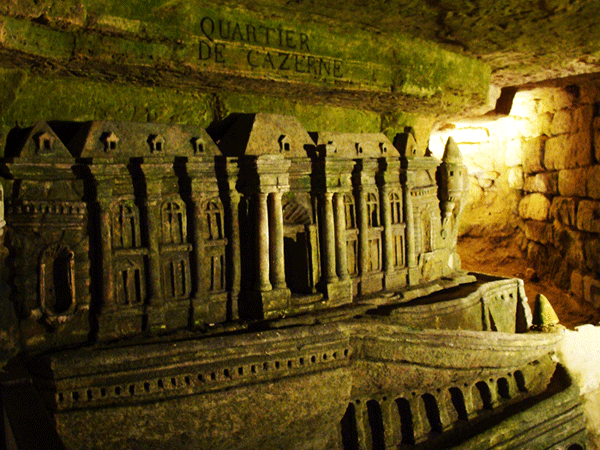
The first thing you see of any particular note are these sculptures, carved out of the rock.  They were carved by a veteran soldier of l'armée Richelieu who was injured during the conquest of Minorque.  He turned quarryman to supplement his salary after recovering from his wounds.  His name was Décure, dit Beauséjour--or something like that--and at one time was imprisoned at Port Mahon (on Minorque), which is what this carving replicates.


According to French wikipedia, Décure wanted to perfect his work and so began to "undertake the creation of a staircase."  Unfortunately, his quarrying cause a sinkhole which collapsed on him and killed him instantly.  No word on where he was buried.

Le bain de pieds des carriers.
A well for the feet of the quarrymen; used by the workers of the ossuary.


Finally; a long walk and there is faint darkness creeping across the floor, though shadows are superfluous.  The entrance to the actual catacombs is hardly grand.  Carved across the lintel in capital letters:

ARRÊTE! C'EST ICI L'EMPIRE DE LA MORT
Stop.  This is the empire of death.

Now, I know I believe in ghosts.  I know that though cemeteries are alluring they always keep me on the edge of fascination and discomfort so that I'm too intrigued to leave immediately and yet always so relieved when I finally do.  I know that watching me in a graveyard (or old country church) is like watching a seven-year-old play hopscotch as I try to avoid stepping on the graves; I would rather step around them.  And I know mass grave-sites are particularly troubling to me, particularly when I'm told about one after I'm already standing atop it.  But--no way in all get-out the empire of death is stopping me.

So I stepped in, of course.

"Et comme tous meurent en Adam, de ême aussi tous revivront en Christ"
For as in Adam all die, even so in Christ shall all be made alive.
                                                                                        1 Corinthians 15.22


Ainsi tout passe sur la terre
Esprit, beauté, grâce, talent
Telle est une fleur éphémère
Que renverse le moindre vent

Thus, everything passes on earth
Spirit, Beauty, Grace, Talent
Such is an ephemeral flower
That reverses the slightest wind

The story of the catacombs I don't think is well known, but is also not as gruesome as one would imagine (or, dare I say, morbidly hope?); it begins with understanding the growth of Paris as a city.  For centuries, Paris was merely the size of Ile-de-la-Cité--the islands in the middle of the Seine.  More of a town, than a city, it was surrounded by farm land, meadows, fields and the like.  During the 16th century, coming out of the Middle Ages, and moving into the Renaissance, the size of the city had hardly changed from when it was run by the Romans.  Even the abbey of St.-Germain-des-Prés, which is but a ten minute walk from the islands now, was outside of the city center.  Of course the city was far more compact then, with narrower streets and houses built on bridges, to accommodate for the growing population.

A model at the Musée Carnavalet of  what16th century Paris would have looked like.

It stands to reason, then, that churches for the towns outside of the city center would ahve their own cemeteries--much like the ones you would imagine surrounding the countryside churches in England.  Likewise, Paris, too, had its own cemetery called Cimetière des Innocents and was located in what is now the area of Paris known as Les Halles.

But as my History of France professor would say, "Cities eat people."  Though by the Revolution the size of Paris was still not even a twentieth of what it is today, the city was taking an influx in population, and thus beginning to grow in size.  Surrounding villages were swallowed up by the city boundaries, and people flooded those areas--areas like Les Halles.  What used to be an outlying area perfectly suited to bury Paris's dead, was becoming overrun with people.  As Paris's population increased, so did its death toll; Cimetière des Innocents became crowded not only by the living, but with the dead.  By the late 1700s, near the eve of the Revolution, Cimetière des Innocents was a public health issue.

The project of the catacombs was realized as a solution soon after, the old quarry tunnels already in existence.  The bones of the cemetery were dug up out of le cimetière in Les Halles and moved across the river then dumped into the quarry tunnels.  Other churches, which used to have space for their parishioners after they died also became crowded, and the bones were also moved to the present area of the catacombs of Paris.  The project took years, and at the time were merely piled, not stacked or arranged.


Tout nait, tout passe, tout arrive
Au terme ignoré de son sort
A l'océan l'onde plaintive
Aux vents la feuille fugitive
L'aurore au soir, l'homme a la mort

All are born, all pass, all arrive
To the end of their unknown fate
To the plaintive ocean wave
To the winds the fleeting leaves
Dawn 'til Evening, man has death


A la mort on laisse tout.
At death, we leave everything.

Among the first visitors to the catacombs was future king Charles X (he would not be king until decades after the Revolution), who was then le comte d'Artois, in 1787.  Curious about the place, he is rumored to have gone down into the catacombs with a company of "women of the Court."  However, not long after the bones were moved, and the areas which used to be cemeteries were developed and covered up--swallowed by the city--the Revolution broke out and the bones in the catacombs were forgotten.

By most.

In fact, during the Revolution many of those who died during certain uprisings or in prison massacres were buried straight in the catacombs, a practice largely hidden from the people.  Those remains and years are marked clearly now.

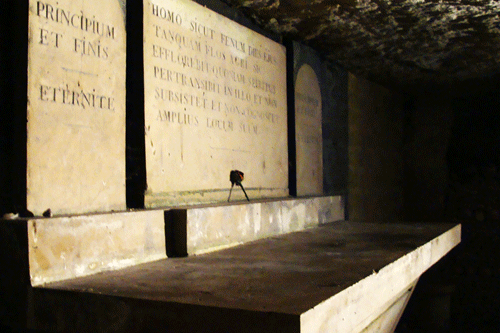
After the Revolution the interment of bones from local church cemeteries continued until the early 19th century when Louis-Étienne Héricart de Thury inherited the duties of overseeing the quarries of Paris, and thus the Catacombs.  It was he who organized the first visits to the Catacombs in the second decade of the 19th century.  It was also he who had the bones, previously 'dumped' in the quarries, organized and aligned in decorative motifs, including plaques for when the bones were moved, where they were moved from, and bits of poetry about death and it's impending certitude.

Croyez que chaque jour est pour vous le dernier.
Believe that each day is your last.
                                                      - Horace


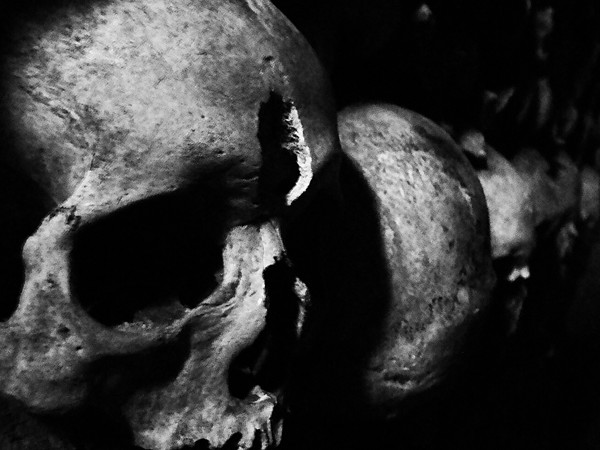
Hopefully his gives you some indication of how many bones are down in the catacombs of Paris.


Quels enclos sont ouverts! quelles étroits places
Occupe entre ces murs l'a poussière des races!
C'est dans ces lieux d'oubli, c'est parmi ces tombeaux
Que le temps et la mort viennent croiser leurs faulx
Que de morts entasses et presser sous la terre!
Le nombre ici n'est rien la foule est solitaire.

What enclosures are open!  What narrow places
Occupied between these walls, the dust of the races of men!
It is in these neglected places, it is among these tombs
That time and death come to cross their scythe
That of the dead, piled up and pressed under the earth.
The number here is nothing; the crowd is solitary.


Venez gens du monde venez dans ces demeures silencieuses et votre âme
alors tranquille sera frappée de la voix qui s'élève de leur intérieur;
«C'est ici que le plus grand des maîtresle Tombeau tient son école de vérité.»

Come people of the world, come into these silent mansions
Then will your soul be struck by the quiet voice which rises from within;
"It is here that the greatest of masters, the Tomb, holds his school of truth."

The basin below used to hold a torch kept lit by the quarrymen to encourage airflow.
Behind it gives an indication of the number of bones and the artistic ways they were stacked.

There are six million bones down in the Catacombs.  Coming from cemetery's and churches of Paris that existed long before the catacombs did.  Some of the bones date from the Revolution--the 18th century.  But others are much older, having been in the ground of the old cemeteries long before they were dug up and moved here.  While the Catacombs of Paris is the largest necropolis in the world, the area it covers is merely 1/800th the area of Paris's modern city limits.


Mass was once held in the catacombs.

Quarry reinforcement arch, to keep it from caving in.

Credits.  The Catacombs brought to you by:
M. Thiroux de Crosne
M. Guillaumot, inspector of the quarrymen in 1786
restored and augmented by order of M. Frochot
and M. Hericart de Thury, inspector in 1810. 


 Chaque mortel parait, disparait sans retour;
Mais par d'illustres faits vivre dans la mémoire
Voilà la récompense et le droit de la gloire.

Each mortal appears then disappears without return;
But by illustrious acts lives in human memory.
In this is the reward and the right to glory.