Pages

Monday, May 14, 2012

Paris au Moyen Age

You can slap my wrist later because I haven't done anything even remotely related to my project for almost a week.  For now, you can be proud of me because I got out of the apartment before noon today without the excuse of having to meet my landlady or the necessity of going to a church meeting.  This is what got me out and about today:


Yes.  That's right.  Medieval Paris.  I think I'm in love, and also, I should have known that 1920 isn't long enough ago.  I was walking through the Montparnasse Cemetery the other day, disappointed that all those people had died between 1875 and 2011.  "Isn't there anyone who's been dead LONGER?"  I'm going to Montmartre Cemetery one of these days to see if people there have been dead longer.  After I get my bearings in the parts of Paris I can walk to, I'll start venturing out to the parts I have to Metro to and walk back from.  I'm hoping my shoes will be nice and worn in by then.

Anyway, Medieval Paris.  I went to St.-Sulpice the other day and just about died


(of happiness).

It's just about that beautiful in person, except all that open space around it is a lie.  There's a nice big square out in front of it, where some boys were playing football before I went in to attend messe and they were still there when I got out an hour later, so I sat and watched them for a while.  I have to admit, Catholic mass feels different from an Anglican service, which I've been to half a dozen of.  Even in the center of Paris, there are local paroissiens/parissioners--um, I don't know the spelling in either English or French, so you'll have to take a cross between the two--and its much like it must have been a hundred years ago: a community church service.  Only there are less people than there used to be (or so I assume) and several of the people attending are tourists (I'm going to count myself as one of them for the time being).  I do prefer the church when its silent and I get to walk around and sit and worship God in my own way, but I'm glad to have had the experience of mass, regardless.

St. Sulpice opened doors.  I decided to do some research on it because I want to write an architecture piece on it for one of my classes.  I started with wikipedia, which is really a lot more useful than academia gives it credit for.  And I found this.


And this is what I thought: "Holy Hell.  Streets.  That existed then.  That might exist now."

So it started a long and involved internet search for Medieval maps of Paris in which one of the maps I found was the first one I posted above.  I encourage you to click on the picture and see it at full resolution, if it lets you.  It's awesome.  Well, I'd been wanting to go to St. Germain-des-Prés, when what should I find out but that it's the oldest church in Paris, founded in the 6th century by the SON OF CLOVIS (relaying this information makes me want to cry--seriously).  ARE YOU HEARING ME?!  CLOVIS!  (Also, a Medieval side-note: Clovis-->Clouis-->Louis.  The French have been using that name for a long time.  Is your mind blown?)  Anyway, the tower of the Abbey of St. Germain-des-Prés was finished in 1014.  You're probably one of those people to whom dates mean nothing.  1014 was almost 1000 years ago.

0 0 0 0 0 0 0 0 0 0 0 0 0 0 0 0 0 0 0 0 0 0 0 0 0 0 0 0 0 0 0 0 0 0 0 0 0 0 0 0 0 0 0 0 0 0 0 0 0 0 0 0 0 0 0 0 0 0 0 0 0 0 0 0 0 0 0 0 0 0 0 0 0 0 0 0 0 0 0 0 0 0 0 0 0 0 0 0 0 0 0 0 0 0 0 0 0 0 0 0 0 0 0 0 0 0 0 0 0 0 0 0 0 0 0 0 0 0 0 0 0 0 0 0 0 0 0 0 0 0 0 0 0 0 0 0 0 0 0 0 0 0 0 0 0 0 0 0 0 0 0 0 0 0 0 0 0 0 0 0 0 0 0 0 0 0 0 0 0 0 0 0 0 0 0 0 0 0 0 0 0 0 0 0 0 0 0 0 0 0 0 0 0 0 0 0 0 0 0 0 0 0 0 0 0 0 0 0 0 0 0 0 0 0 0 0 0 0 0 0 0 0 0 0 0 0 0 0 0 0 0 0 0 0 0 0 0 0 0 0 0 0 0 0 0 0 0 0 0 0 0 0 0 0 0 0 0 0 0 0 0 0 0 0 0 0 0 0 0 0 0 0 0 0 0 0 0 0 0 0 0 0 0 0 0 0 0 0 0 0 0 0 0 0 0 0 0 0 0 0 0 0 0 0 0 0 0 0 0 0 0 0 0 0 0 0 0 0 0 0 0 0 0 0 0 0 0 0 0 0 0 0 0 0 0 0 0 0 0 0 0 0 0 0 0 0 0 0 0 0 0 0 0 0 0 0 0 0 0 0 0 0 0 0 0 0 0 0 0 0 0 0 0 0 0 0 0 0 0 0 0 0 0 0 0 0 0 0 0 0 0 0 0 0 0 0 0 0 0 0 0 0 0 0 0 0 0 0 0 0 0 0 0 0 0 0 0 0 0 0 0 0 0 0 0 0 0 0 0 0 0 0 0 0 0 0 0 0 0 0 0 0 0 0 0 0 0 0 0 0 0 0 0 0 0 0 0 0 0 0 0 0 0 0 0 0 0 0 0 0 0 0 0 0 0 0 0 0 0 0 0 0 0 0 0 0 0 0 0 0 0 0 0 0 0 0 0 0 0 0 0 0 0 0 0 0 0 0 0 0 0 0 0 0 0 0 0 0 0 0 0 0 0 0 0 0 0 0 0 0 0 0 0 0 0 0 0 0 0 0 0 0 0 0 0 0 0 0 0 0 0 0 0 0 0 0 0 0 0 0 0 0 0 0 0 0 0 0 0 0 0 0 0 0 0 0 0 0 0 0 0 0 0 0 0 0 0 0 0 0 0 0 0 0 0 0 0 0 0 0 0 0 0 0 0 0 0 0 0 0 0 0 0 0 0 0 0 0 0 0 0 0 0 0 0 0 0 0 0 0 0 0 0 0 0 0 0 0 0 0 0 0 0 0 0 0 0 0 0 0 0 0 0 0 0 0 0 0 0 0 0 0 0 0 0 0 0 0 0 0 0 0 0 0 0 0 0 0 0 0 0 0 0 0 0 0 0 0 0 0 0 0 0 0 0 0 0 0 0 0 0 0 0 0 0 0 0 0 0 0 0 0 0 0 0 0 0 0 0 0 0 0 0 0 0 0 0 0 0 0 0 0 0 0 0 0 0 0 0 0 0 0 0 0 0 0 0 0 0 0 0 0 0 0 0 0 0 0 0 0 0 0 0 0 0 0 0 0 0 0 0 0 0 0 0 0 0 0 0 0 0 0 0 0 0 0 0 0 0 0 0 0 0 0 0 0 0 0 0 0 0 0 0 0 0 0 0 0 0 0 0 0 0 0 0 0 0 0 0 0 0 0 0 0 0 0 0 0 0 0 0 0 0 0 0 0 0 0 0 0 0 0 0 0 0 0 0 0 0 0 0 0 0 0 0 0 0 0 0 0 0 0 0 0 0 0 0 0 0 0 0 0 0 0 0 0 0 0 0 0 0 0 0 0 0 0 0 0 0 0 0 0 0 0 0 0 0 0 0 0 0 0 0 0 0 0 0 0 0 0 0 0 0 0 0 0 0 0 0 0 0 0 0 0 0 0 0 0 0 0 0 0 0 0 0 0 0 0 0 0 0 0 0 0 0 0 0 0 0 0 0 0 0 0 0 0 0 0 0 0 0 0 0 0 0 0 0 0 0 0 0 0 0 0 0 0 0 0 0 0 0 0 0 0 0 0 0 0 0 0 0 0 0 0 0 0 0 0 0 0.

That's a thousand 0's.  For you.  To see how many 0's it would take to make a thousand.  One 0 at the end of every year.  That's a LOT of years.  Okay.  So here I am just looking at this map of this ancient church that used to sit on this one street in--and I realize, it still does.  I can GO.  I can GO.  It's like...a 20 minute walk.  So I decided to make it a Medieval Monday.  I woke up, got ready to go out, and started on my Medieval Monday adventure.  I walked down to Luxembourg Gardens, then down St. Michel, and ancient Roman thoroughfare, past the Abbey Cluny, now the Musée du Moyen Age, left on Blvd. St-Germain, and down, down, down the street until I got to St. Germain-des-Prés.  St. Germaine of the Fields.

I walked in.

Choeur Des Moines De L'abbaye De Saint Benoît Sur Loire – Fantaisie En Do Mineur

I wish you could hear my laugh.  The happy laugh I get when I walk into really old cemeteries.  That kind of laugh.  The "Yes, I really AM here," laugh.  Because the organ was playing.  It reverberated through the entire church.  I don't know if you know what that sounds like.  These old stone churches were made for noise: for singing, for the organ; for soft chattering.

Sometimes one of your senses takes over, disallowing any other from experiencing a space.  I'm fairly certain I was blind for a few moments after I walked into the church because my ears were taking in the surrounding.  But eventually my ears gave in to my eyes.  Not many people know that the ancient statues outside of the medieval churches like Nôtre-Dame and the old Greek and Roman statues used to be painted.  (At the musée du Moyen Age at the Hôtel Cluny/Abbey Cluny (Hôtel-->Hostel, just another word in French for Mansion, basically) they've got some of the heads of the old statues that used to be part of Nôtre-Dame before they were broken off and destroyed in the revolution, and the ancient statues still have red on the lips and cheeks, and green in the eyes, left over paint from long ago.)  In ancient-style, nearly every inch of Saint-Germain-des-Prés is painted.  The columns, the archways, the walls, the ceiling--everything but the floor.

St-Germain-des-Prés
(Cette image est tirée de simplyparis.org)

I didn't take this picture, and it is a beautiful picture, but it doesn't do the place justice.  The inside of the church is darker than this, so much darker.  And the light is not so soft.  It's creepier, somehow.  And yet still, the color comes through, not like a shine, or a punch, but a resonance, refusing to wear away, though it fades.  I have no idea how often they've restored the paint, and I have no idea if it looks anything like what it looked like when it was painted in antiquity, but the point is certainly gotten across.  No other church I've gone in to is painted this way on the inside, though it gives a good idea of what many of the churches must have been like before they were destroyed during the Revolution.

That's another thing to think about.  Here in Paris, the Revolution happened, but no one in particular started it, carried it out, or even felt the effects of it.  It is almost always spoken of in the passive tense.  "Destroyed during the Revolution," but not destroyed by whom?  Destroyed for what reason?  The Revolution is spoken of like a force of nature that came through Paris, destroying the things people miss most about how Paris used to be: the history, the age, the culture; but blame is attached to no one in general reference to the Revolution.  That's very interesting to me.  I can't tell yet, but will get back to you about whether I deem it shame, reverence, respect, a knowledge of happenstance, a statement of fact, or something else entirely as a reason why they speak of the Revolution this way.  In America we kind of think of the French Revolution as this interesting point in history.  Here...the scar isn't interesting, it's just a reminder of pain.  I'll get back to you on this.

Most of the abbey of St.-Germain-des-Prés was destroyed during the Revolution, but the little church still stands, par la grâce de Dieu, I'm sure.  This reminds me of St. Paul's Cathedral in London.  I do believe God saved that place from ruin; why not these churches in Paris?

So I walked in.  Organ playing, making the place creepier than it would have been in silence.  Entire inside of the church painted, making it darker than St. Sulpice.  Smaller than Nôtre Dame, but still with plenty of Chapelle's around the nave and transept.  Candles burning--I lit one in L'Eglise St.Etienne du Mont the other day, so decided not to light one here.  It's less crowded than Nôtre-Dame, or even St. Sulpice; it's easy to misread as a small parish and decide to walk past after seeing the likes of those other churches.  And I know I keep comparing these churches.  Here's why: they told me when we went to London that I'd get sick of going into the Cathedrals and churches, that after a while they'd all start to look the same, or feel the same.  I'm not saying I'm special or anything, I'm no cathedral-whisperer, but that's never happened to me.  They're all so different, they've all got a very particular feel.  Maybe it was knowing that St.-Germain was the oldest, but I think I could really feel it.  It kind of took me by the spirit and clenched its fist around my insides and didn't let go until I left.  I wasn't uncomfortable, but I was sad.  Does anyone else get that way in places with lots of history?

I sat and thought and wrote for about an hour before leaving the church and walking around the area, particularly down Rue du Four, which is a street that existed in Medieval times, despite the names of all the major roads (St. Michel, St. Germain, etc) having changed.  I decided to wander through some of the smaller roads, making my way back to St. Sulpice, and then returning to Abbey Cluny.

Abbey Cluny I have been more or less fascinated by for two weeks, since I first walked by it with Kate on Bd St-Michel.  Old buildings do that to me.  It was an old Roman Bath, I believe, then an Abbey, then it was destroyed, and made into an Abbey again, and destroyed and into an Abbey again, and then destroyed and built onto by some rich woman who bought the land.  (This is all very spotty history, so don't take my word for it.  It's just to give you an idea.)  I kept telling myself I'd go to the Museum, but didn't, and didn't.  Then it became Medieval Monday, and what do you know...there I was.

I had a somewhat successful conversation in French with the man who I bought my ticket from.  He treated me like I wasn't an idiot, which was preferable.  I asked for a student ticket, he asked if I "had less than 26 years."  I said yes.  He asked to see my ID and I said, I'm American.  He smiled and said, "Tarif Reduit" (Reduced Cost).  I said, "Parfait."  He told me there was an audio guide in the next room, and that I could get it in English.  I said, "Merci."  And then I went on my way.  My conversation with the audio guide woman was less perfect because she started speaking to me in English as soon as I asked for an audioguide "en anglais."  I was going to ask for it in French but decided I was really too curious about the middle ages in France to lose half of the information I could get by listening to it in French.  I'm working on it.

My camera died which wasn't even on the radar for me.  So here are some pictures (the ones I could salvage) from my phone, which hasn't died since I got into Paris, as it's got no SIM card and is on flight mode.  Glorious.  But the pictures aren't so glorious.  I'll go back to the Museum and get pictures of the outside, the pleasure gardens (if you want the explanation of that, you can ask for it, and I'll give it), and the Hotel du Cluny.

Roman foundation and brickwork:


The reason Roman buildings NEVER go away.  These bricks are slabs, so walls are more than a foot thick.  The Romans feared being forgotten and made sure they wouldn't be.


Roman ceiling.  Fascinating to me, but maybe not to you.


Hotel du Cluny, the Abbot had his personal chapel.  Here is the staircase leading up to it.


Here are my feet, standing on the floor of the chapelle.  I love floors and ceilings of old buildings best.


Two other things I loved about the museum.

Arms room.  Old weapons/shields/armor are awesome.


This sculpture carved of wood.  My favorite in the museum.


A common theme of thought for the day was that only the history of the rich is ever really kept.  I, of course, was very interested in all of the things I saw, listened to and read about today, but it was very apparent to me that I was reading and listening to the history of the rich, or of the church--which was rich.  There is so little written or recorded about the lives of the common people who lived in Medieval Paris, and that's something I'd like to spend some time looking into.

The man who did a lot of the excavation for Cluny III, the ruins of the third abbey of Cluny, was an American--Kenneth J. Conant.  He dedicated his life to Medieval Architecture, particularly that of Cluny.  I love that he made such a difference somewhere so far from home.  That he gave this place something they hadn't given to themselves.  I think sometimes it takes someone from the outside to remind the people on the inside of how interesting their history and their ruins are.  It takes someone from the outside to ask the questions that no one else thinks important to ask.  Can you imagine what else is under these Parisian roads and buildings?

The last time I wrote a post this long about the things I learned someone made a comment about it being too academic for them.  This should not have hurt my feelings, but it did.  I get that I've been in school for my entire life, but honestly academic??  This stuff is interesting.  So keep your mouth shut and don't relay this kind of information to me in the future.  If you're interested in me reporting on something else other than what I did while in Paris or something other than the fascinating stuff I'm seeing WHILE IN PARIS, then let me know and I'll be happy to oblige if you find a nice way to say it.  I'm the only me you've got, so take me or leave me.  (I'm guessing most of you will opt for the leaving me part...eh, oh well.)

I proceeded to come home and listen to Chants Gregorien late into the night while eating crepes and nutella, which I'm sure they did in the medieval ages, also.

Any suggestions about what Tuesday's theme should be?

Wednesday, May 9, 2012

Children


Is it just the fact that someone told me once that the French find their families important, or is it really all over these streets of Paris—the truthfulness of that belief?  There are children everywhere, much more a part of the streets of Paris than I’ve ever recognized in London, or Los Angeles or even Provo.  In American cities and towns, children are hidden away at home; but Parisians live their lives and let their children be a part of them.  They take them everywhere, in strollers, and on walks, and they listen to their every word, and take them to play afterschool in the park down the street.  So attentive.  Parisian children are so very loved and encouraged in that love.

I watched a family walk toward me on Rue Vavin as I walked home from church.  A little boy, less than two years old, but walking, had a hand in each parents arm, and it was not the mother only who was attentive, but the father as well, as the opened the door to their apartment building, and walked him inside.  They let go of his hands for a moment, and he wandered between two decorative pillars inside the hallway and sat down between them, stuck in the crevice, smiling proudly.  His mother, patient and attentive, laughed at her son, paying him mind that he was clever, and she knew it just as well as he.

I see fathers in parks with their children always; children are not the woman’s responsibility, but a family responsibility.  At home it seems you only see American fathers with their older sons—when their sons are old enough to play a sport, be taken to the park.  This does not seem the case in Paris.  Rather, fathers take their daughters and their very young children out into the city.  Fathers have a place, even with babies.  And they are attentive to their daughters as well as their sons.  And older siblings too, play a very large role.  I sat in church today and watched a girl who was between seven and nine carry around her younger brother who was hardly old enough to speak.  He had a pacifier and attached to the pacifier was a rag he could hold onto.  He squealed when she put him down.  She was so very attentive to him, holding him and taking him where he wanted to go, reading him and his interests.  She taught him how to stick out his tongue, and she kissed him often.  “Ça c’est qui?” she asked him over and over of a picture of Christ.  “Jésus” she would answer, and he would repeat her with some semblance of sound of the answer.

Tuesday, May 8, 2012

Lesbians and their dogs

I've been in Paris for about a week and a half.  For the four days I had Kate with me, and for the next three I had a friend from school.  I walked around the city with them--mostly the parts of the city tourists go to see: the Seine, Notre-Dame, the Louvre, Jardin du Louvre et Jardin du Luxombourg, Champs-Elysee, Arc du Triomphe, le Tour Eiffel, and then back across Pont Neuf, and down St-Michel through the Latin Quarter.  So this is my second full day in Paris alone.

It's hard to get out of bed in the mornings, either because I haven't got a class to go to or because its cloudy out.  It could be both.  I think it will get better, already today feels better than yesterday did.  I'm getting used to being alone, though I know some days will be much harder than others.

Apart from classes which I haven't really started doing the readings for, I'm taking some notes, though not about anything specific to classes.  I'm trying to get all of the new information I'm soaking up everyday out on paper so I can start looking for specific things like Consumption and Waste or Attire and Adornment.  What most worries me is my French comprehension, so I'm deciding to do an hour of French listening a day either in film or podcast form (church also counts).  I'd sit and listen to french speakers for an hour, but I can't seem to eavesdrop on one conversation long enough to get enough real practice.  So, that's my attempt at making myself learn French.

Participation and Involvement - Entertainment
Yesterday, I wasn't sure I'd get myself out of the apartment to wander the streets alone, so I decided to go to a movie.  To kill two birds with one stone, I went to see a French movie called 'Intouchables' which did really well in the box office initially and was still showing at the cinema less than a block away from my apartment.  This is the first time I've gone to the cinema in foreign-language speaking country, specifically France so it'll take a few séances (that's what they call film shows) to be sure there is any trend to my initial notes, but here it goes.

Whereas in the États-Unis you can stand in line and buy tickets for 10pm at night at 11am in the morning, Paris ticket-offices don't sell tickets to a show until 10 minutes before the film starts.  Also, in the United States there is a particular etiquette in a movie theatre: you can talk during the commercials and especially before the commercials, but typically when the trailers begin, everyone is quiet.  So far, in my grand experience of one movie, this is not the case in Paris.  While there were a few people in the theatre who did not speak once trailers started it was because they, like me, were seeing the movie alone.  Everyone who had come to the theatre with a friend/date/family spoke loudly--did not even bother to whisper--all the way  up until the movie started.  As someone who goes to the cinema often, this was extremely annoying to me until I realized that they might not have the same reverence for trailers that I have--and then I didn't blame them, because reverence for trailers does seem a little strange.

I do have to say--I love that they call them séances, though I'm sure it doesn't even come close to having the same connotation in French as it does in English.  In French it just means 'session' or 'show' while in English it connotes some cultish meeting with the dead.  Regardless, that's interesting.

Well I watched the entire movie and didn't understand a single word of it, which I knew would happen.  It did get me thinking in limited French for about an hour afterwards, however.  At the end of the movie, whereas the lights come up immediate in the United States, the lights were dimmed for at least half of the credits.  I always stay for the credits--something my father always does, that I have continued in my own film viewing--so I felt a certain appreciation for the French who stay for part of the credits until the lights are at least brought up, though most of them stayed even until after the lights came up, until the credits were nearly finished.

--

After the film, I wandered St-Michel to find a MonoP* and Boulongerie to get some food.  So far I've been eating bread, goat cheese and tomato at almost every meal, which, while I realize is nutritionally problematic, is not being contested by my taste-buds.  I did have eggs yesterday...with tomatoes and goat cheese and bread.  Haha.  Well, I'll be working on that, trust me.  It's just that I'm so used to getting food in bulk and I'm used to having a microwave, or an oven.  So the amount of things I feel capable eating are limited.  I'm also quite the wuss.  I usually scout something out several times before I feel comfortable going in and then I get out as fast as I can.  I'm just getting used to my hallway, for example, which I now feel comfortable walking down in my bare feet.

I also hate looking like a tourist.  Because while I am a foreigner, I'm not exactly a tourist.  Also, I hate that I can't understand the things other people say to me.  It's not my inability to respond that bothers me nearly as much as my ability to listen, which I've always used far more often than my ability to speak.  So for those of you who think I talk a lot, imagine how much listening I must do to make up for it!  I do in fact listen to everything around me, as I am unable/incapable of ignoring anybody.  But when they're speaking in a different language it seems a lot easier to assume they're not speaking to me--but the catch is: they might be, I would just have no way of knowing.

Anyway, so I'm just going through some minor "OMG" moments trying to keep my ears and eyes open.  Which reminds me, I'll be walking around in Paris and hear the most bizarre coupling of words in French and think to myself, "Wow, I must have misunderstood that."  Then the other day I was walking by a café and overheard these two English girls talking saying, "...the lesbian and her dog..." and I couldn't help but laugh.  And I realized--I heard them rather clearly, she said "the lesbian and her dog," and I didn't think I misunderstood them, I just realized that I overheard a few odd words in the conversation.  It made me re-think what I was hearing in French--maybe the French are talking about lesbians and their dogs, also, and I'm just overhearding odd things, rather than misunderstanding.  This is why I've decided to listen to podcasts and movies rather than eavesdropping on conversations (though trust me, I'm trying to do that too) but I literally understand nothing.  So many different voices, and accents--its killing me.

Oh, but I have to remind myself, it's just day 2 on my own.  Kate was not speaking to me in Chinese and Jake was not speaking to me in Russian.  So I should cut myself a little slack.  I am getting better at recognizing the tourists: English, Indian, Italian, American, Chinese, Japanese, Russian, French, Spanish, German.  Though I can't understand what they're saying (except the Americans and sometimes the English) I can distinguish between their languages, which I'm rather proud of.

Back to the main point: I will continue looking for food I can eat.  I will continue going to films.  I will continue to eavesdrop on French conversations.  There's an update on the last week and a half.  I must remember to say 'Bonsoir' in greetings after 5pm.

Au revoir!

CE#1

Where to begin?

I'm in Paris.

The 2012 Presidential Elections are going on; the other day while Kate and I were walking by the Opera, there was a large gathering listening to Marine Le Pen in the square.  It was unlike anything I've ever heard and it was glorious.  I couldn't understand everything she said, but she kept talking about 'La France' and returning to what France was, making jokes about Sarkozy and the crowd would laugh and cheer and chant.  I wished I could stand around all afternoon and listen, and I would have had Kate not been with me; had we not other things to see before she left Paris.  I know very little about the political process in France, but I get the feeling Sarkozy is scrambling and I'm not certain he'll win this one.  It's not so much that Hollande will change France significantly, but that the French believe someone new should be in power; Thank God they've got democratic elections now; I prefer that to chanting that leads to bloodshed or something.  I don't know how much presidents change in France because they don't do much in the United States necessarily, things change so slowly at home.  But its the idea of who is representing your country.  As for our own elections, I both sincerely hope and legitimately think that Americans are not angry enough with Obama not to re-elect him.  I'll have to follow these elections here in Paris a little more closely as its a big deal right now.    I do better with hard copies, so maybe I'll have to pick up a newspaper somewhere.

Saturday, April 7, 2012

Who you are.


You don’t seem very happy.  I think maybe a lot is worrying you.  I want to care, and I do care, but I’m afraid to show it, since there is so little I can do about it.

I want to be thoughtful, considerate, kind, but those things I associate with a prior me, a weaker me.  And so I will be those things, when I feel you understand me, but until then I’ll show you the roughness, and there isn’t a way for you to get in until you give me a reason to let you.

I’m eating cinnamon yogurt pretzels from the corner market. They’re not a terribly dignified food, I’ll give you that, but they’re addictive.  There might be cocaine in them.  Which brings me to another point: I think I do more eating in private than I do in public.  I hear this is a major difference between me and France.  We may not get along.

Honestly, how many people have this opportunity?  I’ve done this to myself, so to speak, and I know this is not something most of the people in the world, let alone most of the people in history get to do.  I need to stop treating this as difficult and start regarding it as a chance.  That’s what it is, a chance.  And I think there was a time and place for realizing how difficult this trip was/is going to be.  I don’t think that culture shock should be ignored; I don’t think that safety should be ignored.  However, I also think that I get to live in Paris for three months, and that’s exciting.

Americans have gone to Paris for a lot of different reasons; artistic endeavors, racial equality, social freedoms, a need for inspiration, a love of French culture.  But the great things about France were not introduced to me through war; nor am I escaping some terrible prejudice; neither am I facing financial or social ruin.

Turning 19 was hard for me.  Turning 20 was a million times worse.  I wanted to do something significant in my life because I felt I’d done nothing significant thus far, and that desire has led me down a lot of paths.  I turned 20, and then I went to London.  I turned 21 and I went back to college; moved in with new roommates; became a new person.  I turned 22 and I started planning my trip to France.  I’ll be 22 for a month and nine days before I turn 23.  Sometimes I just feel like time is passing too quickly, and if I don’t hold myself to doing something interesting or memorable, my life will pass without anything in it.  For my first two months of being 23 I’ll be living in Paris; I’ll graduate from university; I’ll hopefully get an internship in a Museum in LA county, I’ll hopefully get a job that makes me want to get up in the mornings.  Hopefully I’ll make enough money to move out to DC, take the GRE and begin applying to graduate programs back East.

But really, everything is in flux and none of these things could happen.  So what do I know?  I know that I’m a different person than I was when I was 18.  I’m a different person than I was in high school.  I’m meaner, I’m more abrasive, I’m more offensive, I’m less likely to give a crap about you or anyone else, I’ve been told I’m mysterious (that’s not really very true).  I’m less religious.  I’m less kind.  I’m less often loved and less often lovable.  I’m less patient.  But.— I’m also less likely to be used or manipulated.  I’m more spiritual.  I’m less likely to let other people dictate to me how I feel.  I’m more long-suffering.  I’m writing my own script for life, and so although the grammatical mistakes and bad cadence are mine, so are the jokes, and the sincerities.  The deep and abiding love which I am capable of feeling is better funneled into the people I know will appreciate it.  I love deeper and know better how to show it.  Some of my relationships are actually fulfilling.  When people say they like me, it’s because they actually like me.  I’m more relatable.  Mistakes don’t bother me.

And it’s not that I don’t have my problems, and it’s not that I don’t feel lonely most of the days of my life but that none of that matters, because it’s just the way life is and I might as well take those opportunities for joy that are so few and far between.  “Such is the life of a man.  Moments of joy obliterated by unforgettable sadness.” – Le Château De Ma Mère (1990).  But if you don’t look for and enjoy those moments of joy, you will have nothing to offset the sadness.

I feel like I should be writing something a little more epic, given this is my last blog post until I go to France, given that this is my last week and a half in Provo (at least for a while), given that I’m finishing up and undergraduate degree, and that I’m starting a whole new part of my life.  But I can’t think of anything at the moment.  As Don Draper of Mad Men says, “Fear stimulates my imagination.”  So I’m sure that when I become terrified again, something will come.  Until then, I’m leaving you with these thoughts, and perhaps to think about yourself and how much you’ve changed since you started school.  Are you better?  Do you like yourself more?  Because sometimes those answers are different.  I think the latter is more important, and let me tell you why: you are the only person you have to live with for forever.  If you like who you are better, chances are you’re more yourself.  And if you’re more yourself, you’ll have an easier time being better in the long run.

No worries, more to come.  Until then,
Signing off.
Jen

Wednesday, April 4, 2012

Random Worries

I gave my presentation today.  It was a little frustrating because one minute in all the two girls in front of me did was watch the clock.  That's not very validating.  I wanted my presentation to be less about moving through my proposal and a little more about learning something new.  Well, I tried.

I really don't know what else to say about this.  I guess the idea is that I leave in 17 days and I should be preparing myself for that.  But what else is really necessary?  You don't care what I'm really going through because it has to connect back to my Field Study in some way, and so I keep going around in circles thinking of things to say without saying what I really need to say.  At this point EVERYTHING connects to the fact that I'm leaving the country, that I'm doing a field study, but...don't let me try to convince you of that.

That's alright. There's a time and a place, I guess.  But the longer this goes on, me saying nothing, the closer I get to spending this time on a n/a grade, which means that I'm just wasting my time.  Apparently I'm in a bad mood.  Just figured that one out.  Or cynical.  Maybe both.  I guess the problem is that I want to be happy about this, and I am, but it's been dragging out so long that I can't really be very excited.  Before I went to London I had a summer to work.  I don't even know if I'll get the loan I applied for.  And I am worried about money.  But when it comes to money I've never once wondered why I was doing this.  Money never seemed to be a problem--even though it is probably the second biggest problem after the fact that I HAVE NO WHERE TO STAY IN PARIS.  That's a big problem, right?  I think so, and yet here I am, 17 days away, doing nothing about it.

I want to care, but I don't.  Maybe I'll get in a car accident and so it won't matter and that's why I'm not worried.  That's morbid.

Sorry.

I'm going to miss my sisters.  I do miss my sisters, though the older I get the less I miss home.  London cured me of that.  I was so homesick by the end of London, and then I was home for 8 months and then I never felt homesick again.  Boy, what's Paris going to do to me?  I already have trouble missing people.  I think maybe I'm broken.  Old news, right?

Also, if I do find a place to stay, probably I'll end up never leaving my apartment.  Just saying.

I think I need to allow myself a movie a weekend.  Did I put aside money for that?  Probably not.  Am I going to do it anyway?  Yeah... I am.  When one is working, one cannot convince oneself they cannot afford everything one wants.  Unless it's a car, a house, or a baby.  I think I'll always be able to talk myself out of those.  A movie a weekend, and 2 food purchases a week out on the town.  Maybe.  It'll depend on whether I'm living with a host family or not.  (Oh yeah, worry #1, fun.)  Okay, but again I hate the word mitigate because I don't know right now how to fix these problems.  But I'm thinking about them, shouldn't I get SOME credit for that?

Something else I'm worried about?  My best friend.  I can't be happy, because if I'm happy she'll just remind me she's NOT happy...because her boyfriend leaves in 2 weeks, and we go to London in 2 weeks, and then she comes back to Provo which she's not happy about.  Okay.  Well, I'm thinking of a way to be a part of her life even if I'm off in Paris.  She's just feeling sorry for herself right now because she's not going off doing something cool, but these are choices she made for herself, and if they're right, then she's going to be fine, and she'll be doing good things, and they'll be plenty cool.  But I still worry about her.

I worry about who I'll be when I get back.  What my family will think of me, what others will think of me.  But mostly where I'll go after that and what my next adventure will be.  I'm afraid of being stuck somewhere or in the middle of something that doesn't make me happy.  So I like to plan adventures a little in advance.  I like to tell myself that something to look forward to makes me happier.  The truth is, it doesn't, it just makes me feel more useful and more interesting, which in turn makes me feel like I'm doing all of this to surprise people or to make people think I'm crazy rather than because it's something I think I ought to do for myself. That's an idea, hm?

Who knows what comes.  I'm thinking past Paris.  I still can't believe I'm doing this.

Well, welcome to some of my crazy worries.  They may or may not be here tomorrow.

Tuesday, April 3, 2012

Pep-talk for Paris

Sometimes I wonder and think what they'd have done in Paris. What they'd have done in any paradise, even if it wasn't paradise, and what I'd do if paradise existed. I should have done my field study in New Orleans. I should have gone down there and been a volunteer, helping rebuild something, somewhere. I should have asked people about jazz. I should have read Langston Hughes and Zora Neale Hurston at night. Is it ridiculous to say that my mother would probably be more nervous about me going to New Orleans than me going to Paris? Not to mention, Caitlin would never forgive me.

It's funny, that I'm less than a month away now, and more than aware that I'm doing the craziest thing I've ever done before, but also aware that this is just a stepping stone for doing things that are crazier in the future. I was watching The Music Man last night with some friends, and I realized how good it was for me that I wasn't born in a small town. The old women talked of the librarian in a way that I realized people would talk about me if the people from where I'm from weren't used to people hauling off and doing crazy things. For most of them, moving to LA from wherever they were from was the crazy thing. So me going off to Paris is surprising, maybe, but not unexpected, if they know me, which many of them do.

My mom says she's afraid I'll never come back.

I'm not afraid of that, though it wouldn't upset me if I found a reason to stay somewhere.

Going over culture shock again I realized what I'm most prone to is holing myself up in whatever apartment I get or wherever I'm living, reading, writing, but never going out because it means I'll have to go out on my own. That's how I am at home. I love getting in the car and driving somewhere, but I always have to have a purpose, and directions. But then again, I am prone to wander. But wandering for me usually comes with the need for comfort--not total comfort, just an understanding that I can control myself, or...something. I haven't figured that one out yet.

I wanted a way to "mitigate"--I hate that word--this issue. I hate the word because it's so impersonal, and it means nothing to me. It's just meaningless. Anyway, I've decided that I'm going to chose one place that I have to visit every day. Not the same place, a new place. Something to get me out of the apartment. When I went to London, and realized I had no idea what I was doing there, and I didn't have alone time, and it was brand new, and I'd never been abroad, I got an email from my father telling me to go to St. Paul's. Honestly, to make him proud, to tell him I had gone, to write back to him about it, was all that got me out that first weekend. And that was all I needed.

I'm not afraid of the romanticism of Paris. I'm afraid that'll all melt away as soon as I'm in that city alone, and part of me wants to just sit on a park bench for two or three days after Kate leaves and force myself to realize that this city will be kind. I think that's why I might need Langston Hughes with me, to keep me company. I may have found something to love. But which love? And in which life? Kate says that God let me listen to the music, enter those speakeasies and listen. I feel I can remember asking, please let me go. Please. And I imagine God rolled his eyes at me. But it makes me wonder if perhaps I've been to these places before, and if I have, then why be nervous?

I remember thinking when I was in Heathrow for the second time, so nervous because it was such a big airport, and that taxi driver had just cheated me out of about £20 and I was angry at him (and will not be speaking for him in the trials of heaven) and I was afraid of never getting home. Getting into JFK airport was like coming home. You could feel America in the soil, coming up through your feet. Everything clean and in straight lines, the shops on the right in the left, rather than circling around you, and I knew I'd get there. On the plane to JFK they gave us these horrible airplane pizzas but on the cover of the pizza box was the Coliseum, the Eiffel tower, and the London Gherkin, all of which I had seen and been to, if not inside of, and it occurred to me that 4 months ago I hadn't at all been to those places, just seen pictures of them. This wonderful sense of accomplishment came over me. The boy sitting next to me laughed at me, and I explained. He said he was going on holiday to Florida with some friends. I thought that a very odd place to decide to go on holiday, but didn't say so. All of this goes back to the point that I said to myself, "If you can get through Heathrow, you can do anything." I honestly believed that, because I was nervous about it, and I was afraid, and it seems a ridiculous thing to be afraid of, if you've done it, but I hadn't. So when I got back home, an occurrence I don't actually remember, Heathrow had been done. And I knew I could do anything.

Why shouldn't that apply now? Why can't I use that as my reason for going to Paris alone on a Field Study? Gosh I'm crazy, but going crazy--so I've been told--can be a fun experience. If I just let it happen. Damn. I've been through Heathrow! What can't I do? Learn and speak a foreign language? Sure! Travel a foreign country on one's lonesome? Done! Live abroad for as long as a tourist visa will let you stay? Not a problem. I mean let's be clear about this: Heathrow is 10 miles in diameter. 5 terminals. Outside of London. It's got really circular design, so its easy to get lost, and there are a trillion people so it's easy to not be certain where you are. It's only when the plane is going to board that they actually tell you where your gate is, so you have to stave off sleep while you wait for the board to update your gate, meanwhile you may be on the other end of the terminal from your gate. That's not nerve-racking at all.  (In another time-continuum, by the way, Jennifer is still sleeping in Heathrow; she missed her plane and just became an illegal immigrant of the UK.) My question is, if I've been through Heathrow, what can't I do? Well, honestly, I'm aware there are plenty of things I can't do. Like speak Romanian. Or French, for that matter. But you know, people have been doing this for centuries. Americans have been doing this for centuries. What really is the problem?

If you haven't figured it out, this is my pep-talk. Because it's easy to tell yourself its all going to be fine when you've got 3 months until you go. But now it's a couple of weeks, and I really have to do myself some convincing.

Tuesday, March 27, 2012

Shifting


A few months ago I lost a journal of mine.  This is a journal I carry around with me, almost like an anthropologist might carry around a notebook to take notes in; that is what I used this book for.  See, most people think if you use the word 'journal' you are writing down what you've been doing throughout the day, or how you feel throughout the day.  Some of those things were included in my journal, but more often this book contained things I saw, things I learned, things I thought about that I wanted to remember.

I've been telling myself I'll find this journal of mine because there are some things in it that I sorely miss and regret losing.  One thing I miss that was in this notebook were 5-10 pages (small pages, given) of notes I took on a tour my family and I took of Downtown LA's movie theatres.  It’s a tour put on by volunteers, organized by USC on different parts of Downtown LA.  My family and I had been on one of these tours before, but when a friend was visiting LA with me, I asked if we could go on another tour, and my father decided on the theatres tour.

I fell in love.  To the extent that I just wanted to study Los Angeles history, film history, and historical theatres around the Los Angeles area.  I love movies; I love the theatres; I love going to the theatres to watch movies, and I love history.  It seemed perfect.  We walked around Los Angeles for over two hours learning about the different theatres, some abandoned, some altered into storefronts for electronics stores, or jewelry stores, others altered into churches, and some used for special occasions but no longer used on a day-to-day basis.  I thought it was all fascinating.  I took so many notes.  I drew pictures of the things I saw, and drew maps of the streets I turned onto.  I wrote about what these places were, I wrote about what they are now, and I wrote about the stories told about these places.  Los Angeles.  Movies.  Gosh, I miss those notes and I pray that when God resurrects me, he will return all lost items to me.

Have you seen Psyche?  Remember that episode where they know a man who can find any lost object?  I need him.  I hope this book turns up.

But I think these notes I took, and this tour I took of downtown Los Angeles helped me realize how much I love cities.  See, I've always known I loved cities, but I always thought that because we as Latter-day Saints are such "Romantics" (notice the capital R) we attach this romantic notion to nature.  I think I like nature, but I don't share the feeling that without nature I'd die.  I don't need wide open spaces in the literal sense, because I get it in the figurative sense when you're in the middle of a city crowded with people and yet alone.  Its a wonderful feeling.  And I don't mind being anonymous.  I also don't mind being around so many people because we share a camaraderie that I love.

It is the love I have for Los Angeles, and every major city I've been in--San Francisco, Seattle, Boston, London, Paris--that led me to this decision to go the route of Urban Studies within my field study.  I love African American history and I want to learn about it, and jazz, and I want to read about the African American expatriates, but I realized that I want to know about their experience in the city, and I want to know about the culture of the city.  The people are important to me, but in the city the culture isn't held by the people--it's held by the city itself.  It's carried in every brick or cobblestone, every layer of paint, and every broken tile.  The place holds something different.

The people in Los Angeles have changed considerably in the last fifty years, but the place still has a power to it that you can feel when you wander the streets, and it's been there longer than the people who inhabit the streets now.  I think that's important, that people bring culture, but sometimes place is embedded with culture and it's okay to study that too.  I want to take that approach with Paris as I discover Paris and the culture of Paris.  It is this idea that the place itself has embedded within it a culture that allows me and mandates that I go to the city to truly understand what these African American expatriate musicians felt and went through upon moving to Paris and working in Paris and making a home for themselves in a city with a culture that predated them, or anyone around them.

This makes going to Paris necessary.  This makes the location integral and I've been struggling with expressing that or explaining or justifying those ideas even to myself.  But I also think it's an important shift in my field study and realizing why I'm going.  It's not about these African American expatriates necessarily, but the city and learning how to think about the city, read about the city, and talk about the city in a way that expresses this theory that the city is a living organism that contains more than just the people living within it.  But the city is a big place, and one way to study the city is to study peoples' interactions with the city and that's where the American expatriates come in.  To know where they worked gives me a place to start.  To know who they were and their experiences gives me a comparison.  To listen and read their creations gives me tangible evidence of their experience which I couldn't have just by walking through the city alone.

I love these ideas, and I also love that this applies not only to my field study and to Paris but to the city I came from which started this whole thing.  It gives a lot more interest to all the places I'll be going and things I'll be doing.  I need to rewrite my proposal now.  Excuse me.

Friday, March 23, 2012

Symbols of France

Le Republique Francaise: Liberté – Égalité – Fraternité
These are three values not to be ignored in France: Liberty - Equality - Brotherhood.  I think these are probably the values France has ideally held onto most since the French Revolution.

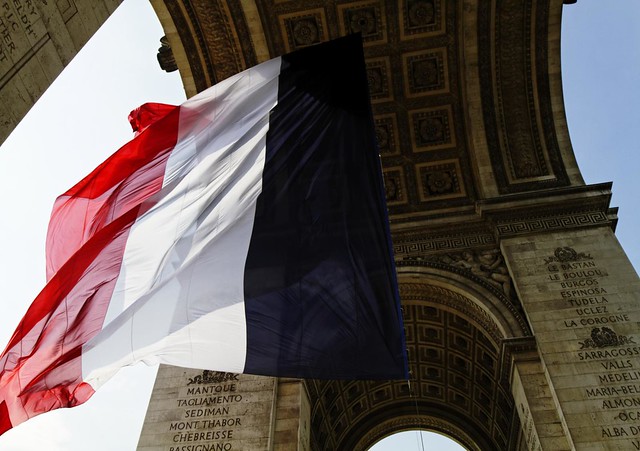
Le drapeau tricolore sous l'arc de triomphe; I have yet to find out why exactly this is done, but it is most certainly a sign of nationalism and it can be seen from so many places within the city.

Fleur-de-lis on the coat of arms of France from ancient times.  Harks back to ancient France, that history and the "legacy" involved.

Lady Liberty - Marianne is an important symbol of France, here she leads men into one of the Revolutions France underwent during the 16th-19th centuries.


Notre Dame, made famous by Victor Hugo after being more or less abandoned after the French Revolution.  A sign of Catholicism in France, but also a National symbol of Gothic architecture.

Blue Virgin Window at Chatres Cathedral - survived from the Romanesque Cathedral after Chartes burned down several times; the Cathedral was not looted during the French Revolution, neither was it destroyed during either of the World Wars.  Once contained the shroud of Mary, given to Charlemagne as a gift from Jerusalem.

Reims Cathedral where the Kings of France--starting with Clovis--were coronated.  This is the third Cathedral on the site, from the 13th century; the cathedral was made bigger for the crowds that would come to coronations.

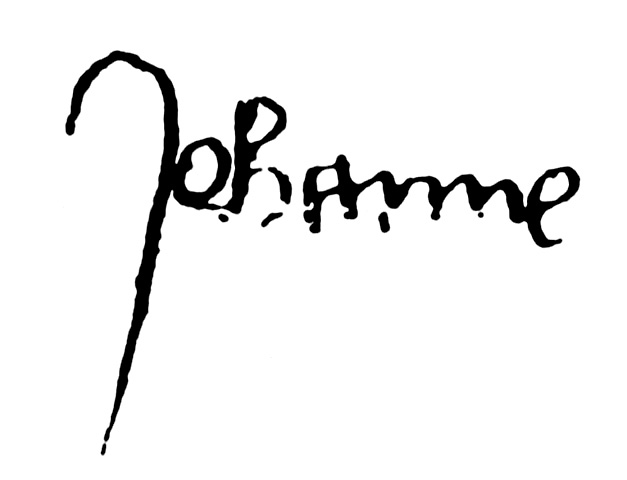
Joan d'Arc has been a consistent symbol in France, her story being used by everyone from Liberals to conservatives, to the Vichy Regime to French Resistance fighters.
Her signature - 'Jehanne' or 'Johanne'  (I just thought this was awesome.)

In all honesty, when we visited the 'Beauty and Belief' exhibit, and we were asked about symbols from our Field Study sites, I had no idea what to say about France.  It didn't take me long when I really started thinking about it, but it did take me a little time to find out why France used some of these symbols to represent their values, ideals, or history.

There's a lot of nationalism in France, a lot of pride for being French and a LOT of history that gets them to those ideals, values and pride.  This doesn't really surprise me.  There are a lot of things not to be proud of in any country's history, but there's so much more to recognize in France as 'legacy.'  Marianne, France's equivalent to our 'Columbia' or Britain's 'Britannia' is the female personification of France, she is valiant and courageous, she is loyal and she is fiercely behind France and its ideals.  She, like Athena, is a warrior, ready to fight if necessary.

French history is also very important, and because of a rocky past, I think the French are big on ideals.  I think Americans are, too, so maybe that's something we can understand about each other.  The difference is the way we interpret or show those ideals, which is something I don't think we always understand about each other.  But in general, the French choose to remember about their history, the things that make them proud of that history, and I think that's par for the course for any country's national memory.  For France, this includes the Cathedrals, even though so much of France are no longer practicing Catholics; this includes Joan d'Arc, even though the French handed her over to the English to be executed.  This includes the values of the French Revolution: Liberté – Égalité – Fraternité, even though those ideals came at such a high cost.  It is interesting that sometimes a culture's most valued ideals are born out of their darkest moments, perhaps when they realize they need them most.

Charles de Gaulle - Regarded as the leader of the Resistance and 'savior' of France after WWII; in reality the history isn't that simple.
Terrein - see my post on Terrein, and the value of 'mon pays.'
The French Resistance during WWII was regarded as being widespread and entirely influential of the eventual dispelling of Germans from France, in reality, most French were not part of the Resistance throughout the occupation.
La rue - Community, and small shops; "small town life" is still important in France, even in big cities.  There is a lot of value put on what we would call 'Mom and Pop shops' or bakeries, and having places you frequent.
Conversation.  Need I say more?  The French will make reservations at a restaurant, and once the restaurant fills there is not 'wait' because guests are expected to stay until the close of the restaurant--doing what?  Talking.  I was born for this place.


Not all values are based off of history, though they are usually based in history.  One such value is the value of mon pays--where someone is from.  I think this comes from a long line of defining oneself as not 'French' necessarily but a Parisien or a Poitevin or a -- no, I'm not going to play this game.  Take a gander at this website which is awesome: (http://www.habitants.fr/index.php).  My point is, ultimately, that there's something to defining yourself against the land you've lived in, rather than the nation constructed around that land.

Furthermore, where did the French get their love for their language?

Acadamie francaise - it's main reason for being is to preserve the French language.  I like to think that this is why direct translations of the French language into English sound like old English--or how we USED to speak, and don't anymore.  Without Academie Francaise, I wonder what French would sound like.

The French are profoundly attached to and proud of their language, I think the existence of the Academie Francaise more or less proves that.  We don't have an English Academy making sure we Americans don't ruin the good language of English--though, I'm fairly certain the English DO think we've ruined their language.  The point is, we don't have one.  We might learn about old English, but that's just the point--it's old.  I'm not sure if the love of talking and conversing about anything and everything is where this pride of language came from, but maybe that's something I'll have to ask.

So how will knowing these symbols help me on my Field Study?  Well, there's something to knowing these values exist, and that they're different from our own.  I think there's something else to knowing the basics so that when you get to your chosen country of study you're not always asking the 'What is that?' question, but asking the 'Why is that?' question.  We waste a lot of time asking, 'What is that?' when the really interesting part is finding out "Why is that?" because that is where, in my opinion, the culture is found.

Wednesday, March 21, 2012

Proposal: Schedule

*working schedule

Winter 2012
IAS 360, Meet with Professor Rowan to create Field Study Courses
Sp/Su 2012
Email Professor Rowan once a week to update him on status of assignments and drafts
Apr 21, 2012
Leave for London
May 1, 2012
Leave for Paris

Find a place to live
May 11, 2012
Complete African American Paris Walks to become acquainted with African American Pairs; Writing Paris: Unit 1 Paper
May 25, 2012
Writing Paris: Unit 2 Paper
June 8, 2012
Writing Paris: Unit 3 Paper
June 22, 2012
Writing Paris: Unit 4 Paper
July 6, 2012
Writing Paris: Unit 5 Paper
July 20, 2012
Writing Paris: Unit 6 Paper
July 30, 2012
Return home from the Field
August 10, 2012
Complete assignments for Cultural Immersion Class
August 22, 2012
Complete final paper for Urban Studies in Paris
August 31, 2012
Complete assignments for Writing Paris; Turn in final “paper” to Field Studies


Cultural Immersion
Urban Studies in Paris
Writing Paris

Gain Entry
Unit 1
Unit 1
April 30 - May 4
Find a place to live, Current Events 1, 2


May 7-11
Spradley’s Social Situations, Kinship Mapping, Current Events 1, 2


Observation
Unit 2
Unit 2
May 14-18
Attire and Adornment, Current Events 1, 2


May 21-25
Consumption and Waste, Current Events 1, 2


Building Rapport
Unit 3
Unit 3
May 28 - June 1
Social Space Mapping, Current Events 1, 2


June 4-8
Participation and Involvement, Current Events 1, 2


Unit 4
Unit 4
June11-15
Domain Analysis, Participation and Involvement, Current Events 1, 2


June 18-22
Education, Current Events 1, 2


Interviewing
Unit 5
Unit 5
June 25-29
Domain and Analysis, Oral Traditions and Storytelling, Current Events 1, 2


July 2-6
Diagraming Local Governance, Current Events 1, 2


Unit 6
Unit 6
July 9-13
Domain Analysis, Education, Current Events 1, 2


July 16-20
Education, Current Events 1, 2


July 23-27
Current Events 1, 2