Our most recent reading about Monochronic and Polychronic time of course made me begin to wonder which I adhered to most, or best. Before reading Hall's article I stumbled across a post written by Averyl Dietering--who is going to the UK--and agreed with her about Monochronic time.
For those of you who don't know Hall's theory about the two different times, M-time is best described as compartmentalizing your time into a schedule. It's what you imagine the President's day is like, with everything from meetings with ambassadors to time for tucking his children into bed mapped out for him. Or, if you knew what my last semester was like, where I had every day to the half-hour mapped out just so I could get everything done, it's like that. The idea of M-time is that the only way to complete things is to compartmentalize them, to schedule them, to do only one thing at a time and then be completed. Hall says that those who adhere to M-time often refer to time as being wasted, killed, saved, lost, or made-up (266). P-time is organic, fluid, and chaotic to someone who operates in M-time, but it is most like a mother's schedule, Hall says. "How else can one raise several children at once, run a household, hold a job, be a wife, mother, nurse, tutor, chauffeur, and general fixer-upper?" If that example doesn't work for you, think of how you learned the Native-Americans treated time. It's about people, Hall says, and the people who deal in P-time are usually never alone, very little is private, and rarely are people excluded or is time compartmentalized. P-time is about keeping people informed, getting people the things they need, and rarely keeping to a schedule, or a queue, etc.
Before knowing this, and just reading Averyl's post, I was certain I was an M-time person. It's what I've done my whole life. School starts at this time, and work starts at that time. Lunch with someone and this time, and a review meting at this time. It's how I've learned to operate, and the way I show I care about people is by not wasting their time. And I definitely think of time as possible to waste if and when I have much I have to do. I, for example, do not appreciate when someone is late to a noon meeting we set up, when I have a lunch planned with a friend at 1. Because I know that lunch friend is operating on M time, and being late is rude. The person I had a meeting with who shows up at 12:45 is even worse because what they're telling me is that they have no respect for my time. But that's ONLY because I have something planned at 1. If I was going to be at work until 4 with no other meetings or plans, I care very little that the person showed up at 12:45. It doesn't matter to me, because I got things done in those 45 minutes and an hour from 12 is just as productive as an hour from 12:45.
So, I realized that I adhere to M-time, and prefer M-time when I know others are keeping me to M-time. But I also realized in reading this article that if it were up to me, I would much rather adhere to P-time. Saturday's, for example, I have always treated as my days. I hate when people schedule things on Saturdays because I like to be in charge of it as my only day. It's my healing day. Yes, I may be doing homework, or I may be sleeping in, or I may be cooking for a crowd, but it's my day and when you M-time schedule my day, I am not a happy person. This is because P-time heals. I couldn't give you a scientific reason why I believe that P-time heals, just that you need time where what time it is doesn't matter to feel like you're just human and not a piece of a machine. And I imagine it's the way life is probably supposed to go, but "civilized" first-world countries can't operate on P-time, or else we don't believe they can and so we don't value it as much. P-time looks lazy, and maybe from some frame of reference it is, but you don't have to be unproductive within P-time, it's just that when you complete things means means little; the clock means little.
I look forward to this Field Study which I feel will consist of the best of both times. I expect M-time to get me up in the morning, and P-time to let me wander. I expect M-time to help me meet people and keep appointments and P-time to let me converse with them with no worries of how long it will take, or how late it is. I expect M-time to catch a train and expect P-time to let it take as long as it needs to. M-time is for initiation into life-experiences, but P-time is for living them. P-time is for healing.
Monday, January 30, 2012

Thursday, January 26, 2012
History is not Dead
I fell into the field of American Studies more by accident than on purpose. And what a happy accident it turned out to be. In high school History had always been my favorite classes, but my favorite subject was always American History and Literature, Government and Economics, and how they all fit together. Hence American Studies sounded perfect. Later in my college career, I discovered I hated the History Department and it's view of history, as though history was finished, complete, done with, over; dead. For me, in my study of history, this is definitely not the case.
In 2010, while I was at home for an 8 month break from school, there was a day I can remember rather clearly when the Armenians in my neighborhood flew flags on their cars and outside of their houses, had parties, were celebrating something. Most of the flags I saw were of an Armenian flag, which made me assume a holiday of some sort, but later in the day I saw the Armenian flag with the words 'ARMENIAN GENOCIDE' printed onto them. I remember my younger sister asking my why the Armenians would be celebrating genocide--let alone genocide of their own people, and all I could respond with was, 'I doubt they're celebrating it, exactly...'
Then in winter 2011 when I took a Political Science class, I did research on my home congressman Brad Sherman, and looked at some of the Resolutions he had been involved in passing, and among them--in March of 2010--was the official recognition of the Armenian Genocide of 1915, despite the Turkish refusal to recognize it as such. Sherman addressed the House saying, "We can not be cowered into denying the first genocide of the twentieth century, because genocide denial is not just the last step of the genocide is the first step in the next genocide. That is why Hitler, when faced with wavering compatriots, could say 'We can get away with the Holocaust, for after all, who today speaks of the annihilation of the Armenians?'" What the Armenians in my town were celebrating was the recognition that the massacre they suffered was in fact one of the first war-crimes of the Great War.
Over a decade ago, in 2001, France passed a law recognizing the Armenian genocide, despite the economic retribution promised them by the Turks. Now, only 3 years from the 100-year mark of the Armenian Genocide, France is voting to pass a law making it illegal to publicly deny that the 1.5 million killed in Armenia was genocide. Sarkozy is criticized for deciding to pass this law, as it is seen as an attempt to regain popularity among the Armenians for the coming elections, but regardless, the Armenian President, Serge Sarkissian wrote, "La France a réaffirmé sa grandeur et son pouvoir, son dévouement pour les valeurs humaines universelles." ("France has reaffirmed her greatness and power, her devotion to universal human values.")
Recognizing the war crimes committed against the Armenians as genocide is an important subject to me, and is why I read up about it for my current-event newspaper article. But what is more important to me is the idea of history in retrospect, that some great wrong committed in the past can still be acknowledged in the present, and that learning about it in the present changes the past in some small way. History is not dead, for if it were, the world would not be moving toward the recognition of the Armenian genocide. History is still being used to swing political favor, to validate economic goals, and to correct past "social wrongs." And it's not just happening in a vacuum: Armenians affect Armenians and the French affect the French, and the Americans affect the Americans. We're more connected than that, and history is more connected to our present than we give it credit for.
This is a small taste of what I would like my project to do: look at history in a new way with the intent of changing how we interpret the present.
More:
Brad Sherman: http://www.youtube.com/watch?v=qFCAXW7ta1Q&feature=colike
In English: http://www.france24.com/en/20120123-genocide-armenia-turkey-france-sarkozy-denial-sanctions
In French: http://www.20minutes.fr/monde/865854-loi-francaise-genocide-armenien-turquie-indignee-riposte-concrete
Tuesday, January 24, 2012
Here follows a series of pictures of the things I'm looking forward to about living in Paris and in France. Towards the end of the semester, I plan to do another to see what has changed/if anything has changed as I learn more about the location, more about the history, more about my project, and more in general. A lot of these things probably strike me as closer to a tourist's goals and aspirations for going to Paris, which there's nothing inherently wrong with. But I would like to see what are some of the first things that come to mind later on in the semester.

L'art (in general)

Boating at Argenteuil - Monet @ Musee d'Orsay

Cinema (ou Jean Dujardin...)

The Views

Notre Dame

The bread

Versailles

The Seine
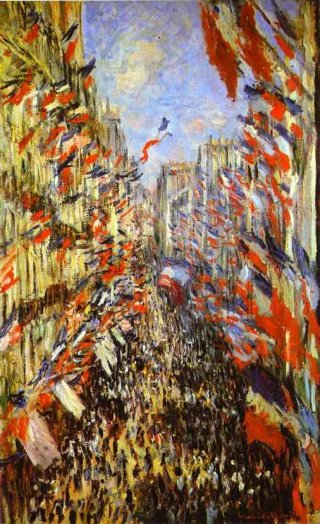
La Fete Nationale

The Museums (Musee d'Orsay)

(Musee du Louvre)

Walking in Paris

Creativity, Conversation, Innovation, Inspiration
Proposal: Statement of Intent
A. Statement of Intent
Little care
is often taken with American culture by Americans—or anyone else for that
matter—but as an American Studies major, I find American culture essential to
understanding those who come to the United States, the United States’ place in
the world, and the changes that take place routinely within the country
itself. However, there are facets of
American culture which are or have been very influential and yet are either
rarely studied, or rarely given credence to as a significant part of a
whole. African-American culture is one
such part which has altered the United States in astounding ways and yet is
rarely given credit within American culture as a whole.
In 2011 I took an American Novels
course which gave me a taste for black-American literature, which resonated
with me further than the other American literature. In this class I realized I was beginning to
love a culture that was not only in part being lost, but was not being
recognized as playing a larger role within main-stream American culture. The fact that we need an African-American
Studies field to augment American Studies is understandable but disappointing
to me—American Studies itself should indicate in its every study the presence
of black Americans, Latino Americans, Chinese Americans . . . the list could go
on. Separating the races is not a true
study of American culture, because America is what it is because of the collision
and/or melding of the races.
In 2010 I began studying French,
and soon decided I wanted to go to France before I began a Graduate
degree. I wasn’t interested in being with
a group of other Americans, since I wanted to be able to practice my
language-speaking, but I would have gone any way I could have when I discovered
Field Studies and realized it allowed me the opportunity to study my French, but
more importantly, meld that interest with my study of American culture. I fell upon an idea and decided I wanted to
study something no one had talked about in my history courses or American Study
classes: the African-American expatriates in Paris and how their presence in
Paris can or has influenced our understanding of American culture.
I want to live in France for three
months so I might be immersed in French culture, much like these American
expatriates were, and so I might better understand what elements of French
culture made Paris appealing for these Americans. I do not feel I can understand the black
American-Parisian culture until I understand the elements of French culture
that brought musicians, writers, painters, and intellectuals out to Paris after
the Great War.
The men and
women who I am interested in studying have been written about before, which is
why my anticipated results are not a series of autobiographical sketches, so
much as a creative linking of these cultures through the people to better
understand African-American-Parisian influence on American culture at the time
and it’s holdover in contemporary American culture. I am not interested in new information but
rather a new outlook, one that is particularly of the American Studies field
and of an American Studies telling.
Sunday, January 22, 2012
Japanese childhood.
Monday, 23 January 2012 is Chinese New Year. In celebration, Kate and I went to Four Seasons in Provo and ordered some dumplings and steamed buns. When we returned home to eat our delicious stash of perfect food, we promptly finished it and realized we had not ordered nearly enough. In the car again, straight out into the snow, we returned to downtown Provo to Chao's.
While there, I remembered a partially forgotten childhood in which Keiko Tapp, a Japanese woman, raised me in part on all sorts of food one could never find in the Playstead house. I don't even know the names of these snacks and foods, but as I wandered the Chinese grocery store (for the express purpose of getting more steamed buns) I saw and remembered eating rice cakes, and cookies, and seaweed, Pocky sticks and Hello Panda's. I could taste them on my tongue again--an odd idea. And she probably didn't even think twice about sharing them with me, but I remember them. And it became part of my culture.
It makes this job of a Field Study far too big for me, for not everything can be taken into account, which is always the case in life. I think about how every time someone dies millions of pieces of information die with them: elements of who they were that no one knew, cared to ask about, or could even know to wonder. We can't even figure out ourselves, let alone others.
People are not to be studied, or figured out. They're to be enjoyed, cared about, talked to, shared with. I'm really not interested in studying anything. I'm interested in a good conversation.
Saturday, January 21, 2012
Wednesday, January 18, 2012
In defense of American culture.
He who knows others is learned;
He who knows himself is wise.
-
Loa-tzu, Tao
te Ching
If I write this, I’ll be able to write anything after
it. In defense of American culture.
Last Thanksgiving, I spoke to my cousin who is half Filipino
about his mission, which he had just returned from. I told him about Field Studies, and I told
him that he should consider doing one—maybe Tonga? Maybe Fiji?
“What about South America?” he asked.
I said, “There, too.” We talked a
little longer, and I told him why I liked the idea of Field Studies—it was the
chance to be immersed in a culture different from your own and I mentioned that
doing that sometimes helped us realize there were things about other cultures
we might like better than our own—that might be better than our own. To
which he smiled and replied, “Yeah, everything.”
I’m not in the habit of letting people get away with telling
me my culture is no good, so I said, “Well, I’m an American Studies major, so I
don’t quite believe that.” And what I
meant was that my whole life I’ve been studying American culture. And I’ve loved every minute of it. Studying a culture doesn’t inherently mean
that you think it’s better. And true to
that statement, I don’t believe American culture is better than other cultures, but I do think it’s fascinating, and I
also think we don’t give it enough credit for being just as interesting and
complex as any other. I am past grateful
that there was something I’ve enjoyed doing all these years that they had a major for. How lucky is that? And all my life people have been telling me
that my love for American history and American literature and American government
and American leadership and American “proverbs,” American values, American music,
American geography, American economics, American—you get the idea—is boring. But it’s not boring at all! And I’ve learned that best through my study
of other cultures.
I don’t know if I believe in the melting pot theory, but I
know that without the search for a passage to the Indies, America wouldn’t be
the same. Without the turmoil of the
Tudor household, America might not be the same.
Without the French Enlightenment philosophers, America would not be the
same. Without wars and slavery in Africa
and the people who brought slavery to the Americas, America would not be the
same. Without trouble in the Balkans, America
would not be the same. Without a
shattered Germany, America would not be the same. Without Coca-Cola, America would not be the
same. Without communism in the Far East,
America would not be the same. Etc.
etc. This might be sounding a bit vague,
or perhaps you’ve begun to cringe, so I’ll stop there. The point is, I’m not saying that these
things made America better, or that America was right about its stance
concerning some of these issues, but that America does not stand alone or apart
from other world cultures. We are the
Irish, and the Mexicans, and the Italians and the Chinese, and the Armenians,
and the English, and the Nigerians, and the El Salvadorians, and the Tongans
and the Turks, and the Ghanaians, and the Chileans, and the Vietnamese, and the
Russians. All of that is here in our
history, and in our culture and who we are is very dependent on who we’ve been.
I love American culture, not because I think it’s better,
not because I think it’s exceptional in comparison to another culture, but just
the opposite—because I think American people and American history and WORLD
history says a heck of a lot about who Americans are and what we value. We are
not the tabula rasa. We are not the blank slate on which others
take away or add values, insert traditions, alter and shift customs or speak alternate
languages and thereby make a culture different from ours. Aha! Samoans!
Thinking that way is like thinking that Western Americans are the ones without
an accent when in fact we did not come first, and so ours is not the absence of
accent, but just a different accent. Furthermore, a Chinese housekeeper might tell
us we have the most interesting accent on the planet. We are a culture all our own. We are a culture which has taken some
languages, added some customs, adopted some traditions, retained some values
and in doing so have created this bizarre culture that most don’t even try to
figure out. But for a long time, trying
to piece together what makes us who we are is all that has interested me and I’m
not about to throw that away because someone else has decided quite erroneously
that we are a blank, and therefore boring, slate.
Tuesday, January 17, 2012
Worries & Preparations
The worries keep stacking up. The initial worry was whether or not I'd be able to speak this language. People are people. That's a good thing. But I think through every word I use when I'm speaking in English, let alone having to think through/figure out what I want to say in a French.
Ce pourquoi, j'ai decidé que je vais écouter un podcast par semaine en français sur l'histoire ou la culture. Aussi, je vais faire une heure de travaille par jour en français--faire les devoirs, écouter les podcasts, lire les lectures, pratiquer d'écriture ou parler à les autres.
More about that another time, because I can force myself to believe that I'll be better at this language in four months. My new worry I don't want to overlook this culture simply because it's "Western." As preliminary reading, I've purchased Sixty Million Frenchmen Can't Be Wrong. It had the best reviews on French culture for English reading that I could find, and I really don't have the stamina to read a book about French culture in french. A project for another day. I hope that this reading will give me an idea of where to go next about French culture.
Parce que je sais que la culture de nourriture en français est importante, je vais essayer cuisiner une repas française chaque mois, et lire au sujet de la nourriture en « Around My French Table ».
Hopefully these few decisions will help me not only with the language, but with my steps into understanding the culture I'll be entering. Although my field study 'question' will be important, and I'll want to be aware of a plethora of cultures evident in Paris, I don't want to overlook the main one simply because I'll be in a large city where culture can sometimes seem lost.
Project Questions
How do the melding of French and American cultures and the freedoms found in France versus those found in America alter our perceptions of American values which go by the same name but which are communicated in different, and sometimes contradictory ways?
How can the experiences of African-American expatriates in Paris inform our understanding of the American experience? (Especially to those who study in the field of American Studies.)
edit 20 February 2012:
What was the influence of French culture on African-American expatriate musicians (who went to Paris after the Great War)?
edit 20 February 2012:
What was the influence of French culture on African-American expatriate musicians (who went to Paris after the Great War)?
Thursday, January 12, 2012
vingt-cinq questons.
1.)
How do I effectively meld a French FS with an
American Studies major? No clue.
2.)
How France influenced America? Post WW1
3.)
How America influenced France? Coca-Cola and
Foreign Relations.
4.)
What are current affairs of French-American
relations?
5.)
What do the French—Parisians think of us?
Boring.
6.)
What about Post WWI is interesting? Expatriates.
7.)
American Expatriates—Writers. Artists.
8.)
What about French?
9.)
How the French influenced these writers and
artists?
10.)
How the writers and artists subsequently influenced
Americans?
11.)
Americans in Paris, though? Overdone.
12.)
What about Post WW1 African-American servicemen?
13.)
Influence in the States? Jazz.
What about writers?
14.)
So What about African-Americans in Paris?
15.)
What about them?
16.)
Why did they leave the States? Obvious.
17.)
More pointedly, why did they come to
Paris/France in general?
18.)
What kind of freedoms did they find?
19.)
In what ways did French culture influence them?
20.)
What were some of their writings?
21.)
How do their writings/music/art influence the
American scene?
22.)
If they don’t, how could their existence
influence American Studies in retrospect?
23.)
What about these African-Americans is American?
24.)
What about them is now ‘French?’
25.)
What do the melding of these two cultures, and
the freedoms found in France versus those found in America alter our
perceptions of American values which go by the same name, but which are
communicated in different, sometimes contradictory ways?
Subscribe to:
Posts (Atom)